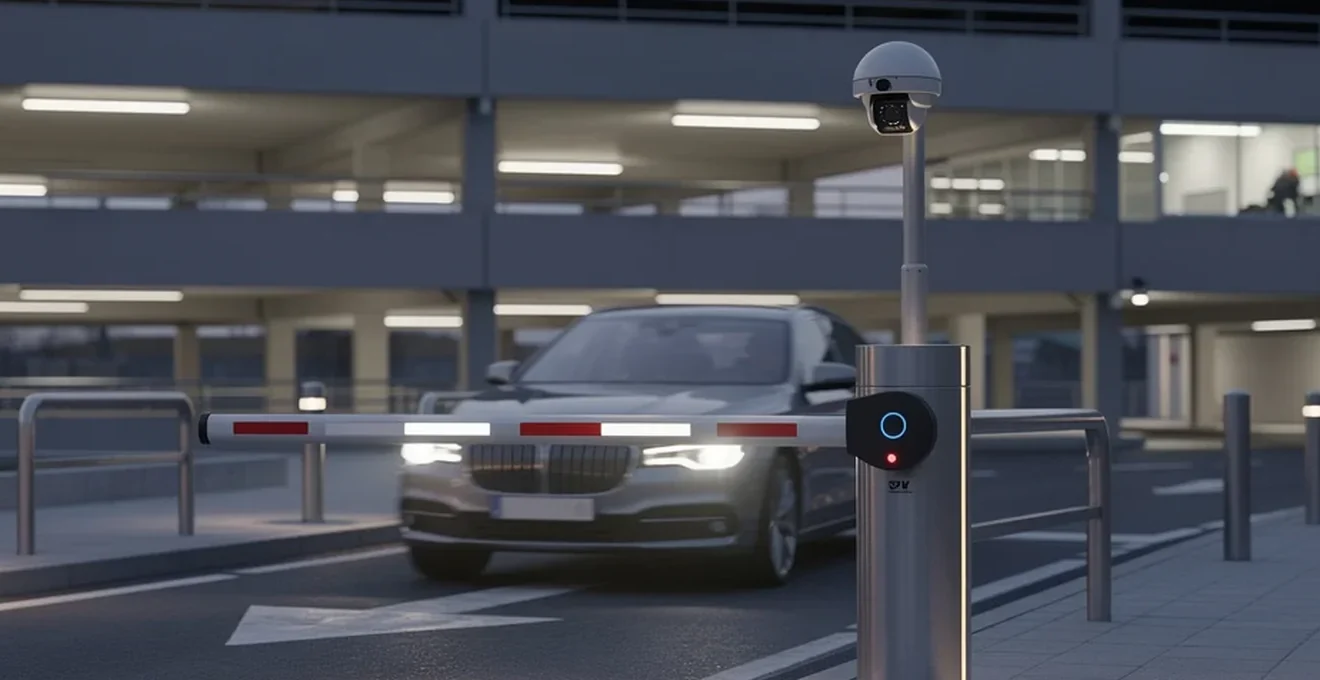
Car parks are among the busiest and most exposed areas of any site, whether that’s a shopping centre, a factory or a town centre multi-storey. Pedestrians, cyclists and vehicles all share the same space, often with limited visibility and inconsistent lighting, which makes them a common setting for accidents, vehicle crime and unauthorised access. Improving safety and access control isn’t about a single fix; it’s about combining physical measures, such as barriers, bollards and signage, with smart technology like ANPR, RFID and video analytics. This article looks at the most common vulnerabilities found in car parks, the access control systems available to address them, and the lighting, pedestrian safety and technology standards that underpin a genuinely secure and efficient facility.
Common security vulnerabilities in Multi-Storey and surface car parks
Before investing in new equipment, it’s worth understanding where car parks typically fall short. Most security and safety failures stem from a small number of recurring issues: poor visibility, weak points in access control, insufficient lighting, and a lack of awareness of where incidents actually happen.
Blind spots and poor CCTV coverage in stairwells and corner bays
Stairwells, corner bays and areas behind large support columns are notorious blind spots in multi-storey car parks. These are exactly the locations where someone acting maliciously is least likely to be seen, either by other users or by camera coverage. A car park that relies on a handful of cameras positioned only at entrances and exits will inevitably leave these pockets unmonitored. Reviewing camera placement specifically with stairwells, lift lobbies and end-of-row bays in mind is a straightforward way to close these gaps.
Tailgating risks at automatic number plate recognition (ANPR) barriers
Tailgating, where an unauthorised vehicle follows an authorised one through a barrier before it closes, is a persistent weakness of ANPR-controlled entrances. Because the system only checks the lead vehicle’s plate, a second car can slip through unchecked if the barrier timing or vehicle spacing isn’t properly managed. This is particularly likely during busy periods when drivers are queuing close together. Barrier speed, loop detector placement and clear signage warning against tailgating all help reduce the risk, though no purely automated system eliminates it entirely.
Inadequate lighting levels against BS 5489-1 recommendations
Lighting is one of the most cost-effective deterrents against vandalism and vehicle crime, yet it’s frequently under-specified. BS 5489-1 sets out recommended lighting levels for different types of outdoor and car park environments, and many older facilities simply don’t meet them, particularly in areas that have been retrofitted or extended over time. Poorly lit ramps, stairwells and perimeter zones not only increase the risk of accidents but also make it easier for opportunistic crime to go unnoticed.
Vandalism and vehicle crime hotspots identified through crime pattern analysis
Not all areas of a car park carry equal risk. Crime pattern analysis, whether informal (based on incident logs and complaints) or more structured, tends to show that vandalism and vehicle crime cluster around specific hotspots: poorly lit corners, areas outside CCTV range, and sections furthest from staffed entrances or help points. Identifying these hotspots allows operators to prioritise investment in lighting, camera coverage and patrols where it will have the greatest impact, rather than spreading resources evenly across a site.
Access control systems: ANPR, RFID and barrier technology
Controlling who enters and exits a car park is the foundation of both security and revenue protection. A number of technologies now exist to manage this, each suited to different types of user and site.
ANPR camera accuracy and integration with Pay-on-Foot systems
ANPR cameras identify vehicles by reading number plates using character recognition algorithms, and they can trigger a barrier to open automatically when a recognised plate is detected. Their accuracy depends heavily on installation: camera angle, lighting quality and alignment with the vehicle all affect how reliably a plate is read, and cameras should be positioned to withstand impact or vandalism. When integrated with pay-on-foot systems, ANPR allows a driver to pay at a machine before returning to their car, with the barrier recognising their plate on exit rather than requiring a ticket. This reduces queuing at exit barriers and speeds up the overall parking experience.
RFID tags and proximity cards for season ticket holders
RFID (Radio Frequency Identification) uses radio waves to enable short-range wireless communication between a card or tag and a reader, making it well suited to season ticket holders and regular users who need repeatable, low-friction access. However, RFID systems bring administrative overhead: cards need to be issued, assigned, tracked and recovered when a user’s access ends, and lost or forgotten cards create ongoing friction at the barrier. There’s also a security limitation worth noting: because cards and badges can be lent or shared between users, an RFID system alone can’t guarantee that the person entering is the person authorised to do so.
Bluetooth and mobile App-Based entry systems like RingGo and JustPark
Mobile app-based systems allow drivers to pay for and manage parking directly from their smartphone, often removing the need for a physical ticket or card altogether. Apps such as RingGo and JustPark let users start and extend sessions remotely, which reduces the risk of overstaying and the associated enforcement costs. For car park operators, these systems also generate useful data on usage patterns without requiring additional hardware at the barrier itself.
Rising kerb and bollard systems for perimeter vehicle control
Where a barrier isn’t appropriate or additional perimeter control is needed, rising kerbs and retractable bollards offer a robust physical alternative. These systems lock in the raised position when not in use and lower on demand, which makes them particularly effective for protecting reserved spaces or restricted zones from unauthorised vehicles. Parking space protectors work on a similar principle, keeping specific bays locked until an authorised user requires access.
Integration with ParkMobile and PayByPhone for frictionless payments
Payment platforms like ParkMobile and PayByPhone integrate with barrier and ANPR systems to remove the need for cash or card payments at a machine. Drivers pay via their phone, and the access control system checks payment status against the vehicle’s plate or session data before allowing entry or exit. This kind of integration reduces bottlenecks at pay stations and supports a smoother overall flow of traffic, particularly during peak periods.
CCTV surveillance and video analytics for Real-Time threat detection
Cameras alone are a deterrent, but modern video analytics turn CCTV into an active security tool capable of flagging incidents as they happen rather than simply recording them for later review.
Ai-powered video analytics for loitering and suspicious behaviour detection
AI-driven analytics can be configured to detect specific behaviours, such as a person loitering in one spot for an extended period, someone moving against the normal flow of pedestrian traffic, or a vehicle circling repeatedly without parking. Rather than requiring a control room operator to watch every screen at all times, these systems can raise an alert when a pattern matching a defined risk is detected, allowing staff to respond more quickly to genuine incidents.
Licence plate recognition integration with police national computer alerts
Beyond simply controlling access, ANPR systems can be linked to broader databases to flag vehicles of interest as they enter a site. This kind of integration supports faster identification of vehicles linked to reported incidents and strengthens the overall security posture of a car park, particularly on larger sites where manual checks aren’t practical.
Remote monitoring control rooms and SIA-Licensed operator protocols
Many car parks, particularly larger or higher-risk sites, are monitored from a remote control room staffed by SIA-licensed operators. These operators are trained to interpret CCTV footage and analytics alerts, spot suspicious behaviour, and coordinate a response, whether that’s contacting on-site security, alerting the police, or communicating directly with the person involved via help points. Human presence, whether on-site or remote, remains an important complement to automated systems: technology can flag a potential issue, but trained judgement is often needed to decide how to respond.
Lighting design and structural safety standards compliance
Lighting and structural safety are less visible than access control systems but are just as important to overall car park safety, particularly in enclosed or multi-storey structures.
LED retrofit projects and lux level requirements per BS EN 12464-1
BS EN 12464-1 sets out lighting requirements for indoor workplaces, including the lux levels appropriate for car park environments where people need to move safely and read signage clearly. LED retrofit projects are an increasingly common way for car park operators to bring older lighting installations up to these standards, replacing inefficient and unevenly distributed lighting with brighter, more consistent coverage. Beyond compliance, well-lit car parks are simply safer: good lighting reduces the risk of trips and falls and makes it harder for anti-social or criminal behaviour to go unnoticed.
Emergency lighting and fire escape route illumination
In the event of a power failure or fire, emergency lighting along escape routes and stairwells is essential to allow people to leave the car park safely. This lighting needs to activate automatically and remain functional for long enough to support a full evacuation, and it should be tested regularly as part of a site’s ongoing fire safety management.
Structural fire safety per approved document B and sprinkler retrofits
Approved Document B sets out structural fire safety requirements relevant to car parks, particularly multi-storey and underground facilities where fire spread and smoke management present distinct challenges compared with open surface car parks. Many older structures are being retrofitted with sprinkler systems to bring them in line with current expectations, reducing the risk of rapid fire spread between vehicles and improving overall occupant safety.
Pedestrian safety measures within car park environments
Cars and pedestrians moving through the same space is one of the fundamental safety challenges of any car park. Reducing conflict between the two is central to preventing accidents.
Segregated walkways and dropped kerbs for wheelchair accessibility
Clearly defined, segregated walkways keep pedestrians away from vehicle routes wherever possible, reducing the chance of a driver and a pedestrian occupying the same space unexpectedly. Dropped kerbs are essential for wheelchair users and anyone with reduced mobility, ensuring that accessible routes exist between parking bays, pedestrian zones and building entrances without unnecessary obstacles.
Speed bumps, chicanes and 10mph signage enforcement
Speed bumps and ramps, strategically placed throughout a car park, slow vehicles down and give both drivers and pedestrians more time to react to one another. Chicanes serve a similar purpose by physically preventing vehicles from travelling too quickly through tight sections. Clear, reflective signage indicating a 10mph limit (or whatever speed is appropriate to the site) reinforces these physical measures and should be placed prominently at entrances and at regular intervals throughout the car park, particularly where it’s used during darker hours.
Personal attack buttons and help points linked to control rooms
Help points fitted with personal attack buttons give users a direct means of contacting security or a control room if they feel unsafe or witness an incident. These should be positioned in areas identified as higher risk, such as stairwells, isolated corners and areas with weaker CCTV coverage, and should be clearly signposted so that users know where to find them without having to search.
Integrating smart parking technology with physical security infrastructure
The most effective car parks don’t treat security, access control and space management as separate systems. Bringing them together allows operators to respond more efficiently and gives users a smoother overall experience.
Iot sensors for occupancy monitoring and space guidance systems
IoT sensors fitted to individual bays or zones can monitor occupancy in real time, feeding data into guidance systems that direct drivers to available spaces. This reduces the time vehicles spend circulating in search of a space, which in turn reduces congestion and the associated risk of low-speed collisions. Occupancy data also supports better long-term planning, helping operators understand peak usage patterns and adjust their parking policy accordingly.
Centralised building management systems linking access control and CCTV
Rather than managing barriers, CCTV, lighting and alarms as separate systems, many sites now link them through a centralised building management platform. This allows a single control room to see an ANPR alert, pull up the relevant camera feed, and trigger a lighting or barrier response without switching between multiple disconnected interfaces. For larger or multi-site operators, this kind of integration also supports consistent policy enforcement across locations.
Cybersecurity considerations for networked barrier and ANPR systems
As barriers, ANPR cameras and access control systems become increasingly networked, they also become potential targets for cyber interference, whether that’s unauthorised access to camera feeds, tampering with barrier controls, or interception of payment data. Operators should ensure that networked systems are properly secured, with strong authentication, regular software updates and restricted access to administrative controls, treating car park technology with the same level of cybersecurity diligence as any other connected business system.