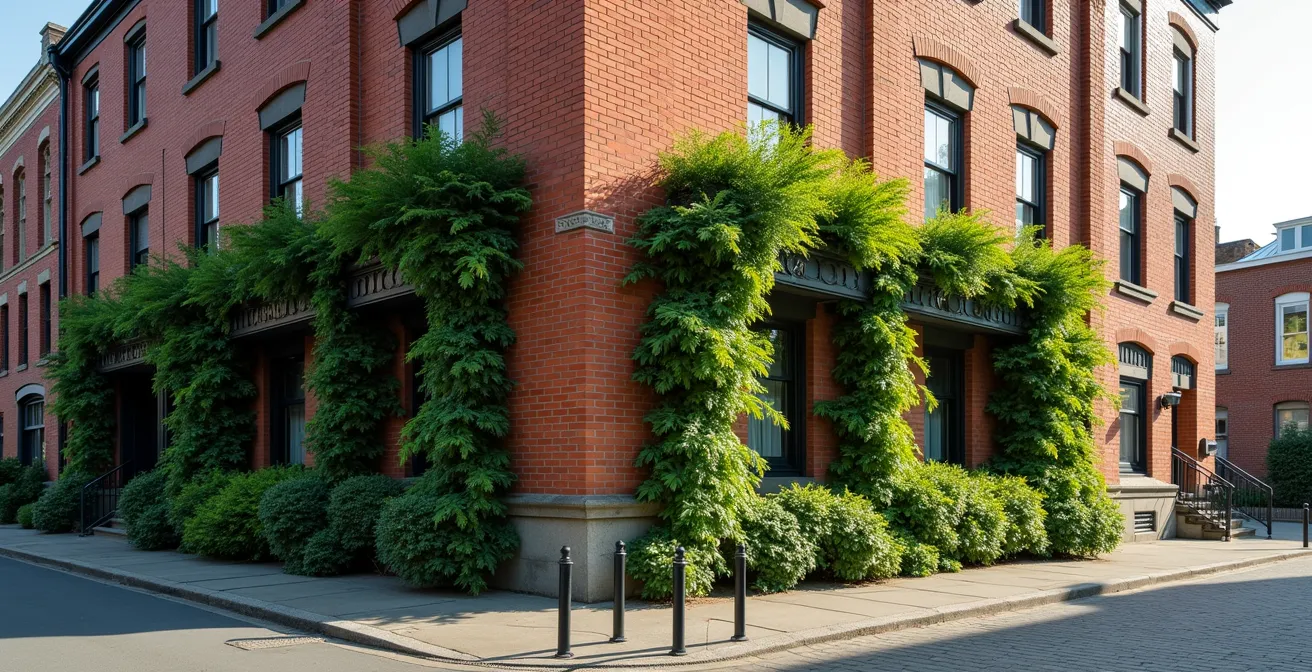
The key to a successful vertical garden on a historic building is not the plant choice, but selecting a system that preserves the wall’s ability to breathe and manage moisture.
- Non-penetrative climbers (like Virginia Creeper) or standoff panel systems are significantly safer for historic mortar than traditional, invasive ivy.
- Approval processes and climate challenges differ vastly between Canada (focus on freeze-thaw cycles) and Ireland (focus on damp and salt air).
Recommendation: Always begin with a heritage impact assessment and consult a structural engineer before committing to any specific green wall installation.
The image of a centuries-old brick building in Dublin’s Temple Bar or a stone facade in Old Montreal, gracefully draped in green, is powerfully romantic. For property owners, this vision promises to blend historic charm with ecological vibrancy. However, this romanticism is often shadowed by a significant fear: the dreaded story of roots and tendrils prying apart fragile mortar, causing irreversible structural damage and trapping destructive moisture within the walls.
Conventional advice often stops at vague warnings like “be careful with ivy” or “choose the right plants.” This approach is insufficient because it misses the fundamental principle of heritage building science. The real issue isn’t just the plants; it’s a question of vapour permeability. A historic wall is not an inert, sealed surface; it is a dynamic system that must be able to release moisture to survive. A poorly chosen green wall can act like a plastic sheet, trapping dampness and accelerating decay, particularly in the challenging climates of Canada and Ireland.
But what if the entire framework is wrong? What if the true key is not to simply decorate a facade, but to create a symbiotic, living ‘second skin’ that protects the building? The right vertical garden system works *with* the historic materials, not against them. It can buffer the wall from extreme temperatures, shield it from driving rain, and enhance its natural ability to breathe. This guide moves beyond the platitudes to provide a strategic framework for property owners, grounded in the realities of material science and horticulture.
This article will guide you through the critical decisions required for a successful and safe installation. We will explore the specific plants that thrive without destruction, compare the systems that respect your building’s integrity, and outline the distinct regulatory pathways in both Canadian and Irish heritage districts, ensuring your green vision becomes a lasting, valuable asset.
Summary: A Guide to Vertical Gardens on Historic Buildings: Enhancing Beauty Without Causing Damage
- Ivy vs. Native Climbers: Which Plants Survive Canadian Winters on a Wall?
- Limewash vs. Modern Paint: Which Is Best for Preserving 18th Century Stone?
- Tree Canopy vs. White Roofs: Which Lowers Street Temperature More Effectively?
- Pine vs. Oak: Which Wood Tone Creates a Warmer Psychological Effect?
- Property Value: How Much Does a Community Garden Increase Home Prices Nearby?
- Hydroponics vs. Soil: Which System Uses Less Water for Rooftop Farms?
- Guerrilla Gardening: How to Green Abandoned Lots Without Getting Arrested?
- Quebec City vs. Dublin: Comparing Preservation Tactics in Historic Colonial Districts
Ivy vs. Native Climbers: Which Plants Survive Canadian Winters on a Wall?
The first question for any property owner is plant selection, and the classic English Ivy is often the first image that comes to mind. However, its method of attachment is its greatest liability. Ivy uses penetrating aerial rootlets that actively seek out and grow into the tiniest cracks in mortar. For historic structures, this is a critical flaw. In fact, research shows that historic buildings constructed before 1930 with soft lime-based mortar are exceptionally vulnerable to this kind of invasive damage. These rootlets expand, widen fissures, and can ultimately compromise the structural integrity of the facade.
The safer alternative lies with native climbers that use a different strategy. Plants like Virginia Creeper (Parthenocissus quinquefolia), native to Eastern North America and well-suited to Canadian climates, attach themselves using non-penetrative adhesive pads or ‘holdfasts.’ These function like tiny suction cups, sticking to the surface of the brick or stone without invading the mortar joints. This makes them inherently more compatible with heritage materials. While any dense plant cover requires management, the risk of foundational damage is dramatically reduced. The key difference is choosing a plant that adheres to the wall, rather than one that integrates with it.
This distinction is crucial for longevity and preservation. An Oxford University study on ancient British manors found that even ivy, when rigorously managed, could offer protective benefits. However, for a typical property owner without a team of dedicated gardeners, choosing a plant with a non-invasive attachment mechanism is the most prudent path forward. It provides the desired green aesthetic while respecting the building’s historical fabric.
This table illustrates the fundamental differences in how common climbers interact with heritage buildings, a critical factor for owners in both Canadian and Irish contexts.
| Plant Type | Attachment Method | Damage Risk to Historic Mortar | Winter Hardiness (Canada) |
|---|---|---|---|
| English Ivy | Aerial rootlets (penetrative) | High – grows through mortar | Zone 5-9 |
| Virginia Creeper (native) | Adhesive pads (non-penetrative) | Low – surface attachment only | Zone 3-9 |
| Boston Ivy | Holdfasts | Medium – less invasive than English Ivy | Zone 4-8 |
Limewash vs. Modern Paint: Which Is Best for Preserving 18th Century Stone?
To understand the best vertical garden systems for historic buildings, we must first look to traditional preservation methods. For centuries, materials like limewash were used on stone and brick not just for color, but because they were highly vapour-permeable. Limewash allows moisture trapped within the wall to escape, enabling the building to “breathe.” In contrast, modern acrylic or latex paints act as a sealant, trapping moisture which, especially in a Canadian climate, leads to devastating freeze-thaw cycles and spalling brick. A vertical garden system must be evaluated by the same principle: does it allow the wall to breathe, or does it seal it?
Many modern “living wall” systems consist of sealed panels or fabric pockets mounted directly onto the facade. While aesthetically pleasing, they can pose the same risk as modern paint by trapping moisture against the wall. A 2024 meta-analysis of vertical greening’s impact on historic materials confirms that without proper ventilation, these systems can accelerate biodeterioration and salt crystallization. The trapped dampness creates a perfect microclimate for decay, turning a well-intentioned green project into a structural liability.
The superior solution for heritage contexts is a system that creates an air gap between the vegetation and the wall surface. This can be achieved in two primary ways: a traditional trellis for climbing plants, or a modern standoff framework that holds modular panels or planters away from the facade. This air gap is critical; it allows for continuous air circulation, ensuring that the wall can dry out naturally. This approach provides the thermal and aesthetic benefits of a green wall while respecting the fundamental need for breathability, mimicking the wisdom of traditional limewash.
Comparing these systems reveals a clear hierarchy of risk and compatibility for any owner of a historic property.
| System Type | Moisture Management | Heritage Building Compatibility | Freeze-Thaw Resistance |
|---|---|---|---|
| Trellis with Climbers (Breathable) | Allows vapor escape | High – mimics traditional limewash principles | Excellent |
| Sealed Panel System (Non-Breathable) | Can trap moisture | Low – risk of moisture damage | Poor in Canadian winters |
| Standoff Framework | Air gap prevents moisture buildup | Highest – no wall contact | Best option |
Tree Canopy vs. White Roofs: Which Lowers Street Temperature More Effectively?
While urban greening discussions often compare large-scale interventions like tree canopies and reflective “white roofs,” a vertical garden offers a unique, building-specific method of temperature control. It functions as a dynamic, living shield against solar radiation. A bare brick or stone wall, particularly a dark-colored one common in historic districts, absorbs vast amounts of solar energy, heating up and radiating that heat back into the street and the building’s interior long after sunset. This phenomenon, known as the “urban heat island effect,” is significantly mitigated by a green facade.
The cooling effect is twofold. First, the dense layer of leaves provides direct shading, preventing sunlight from ever reaching the wall’s surface. Second, through the natural process of evapotranspiration, the plants actively cool the surrounding air. As water evaporates from the leaves, it draws heat energy from the environment, much like sweat cooling the skin. The impact is significant; research indicates that the surface temperature of plants on a green wall typically does not rise more than 4-5°C above the ambient air temperature, whereas a dark, sun-beaten brick wall can be tens of degrees hotter.
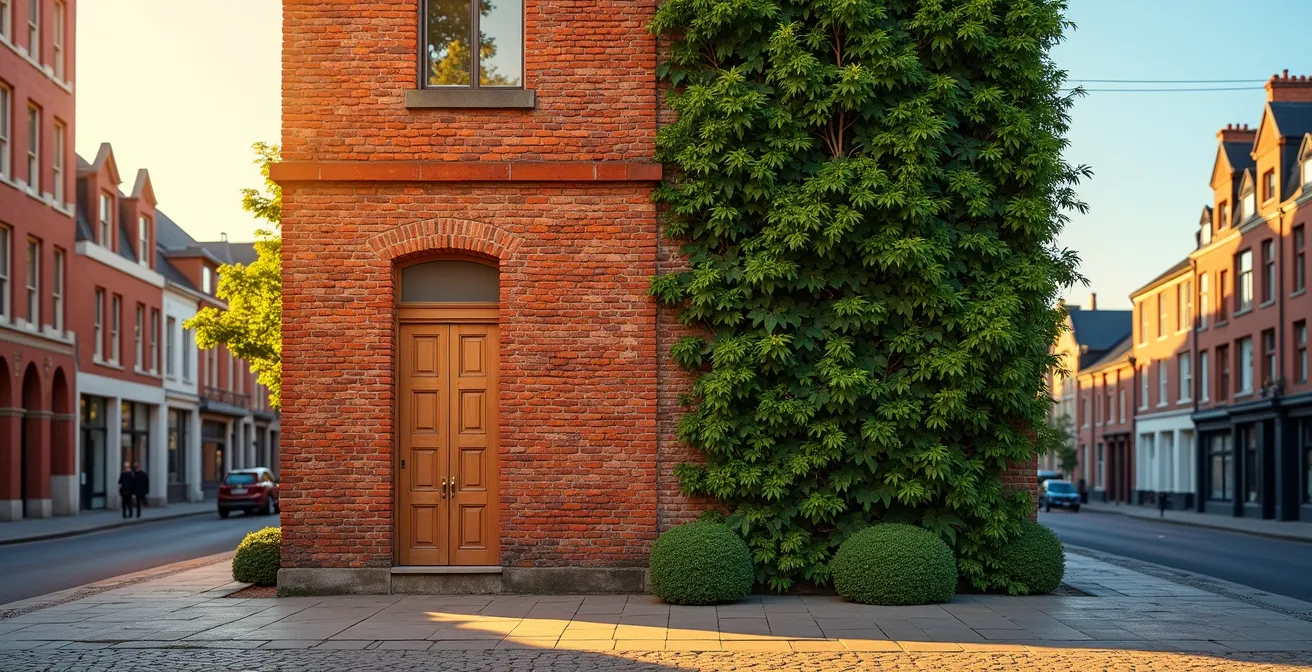
As this diagram illustrates, the effect is not just superficial. This “bioshield” reduces the thermal load on the building itself, leading to lower indoor temperatures and decreased reliance on air conditioning during hot summer months. For a historic building, this reduction in thermal stress—the constant expansion and contraction of materials—can also contribute to its long-term preservation. A vertical garden, therefore, is not merely an aesthetic addition but an active, high-performance building envelope that enhances both comfort and sustainability.
Pine vs. Oak: Which Wood Tone Creates a Warmer Psychological Effect?
Just as the choice between pine and oak in interior design creates vastly different psychological atmospheres, the design of a vertical garden has a profound impact on human well-being. This goes beyond the simple presence of “green” and enters the realm of biophilic design—the practice of connecting people with nature in the built environment. The psychological effect of a green facade is not monolithic; it is shaped by its diversity, texture, and dynamism.
Research on greenery-covered buildings has shown that a monoculture—a wall covered in a single plant species—is far less engaging than one that features a rich variety of species. A diverse palette of plants, with different leaf shapes, textures, colors, and seasonal changes, mirrors the complexity and richness found in a natural ecosystem. This visual variety captures our attention, reduces stress, and creates a more restorative experience. It’s the difference between a uniform green carpet and a vibrant, living tapestry.

This macro view highlights the intricate patterns and textures that contribute to the positive psychological effect. The goal for a historic building should be to select a mix of native plants—ferns, grasses, and flowering climbers suited to the local climate of Ireland or Canada—that create this rich sensory experience. This approach not only provides documented well-being benefits, such as improved mood and productivity, but also enhances the building’s character, making it a unique and cherished part of the urban landscape. It transforms the wall from a static architectural element into a source of daily connection to the natural world.
Property Value: How Much Does a Community Garden Increase Home Prices Nearby?
For a property owner, the investment in a vertical garden must also make financial sense. While quantifying a direct percentage increase in home value is complex, the evidence points to a significant enhancement of both monetary and reputational value. The green wall market is booming; market data shows that a staggering 80% of large-scale outdoor green walls were constructed after 2009, indicating a strong and growing perception of their value in modern real estate.
This value is derived from several factors. Firstly, there is the curb appeal and differentiation. In a historic district where buildings may have similar architectural styles, a beautifully executed green wall makes a property a landmark. It stands out, becomes a photo destination, and elevates the perceived quality and prestige of the address. Case studies of famous vertical gardens in urban centers like Dublin and Vancouver show they become cultural assets, enhancing the entire neighborhood’s desirability. This “reputational capital” translates into higher demand from tenants and buyers.
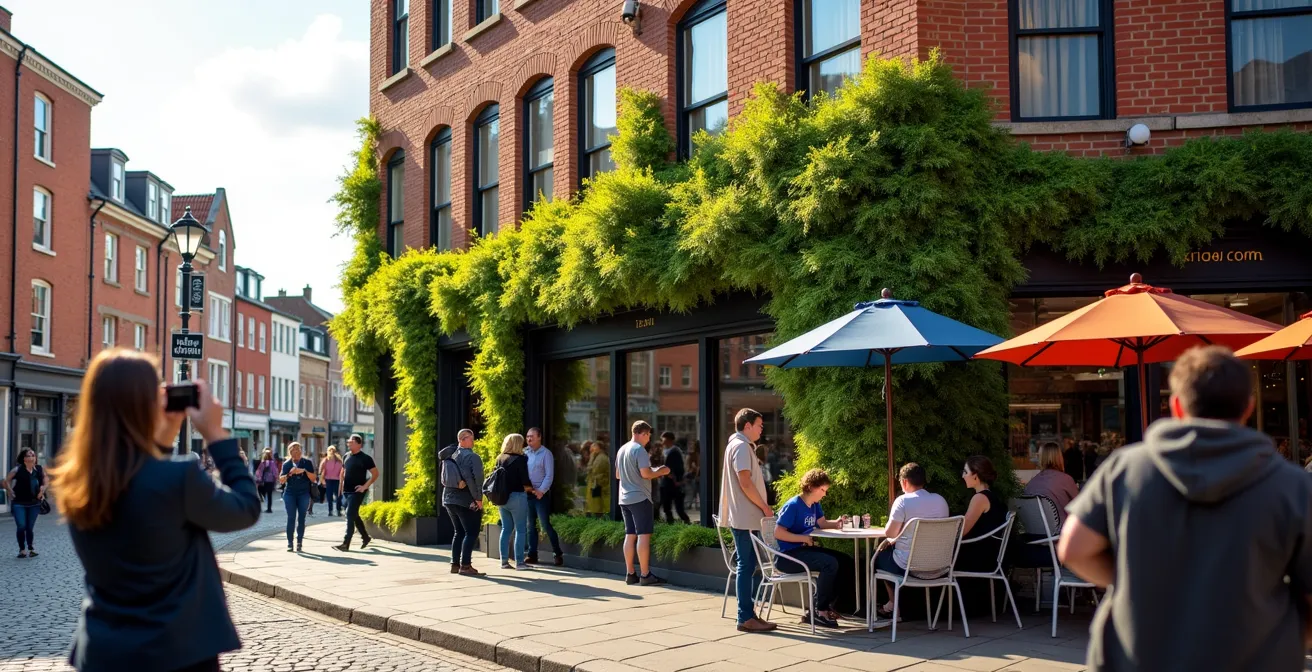
Secondly, there are tangible financial returns. The thermal insulation provided by the green wall can lead to documented energy savings, an attractive feature for any potential buyer or renter. Furthermore, by protecting the facade from weathering and UV degradation, a well-designed system can reduce long-term maintenance and repair costs, effectively preserving the building’s capital value. The initial investment in the system is thus offset by long-term savings and an increase in the property’s marketability and prestige. It is an investment in the building’s future, not just its present appearance.
Hydroponics vs. Soil: Which System Uses Less Water for Rooftop Farms?
When moving beyond simple climbers on a trellis to modular systems, the choice of growing medium—soil vs. hydroponics—becomes a key consideration, especially concerning water use and weight. While the question is often framed around rooftop farms, the principles apply directly to vertical gardens. Hydroponic systems, which deliver nutrient-rich water directly to the plant roots, are generally more water-efficient. They operate in a closed-loop or recirculating manner, minimizing waste from evaporation and runoff. However, they introduce mechanical complexity, requiring pumps and monitoring systems.
For historic buildings, a more pressing concern than water usage is often the structural load and installation cost. Soil-based modular systems, while less water-efficient, are often simpler and less technologically dependent. However, soil is heavy, especially when saturated with water, and this weight must be carefully calculated and supported by the building structure. The installation process itself represents a significant capital investment. For property owners, balancing the long-term water savings of hydroponics against the upfront cost and structural implications is a critical part of the decision-making process.
In Canada, for example, the cost of a professionally installed living wall system is substantial. Data shows that Canadian installation costs for living wall systems average between $195 and $265 per square foot. This figure includes the structure, irrigation, plants, and labor. Given this investment, the choice of system must be robust, low-maintenance, and perfectly suited to both the building’s capacity and the owner’s budget. Often, a hybrid approach or a simpler soil-based modular system on a standoff frame offers the best balance of performance, cost, and safety for a heritage context.
Key Takeaways
- Prioritize breathable systems (standoff frameworks, trellises) to prevent moisture damage on historic walls.
- Choose non-penetrative native plants, like Virginia Creeper, over invasive English Ivy to protect fragile, old mortar.
- Always design for the local climate: account for severe freeze-thaw cycles in Canada and persistent dampness with salt-laden air in coastal Ireland.
Guerrilla Gardening: How to Green Abandoned Lots Without Getting Arrested?
While the term “guerrilla gardening” evokes a rebellious, anti-establishment spirit, the desire to green urban spaces is something property owners share. However, when dealing with a heritage-listed building, the approach must be the polar opposite: meticulous, respectful, and fully compliant with regulations. Adding a green facade to a historic property is not a DIY project; it is a formal process that requires navigating a complex web of local and national preservation laws. As the climate research group Ouranos notes, “Built heritage is more than simply architectural heritage”; it is a cultural asset that is legally protected.
Built heritage is more than simply architectural heritage
– Ouranos Climate Research, Built Heritage Climate Challenges Report
Attempting an unauthorized installation can lead to orders for its removal, fines, and liability for any damage caused. The correct path involves proactive engagement with heritage authorities. In Ireland, this means contacting the local Architectural Conservation Officer (ACO), while in major Canadian cities, the first point of contact is typically the municipal heritage committee. These bodies are not adversaries; they are stewards tasked with ensuring that any intervention is appropriate and reversible. They will require detailed documentation, including a Heritage Impact Assessment and a structural engineering report, to prove the project will not harm the building.
This formal process, while daunting, offers significant benefits. It forces a thorough and professional design, mitigates risk, and ensures the project’s long-term success. Furthermore, by following the official channels, property owners may become eligible for financial incentives, such as Ireland’s Built Heritage Investment Scheme, which can help offset the costs. The key is to approach the project as a collaboration with preservation authorities, not as a fight against them.
Your Action Plan for Heritage Green Wall Approval
- Initial Contact: Identify and contact your local Architectural Conservation Officer (ACO) in Ireland or the relevant municipal heritage committee in Canadian cities like Montreal or Toronto.
- Assemble Your Team: Engage a structural engineer and a landscape architect with proven experience in heritage projects to prepare the necessary documentation.
- Heritage Impact Assessment: Commission a formal report detailing the building’s history, its material condition, and how the proposed system will interact with it without causing harm.
- Structural Report: Provide a detailed engineering analysis confirming the building can support the weight of the proposed system and that all anchor points are sound and appropriate for the historic materials.
- Seek Funding: Investigate and apply for relevant grants or financial incentives, such as Ireland’s Built Heritage Investment Scheme or local Canadian municipal programs for green infrastructure.
Quebec City vs. Dublin: Comparing Preservation Tactics in Historic Colonial Districts
The practical application of these principles varies significantly depending on the specific location. Comparing the heritage contexts of Quebec City and Dublin provides a clear illustration for property owners. While both cities cherish their historic building stock, their climates and regulatory frameworks impose different challenges and priorities. As Ireland’s own tourism materials suggest, even historic walls serve a functional, environmental purpose. Understanding that local function is key.
Tall walls have strong aesthetic value but still retain their original function: to raise temperature and provide protective environment for plants
– Ireland Tourism Heritage Gardens, Ireland’s Historic Walled Gardens Guide
In Quebec City, the primary concern is the brutal -30°C winter temperatures and heavy snow loads. Any vertical garden system and its plants must be able to withstand the intense freeze-thaw cycle. Regulators at the municipal heritage committee will scrutinize engineering reports to ensure anchor points won’t be compromised by frost heave and that the system’s weight, including potential snow and ice accumulation, is safely supported. The focus is on structural resilience and material durability against extreme cold.
In Dublin, the challenge is different. The climate is defined by high humidity and salt-laden air, especially in areas closer to the coast. The Architectural Conservation Officer’s main focus will be on moisture management. They will demand proof that the system provides adequate ventilation to prevent damp from being trapped against the city’s characteristic brick and rendered Georgian facades, which are susceptible to mould and decay in persistently wet conditions. The selection of salt-tolerant plants is also a key consideration. Successfully implementing a green wall requires a design that is acutely responsive to these distinct local environmental pressures.
This comparative table breaks down the key differences a property owner would face in these two iconic heritage cities.
| Aspect | Quebec City | Dublin |
|---|---|---|
| Primary Legislation | Quebec Cultural Heritage Act | Planning and Development Acts |
| Climate Challenge | -30°C winters, heavy snow loads | High humidity, salt-laden air |
| Building Material | Granite and stone | Brick and render (Georgian) |
| Key Authority | Municipal heritage committee | Architectural Conservation Officer |
| Typical Approval Time | 3-6 months | 2-4 months |
To ensure your project respects both history and nature, the next logical step is to commission a site-specific heritage impact assessment. This will provide a clear roadmap for a beautiful and structurally sound green facade.