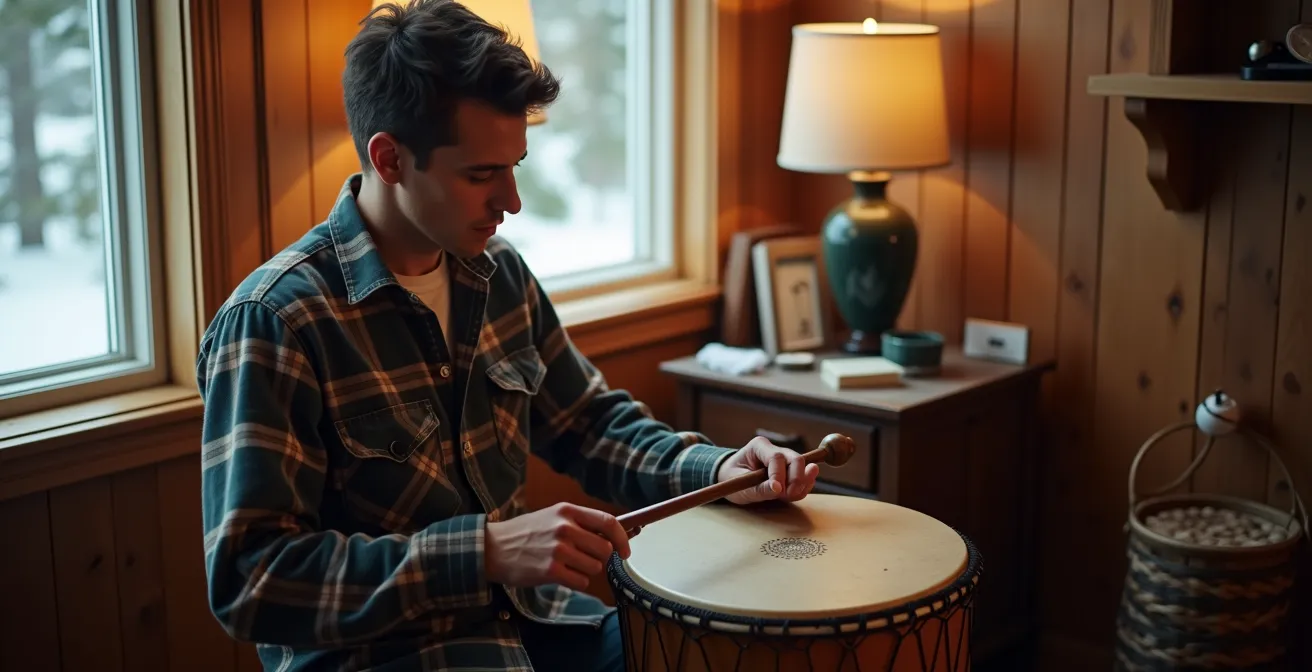
A quality bodhrán is not a decorative souvenir; it’s a dynamic acoustic engine engineered to perform.
- Tunability is non-negotiable to combat Canada’s extreme humidity shifts which can damage or detune an instrument overnight.
- The choice between goatskin and synthetic heads is a practical decision based on sonic projection for pub sessions, not just tradition.
Recommendation: Prioritize a robust, tunable frame and a head that matches your primary playing environment over purely aesthetic features.
Walk into any shop with a Celtic theme in Canada, and you’ll likely find a bodhrán hanging on the wall. Often adorned with an intricate Celtic knot, it looks the part. But many of these are what I call “BSOs” – Bodhrán-Shaped Objects. They are wall decorations, not musical instruments. The frustration for a budding musician is spending good money on something that will never produce a quality tone, will constantly go out of tune, and may even crack within the first Canadian winter.
The common advice is often to “start cheap,” but this is a false economy. A cheap, non-tunable bodhrán fights you at every step, making the learning process a struggle against the instrument itself rather than a journey into rhythm. The real secret to buying a great bodhrán isn’t about the complexity of the decal on its skin; it’s about understanding the instrument as a piece of acoustic engineering designed for a specific purpose. It’s about appreciating the material science of the skin, the mechanics of the tuning system, and the ergonomics of the tipper.
But what if the key to avoiding the tourist trap wasn’t just looking for quality, but understanding *why* certain features are essential for a musician in Canada? The climatic demands, from a humid summer festival in Nova Scotia to a dry, centrally-heated winter in Alberta, place unique stresses on a traditional frame drum. This guide moves beyond the surface-level advice. From my perspective as a luthier, we will dissect the critical components that separate a lifelong musical partner from a disappointing souvenir. We’ll explore why a tunable system isn’t a luxury but a necessity, how to choose a drum head for a loud pub session, and how to care for your investment through our country’s challenging seasons.
This article provides a detailed roadmap for any aspiring musician in Canada looking to purchase their first serious bodhrán. We will cover the essential technical aspects, practical considerations for our climate, and the path to developing your skills once you have the right tool in your hands.
Summary: Your Guide to Selecting a Performance-Ready Bodhrán in Canada
- Why Is a Tunable Bodhrán Essential for Canadian Climate Conditions?
- How to Hold the Tipper Correctly to Prevent Wrist Strain?
- Goatskin vs. Synthetic Heads: Which Sounds Better for Pub Sessions?
- The Storage Error That Cracks Bodhrán Skins in Winter
- From Basic Reel to Polyrhythms: How to Advance Your Playing in 6 Months?
- How to Mix Live Bodhrán and Fiddle Audio for Outdoor Venues?
- STEAM vs. STEM: Why Adding ‘Arts’ Improves Engineering Creativity?
- How to Start Adult Irish Step Dancing in Vancouver Without Joint Injury?
Why Is a Tunable Bodhrán Essential for Canadian Climate Conditions?
The single most important feature that separates a real instrument from a BSO is a tunable system. For a musician in Canada, this is not a professional luxury; it is a fundamental requirement for the instrument to function year-round. A bodhrán’s skin, traditionally made of goatskin, is a hygroscopic material. This means it absorbs and releases moisture from the air, directly affecting its tension and, therefore, its pitch.
Canada’s climate presents an extreme challenge. In a humid summer, the skin absorbs moisture and slackens, producing a low, flabby “thud” with no tonal definition. Conversely, the dry air of a Canadian winter, especially in a home with forced-air heating, wicks moisture from the skin, causing it to tighten excessively. This can raise the pitch to a high-pitched, unmusical “tick” and, in worst-case scenarios, create so much tension that the skin splits. An instrument’s ability to maintain playable tension is key, and it’s wise to ensure proper storage requires maintaining a stable environment.
A tunable bodhrán incorporates a mechanical system—often a series of Allen-key driven screws or an internal hand-tuning wheel—that allows the player to adjust the pressure on the skin, counteracting the effects of humidity. This grants you control over your sound, ensuring you can achieve a deep, resonant bass tone whether you’re at a festival in July or a session in January. As one of the most respected music shops explains:
Dry weather conditions cause the skin to lose moisture, causing it to tighten which raises the tone. Damp weather conditions, or high humidity, cause the skin to absorb moisture, causing it to expand and loosen, lowering the tone.
– McNeela Music Blog, Top Tips for Caring for Your Bodhrán
Choosing a non-tunable bodhrán in Canada is choosing an instrument that will only sound good on a handful of days per year. For a serious musician, investing in a reliable tuning mechanism is the first and most critical step.
How to Hold the Tipper Correctly to Prevent Wrist Strain?
Once you have a quality instrument, your primary interface with it is the tipper. An incorrect grip is not only a barrier to speed and rhythmic complexity, but it’s also a direct path to wrist strain and repetitive stress injuries. Many beginners grip the tipper like a hammer, a tense fist that restricts movement to the elbow and shoulder. This is inefficient and exhausting. The correct technique is all about relaxation and using the natural pivot points of your wrist and fingers.
The most common and versatile grip involves holding the tipper like a pen, about a third of the way down from the top. It should rest lightly between your thumb and index finger, with the other fingers curled loosely for support. The motion should originate from the wrist, like waving goodbye, not from the arm. This allows for a fluid, relaxed movement that can produce both powerful downbeats and subtle, complex ghost notes. The goal is to let the weight of the tipper do the work.
This close-up view demonstrates the relaxed hand position, with the tipper held lightly, ready to pivot from the wrist.

This ergonomic approach is crucial for developing endurance for long pub sessions. An excellent way to conceptualize this for Canadians is to relate it to a familiar motion, as one prominent instructor has done.
Case Study: From Hockey Stick to Tipper – A Canadian Ergonomic Approach
To make the technique more intuitive for Canadians, instructor Michelle Stewart developed the ‘Hockey Night In Canada’ rhythm pattern. This exercise helps players relate the fluid wrist-snap of a hockey shot to the movement of the tipper. This approach uses existing muscle memory to foster a proper, relaxed wrist alignment, effectively preventing the kind of strain that can sideline a player.
Mastering this ergonomic interface is as important as learning the notes. It transforms playing from a physical effort into a fluid expression of rhythm, ensuring you can play for hours without pain.
Goatskin vs. Synthetic Heads: Which Sounds Better for Pub Sessions?
The “engine” of your bodhrán is its head, and the choice between traditional goatskin and modern synthetic materials is a major decision. The debate isn’t about which is “better” overall, but which is the right tool for the job, especially for the high-volume environment of a Canadian pub session. While purists often favour goatskin for its warmth and organic character, it has practical drawbacks in a performance setting.
Goatskin offers a complex, rich tone with a beautiful bass response, making it ideal for recording or more intimate acoustic sessions. However, it is highly sensitive to climate and can lack the “cut” or sonic projection needed to be heard over fiddles, pipes, and the general din of a crowded pub. Synthetics, like the popular Remo Skyntone®, are engineered for climatic resilience and consistency. They are virtually immune to humidity changes and deliver a bright, focused tone with a sharp attack that slices through a dense live mix.
This paragraph introduces the following table, which breaks down the practical differences for a musician in Canada, as detailed in a recent comparative analysis.
| Feature | Traditional Goatskin | Synthetic (Remo Skyntone) |
|---|---|---|
| Climate Sensitivity | High – requires constant adjustment | Low – stable in all conditions |
| Winter Performance | Can crack in dry heated rooms | Maintains consistency |
| Sound in Loud Pubs | Warm but may lack projection | Cuts through mix better |
| Maintenance | Monthly conditioning required | Minimal care needed |
| Price Range (CAD) | $400-800 for quality | $200-400 |
| Best For | Studio recording, intimate sessions | Pub sessions, touring |
For many working musicians in Canada, a synthetic head on a quality tunable frame is the perfect road-worthy combination. It delivers reliability and the necessary sonic projection night after night, without the constant worry about temperature and humidity. Your choice should be guided by your primary playing environment.
The Storage Error That Cracks Bodhrán Skins in Winter
You can own the finest instrument in the world, but one simple mistake during a Canadian winter can destroy it. The single most catastrophic storage error is leaving your bodhrán in a car. The temperature fluctuations are lethal to a natural skin head. Imagine finishing a warm, humid gig and placing your drum in a car trunk where the temperature plummets to -20°C overnight. That rapid change can cause a fatal crack.
The danger is not just the cold itself, but the extreme temperature swing from a Canadian winter car trunk to a warm venue, often a 40°C difference or more. Beyond the car, indoor storage presents its own hazards. Placing a drum near a forced-air heating vent, a radiator, or in direct sunlight from a window will rapidly dry out the skin, leading to excessive tension and potential damage. The goal is to maintain a stable micro-environment for your instrument.
Proper storage means keeping the drum in a padded case, away from direct heat or cold sources, in a room with stable humidity.
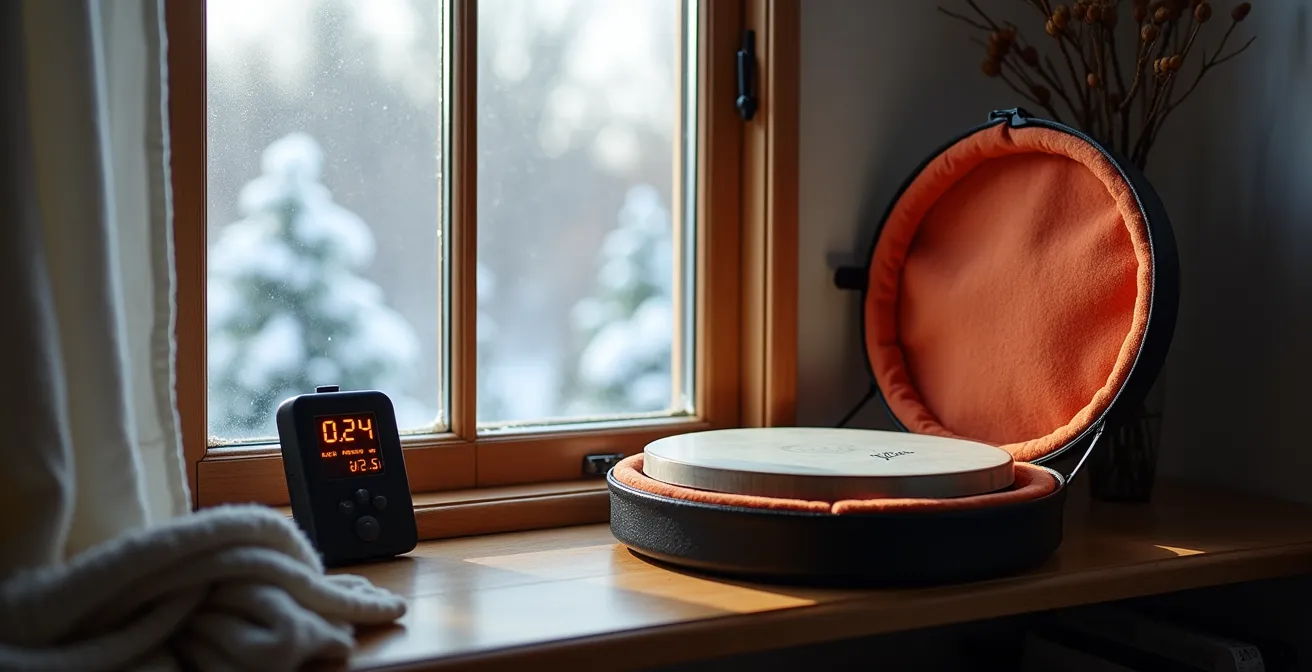
For players in particularly dry regions like the Prairies, active humidification might be necessary. This can be as simple as a damp sponge in a plastic bag inside the case or a commercial guitar humidifier. Protecting your investment is an active process of managing its environment.
Your Bodhrán Winter Survival Checklist
- Monitor the environment: Store your bodhrán in a case with a hygrometer to track humidity levels.
- Maintain humidity: Use humidity control packs (like Boveda) inside the case to keep relative humidity between 30% and 60%.
- Condition the skin: Apply a specialized skin conditioning cream or lanolin monthly during dry winter months to prevent brittleness.
- Avoid temperature shocks: Never leave your drum in a vehicle during winter and allow it to acclimatize slowly when bringing it in from the cold.
- Choose a safe spot: Keep the drum case away from heating vents, radiators, and direct sunlight.
Treating your bodhrán with the same care as any fine wooden instrument, like a guitar or fiddle, will ensure it has a long and sonorous life.
From Basic Reel to Polyrhythms: How to Advance Your Playing in 6 Months?
Buying a quality instrument is the first step; growing with it is the journey. Advancing from playing a simple, steady beat behind a reel to weaving complex, dynamic rhythms requires a structured approach. While self-teaching through videos is possible, a more reliable path to advancement in Canada involves connecting with the living tradition through organizations and a creative mindset.
A clear, structured path with milestones is the fastest way to improve. This is where local community organizations become invaluable, offering a curriculum that takes you from beginner to advanced player.
Case Study: Structured Learning with Canadian Comhaltas Branches
Canadian cities like Ottawa, Toronto, and Calgary host active branches of Comhaltas Ceoltóirí Éireann, the global organization for Irish music. These branches offer structured bodhrán programs where students learn to accompany jigs and reels with appropriate rhythmic patterns. According to the Online Academy of Irish Music, this structured approach helps students learn basic bodhrán rhythm techniques while distinguishing between tune types. Progressing through graded examinations provides clear, achievable milestones for rapid advancement over a six-month period.
True artistry, however, comes from moving beyond established patterns. A unique advantage for Canadian players is the rich tapestry of other percussive traditions in our country. Drawing inspiration from these sources can unlock a new level of creativity and polyrhythmic sophistication.
Incorporating rhythms from other Canadian folk traditions (e.g., the foot-tapping ‘podorythmie’ of Québec, Métis jigging) to develop unique polyrhythmic skills.
– Cross-Cultural Rhythm Integration, Canadian Traditional Music Fusion Approach
This cross-pollination allows a player to develop a unique voice. The journey of advancement is a mix of disciplined learning of the tradition and a creative exploration of the rhythmic world around you. Your quality instrument is the vehicle for this exciting journey.
How to Mix Live Bodhrán and Fiddle Audio for Outdoor Venues?
A serious musician will eventually take their instrument to the stage. For a bodhrán player, this often means performing at outdoor venues like Canadian folk festivals, where getting a good live sound can be a major challenge. Understanding the basics of live audio mixing, especially in relation to a fiddle—the bodhrán’s most common melodic partner—is a practical skill that enhances the value of your instrument.
The two main enemies outdoors are wind noise and frequency clashes. The low, resonant boom of the bodhrán occupies the same sonic space as the lower register of the fiddle, which can result in a muddy, indistinct sound in the main speakers. The key is to create sonic separation using equalization (EQ). By using a high-pass filter on the fiddle channel to cut frequencies below 200Hz, you instantly create a dedicated space for the bodhrán’s fundamental tone to sit. This simple move cleans up the entire mix.
Mic placement is also critical. A microphone placed too close to the bodhrán head will capture excessive boominess, while one too far away will pick up stage noise and be prone to feedback. The sweet spot is typically 6-8 inches from the rim, angled at 45 degrees toward the center of the skin. For windy Canadian festival stages, using a hypercardioid microphone with a windscreen is essential to reject unwanted noise.
Here are some essential EQ and mixing tips for a clear bodhrán and fiddle sound outdoors:
- Create Space: Cut the fiddle’s EQ below 200Hz to eliminate frequency clashes with the bodhrán’s core tone.
- Define the Attack: Boost the bodhrán’s EQ in the 2-4kHz range to accentuate the “click” of the tipper, helping it cut through the mix.
- Control Feedback: Use a notch filter on the bodhrán channel to identify and eliminate any single low frequency that is causing feedback.
- Mic Technique: Position your bodhrán mic 6-8 inches from the head at a 45-degree angle for a balanced tone.
- Phase Inversion: If feedback persists between the bodhrán mic and fiddle pickup, engage the phase-inversion switch on one of the channels.
Knowing how your instrument behaves with a microphone and how to communicate with a sound technician are skills that mark the transition from a hobbyist to a performing musician.
STEAM vs. STEM: Why Adding ‘Arts’ Improves Engineering Creativity?
It may seem like a leap from buying a drum to discussing educational philosophies, but a well-made bodhrán is a perfect embodiment of the STEAM (Science, Technology, Engineering, Arts, and Mathematics) principle. Understanding this elevates your appreciation for the instrument and helps you recognize true craftsmanship. It reframes the bodhrán not as a simple folk artifact, but as a sophisticated piece of acoustic engineering where art and science are inseparable.
A luthier doesn’t just build a drum; they solve a series of engineering challenges in service of an artistic goal. The “A” for Arts is the driving force—the desire for a specific tone, feel, and musical expressiveness. But achieving that goal requires a deep, practical application of STEM principles. This fusion is where true innovation and quality lie.
Consider the components of a professional, tunable bodhrán:
- Science: The luthier must be an applied acoustician, understanding how the diameter, depth, and skin tension interact to produce specific frequencies and overtones.
- Technology: The development of modern tuning mechanisms, from simple hex-nut systems to complex internal gear wheels, is a direct application of technology to solve the age-old problem of skin tension.
- Engineering: The frame must be engineered for structural integrity, strong enough to withstand the immense pressure of a tensioned skin and stable enough to remain perfectly round over decades of use.
- Mathematics: The geometric proportions of the shell, the precise spacing of the tuning lugs, and the mathematical ratios between different tones are all crucial calculations.
Case Study: The Bodhrán as a STEAM Teaching Tool
Modern luthiers are quintessential STEAM practitioners. Makers like Paraic McNeela are known to combine traditional Irish craftsmanship with engineering principles. They use acoustic science to optimize shell depth, apply material science in selecting and treating skins, implement precision tuning mechanisms (Technology), calculate geometric frame proportions (Engineering), and understand mathematical tuning ratios. This entire technical process is guided by the artistic goal of preserving and enhancing the musical tradition that makes each drum a unique and expressive voice.
When you buy a high-quality bodhrán, you are not just buying wood and skin. You are investing in a successful synthesis of art and engineering. Recognizing this helps you see past the decorations and identify an instrument built with purpose and intelligence.
Key Takeaways
- A tunable system is the most critical feature for a bodhrán in Canada due to extreme humidity swings.
- The choice between goatskin (warmth) and synthetic (projection) heads should be based on your primary playing venue, like a loud pub.
- Never leave a bodhrán in a car during Canadian winter; proper storage and conditioning are essential to prevent cracking.
How to Start Adult Irish Step Dancing in Vancouver Without Joint Injury?
Ultimately, the purpose of a fine bodhrán is to connect with the heart of the Irish tradition: the music and the dance. While this guide focuses on the instrument, understanding its role in the wider culture informs both your playing and your appreciation. For a bodhrán player, there is no greater joy than locking in with a dancer’s feet, creating a powerful rhythmic dialogue. This synergy is the lifeblood of the tradition.
This connection is not abstract; it’s physical and local. In a city like Vancouver, the Irish music and dance scenes are deeply intertwined. Learning the basic rhythms of the dance, even just by observation, can profoundly improve your bodhrán playing. You begin to understand *why* you place accents in certain parts of a reel or a hornpipe—you are “lifting” the dancer, providing the rhythmic foundation for their movements.
For an adult looking to engage with this side of the tradition, whether through playing or dancing, the key is to find beginner-friendly communities that prioritize safe practices. The Vancouver scene offers many such entry points.
- Learn the Steps: Schools like the O’Brien School of Irish Dance offer specific classes for adult beginners, focusing on proper technique to avoid joint strain.
- Join the Session: Pubs like The Wolf and Hound host weekly Irish music sessions, providing a welcoming environment for a new player to practice accompanying others.
- Immerse Yourself: Events like the Vancouver Celtic Festival are perfect opportunities for workshops and performances, showcasing the powerful link between musicians and dancers.
- Play for the Dance: As a player, focus on understanding how your rhythms support dance steps, such as placing strong accents to match the “trebles” in a hornpipe.
Choosing a professional-grade instrument is your entry ticket to this world. It gives you the tool you need to participate fully in the living, breathing tradition that is happening in communities across Canada. Your bodhrán is not just for playing tunes; it’s for making music that moves people, quite literally.
Now that you are equipped with the knowledge to select a true musical instrument, the next step is to join your local session, listen, and begin your journey into the heart of Irish rhythm.