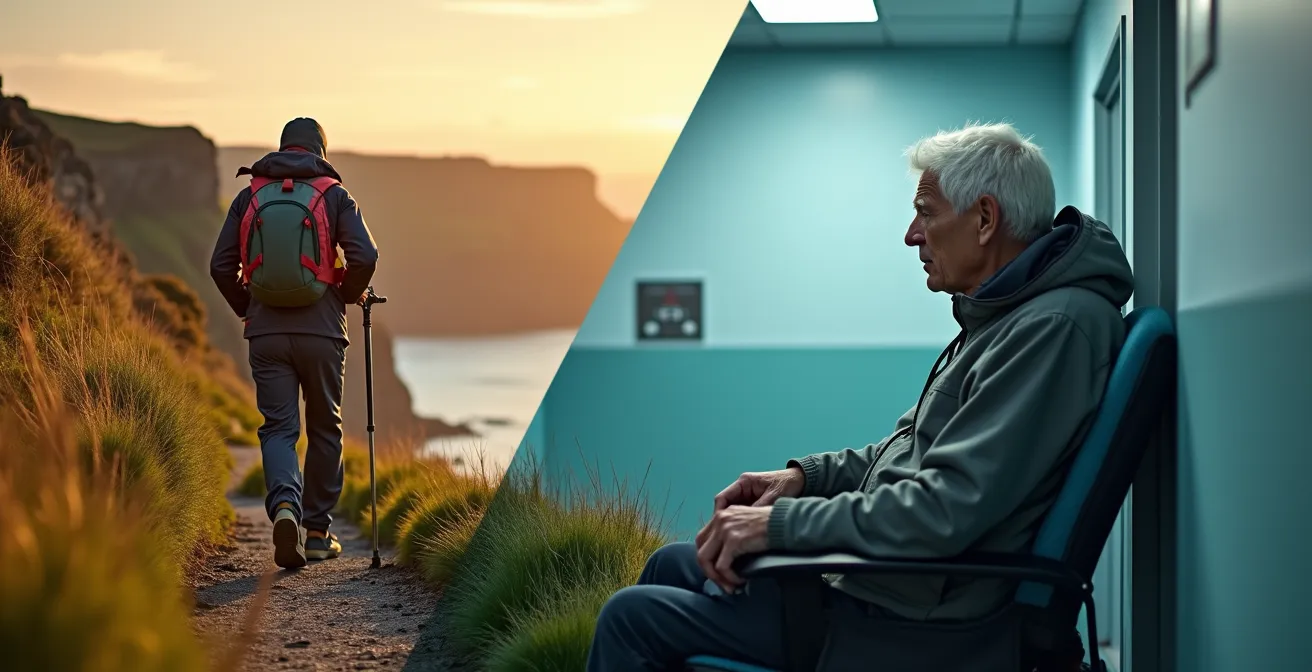
The ultimate goal isn’t just to live longer, but to live better for longer; your Health Span is a set of quantifiable metrics you can actively manage today.
- Proactive health management relies on specific data (blood markers, HRV) and targeted investments, not vague wellness advice.
- A resilient mindset (“Atlantic Stoicism”) and adapting to your local environment (Canadian winters, Irish weather) are as critical as diet and exercise.
Recommendation: Shift your focus from reactive medicine to building a proactive “Personal Health Economy” by tracking key metrics and making small, consistent investments in your future self.
For decades, the conversation around longevity has been dominated by a single, simple question: how long can we live? This focus on “lifespan” has driven incredible medical advances, but it overlooks a far more important question for those of us in our 40s, 50s, and 60s: how long can we live well? This is the crucial concept of “Health Span”—the period of life spent in good health, free from chronic disease and disability. As a longevity specialist, I see countless patients who assume that a long life automatically means a healthy one. They follow the generic advice to “eat better” and “exercise more,” hoping for the best.
But what if we treated our health with the same rigour we apply to our finances? What if, instead of hoping, we started measuring? The truth that modern medicine is uncovering is that health span isn’t a lottery; it’s a skill. It can be quantified, tracked, and significantly improved through deliberate, proactive strategies. This involves moving beyond platitudes and embracing a data-driven approach to your own biology. It means understanding your personal risk factors, making targeted investments in prevention, and building resilience not just in your body, but in your mindset and your relationship with your environment.
This guide is designed to be your framework for that shift. We will move beyond the superficial to explore the specific, quantifiable pillars of a long health span. We will examine concrete strategies, from interpreting critical blood markers relevant to northern latitudes to understanding the economic return on investment of preventive scans. We will explore how activities rooted in your local culture can be more effective than generic exercise, and how adopting a specific mindset can be the key to long-term success. Your journey to an active, vibrant, and long future doesn’t start in the doctor’s office when you’re sick; it starts now, with the decision to manage your health span as the most valuable asset you will ever own.
This article provides a detailed roadmap for maximizing your health span. Below is a summary of the key areas we will explore to help you build a proactive and quantifiable health strategy.
Summary: A Doctor’s Framework for Maximizing Health Span
- Private vs. Public MRI: When Is It Worth Paying for a Full-Body Scan?
- Ferritin and Vitamin D: The 2 Levels Canadians and Irish Must Check Every Winter
- Yoga vs. Weightlifting: Which Is Better for Preventing Osteoporosis After 50?
- HRV (Heart Rate Variability): How to Use It to Predict Illness Before Symptoms Start?
- The Cost of Prevention: How Investing €100/Month Now Saves €10,000 Later?
- Why Is Irish Set Dancing More Effective Than Jogging for Cardiovascular Health?
- Atlantic Stoicism vs. American Optimism: Which Mindset Fits a Resilient Health Economy?
- How to Start “Rucking” (Weighted Walking) to Build Resilience in Bad Weather?
Private vs. Public MRI: When Is It Worth Paying for a Full-Body Scan?
One of the first questions in proactive health management is about visibility. How can we see problems before they manifest as symptoms? While not a routine recommendation for everyone, a full-body MRI scan is a powerful tool for establishing a detailed baseline of your health. However, accessing this technology presents a classic dilemma, especially in countries with robust public healthcare systems like Canada and Ireland. The public systems are designed for medically necessary, reactive diagnostics, leading to significant delays. In contrast, private clinics offer speed and accessibility, but at a cost. This is where you must act as the CEO of your own “Personal Health Economy.”
The decision to pay for a private scan is an investment in data. In the public system, wait times for a routine MRI can stretch from weeks to months. According to recent Canadian healthcare data, this delay is a significant barrier, while private scans can cost between $400 and $3,000. Similarly, in Ireland, the HSE provides essential scans, but a proactive, preventive scan is typically only available privately. The table below, based on data from both Irish and Canadian private and public systems, clarifies the trade-offs.
| Aspect | Public System (HSE/Provincial) | Private Clinics |
|---|---|---|
| Wait Time | Weeks to months for routine scans | Often within 24-72 hours |
| Cost | Covered with medical necessity | €500-€2,000 (Ireland) / $400-$3,000 (Canada) |
| Purpose | Reactive (diagnosing symptoms) | Proactive (preventive baseline) |
| Justification | High-risk patients, family history of cancer, establishing a comprehensive health baseline | Immediate peace of mind, data for long-term health planning |
Is it worth it? For an individual in their 40s or 50s with a strong family history of cancer or who is serious about establishing a preventive health baseline, the answer is often yes. As demonstrated by practices at institutions like St. Vincent’s Private Hospital in Ireland, the data from a single baseline scan can inform a decade of health decisions, potentially detecting issues years before symptoms would have triggered a public referral. It’s not about jumping the queue; it’s about buying information that the public system isn’t designed to provide proactively.
Ferritin and Vitamin D: The 2 Levels Canadians and Irish Must Check Every Winter
If an MRI provides the big picture, targeted bloodwork offers the real-time data on your cellular health. For those living in northern latitudes like Canada and Ireland, two of the most critical, yet often overlooked, markers for energy, immunity, and overall health span are ferritin (your body’s iron storage protein) and Vitamin D. Standard medical practice often only tests for outright deficiency, but for optimal health span, we need to aim for optimal levels. The persistent fatigue, low mood, and frequent illnesses that many attribute to “just winter” are often direct results of suboptimal levels of these two powerhouses.
The difference between “not deficient” and “optimal” is vast. Many longevity specialists and functional medicine doctors advocate for levels significantly higher than the standard laboratory reference ranges. As a guideline based on a consensus among longevity researchers, you should be aiming for a health span sweet spot:
Optimal health span ranges for Ferritin should be >100 ng/mL and Vitamin D >50 ng/mL, significantly higher than the ‘deficiency’ thresholds used by health authorities.
– Multiple longevity researchers, Root Functional Medicine optimal levels guidelines
Achieving these levels can be transformative for your energy and resilience. Ferritin is essential for oxygen transport and cellular energy production, while Vitamin D is a hormone crucial for immune function, bone health, and mood regulation. Low levels of either can be a major roadblock to your health span goals. Getting tested is the first step, but it can sometimes require proactive communication with your GP or turning to private options.
Your Action Plan: Getting Tested for Ferritin and Vitamin D
- Request a Test: Ask your GP for both tests during a routine check-up. Emphasize symptoms like persistent fatigue, low mood, or concerns about winter wellness to justify the request.
- Advocate for Yourself: If the request is denied, explain any relevant family history or the impact of your symptoms on your quality of life. Frame it as a proactive measure to maintain health.
- Consider Private Labs: In Ireland, services like Medichecks or local clinics offer these tests directly for €45-€80. In Canada, private labs or online services are available if provincial coverage is not an option.
- Time It Right: Schedule your tests for late autumn or early winter (October/November) to get a true baseline before the darkest months.
- Test and Tweak: After 3-4 months of guided supplementation, re-test to ensure you have reached optimal levels and can adjust your dosage to a maintenance level.
Yoga vs. Weightlifting: Which Is Better for Preventing Osteoporosis After 50?
A long health span requires a resilient physical structure. After 50, one of the greatest threats to our mobility and independence is osteoporosis—the silent loss of bone density. The conventional wisdom for combating this is “weight-bearing exercise,” but this often leads to a false dichotomy: should I focus on weightlifting for strength or yoga for flexibility and balance? As a longevity specialist, my answer is unequivocal: this is not an “either/or” question. It is a “both/and” imperative. Relying on one while neglecting the other leaves a critical gap in your physical armour.
Weightlifting, or resistance training, is the single most effective tool for stimulating osteogenesis—the creation of new bone tissue. The mechanical stress placed on your skeleton by lifting heavy weights signals your body to deposit more minerals, directly increasing bone mineral density. This is your primary defence against fragility fractures. It builds the raw strength and structural integrity of your chassis.

However, strength without stability is brittle. This is where yoga becomes essential. Yoga excels at improving balance, proprioception (your sense of body position), and flexibility. The majority of osteoporotic fractures, particularly hip fractures, are the result of falls. By improving your stability and ability to recover from a stumble, yoga directly reduces your fall risk. Furthermore, the practice of holding challenging poses creates isometric tension, which also contributes to maintaining bone density, albeit differently than heavy lifting. One builds the fortress, the other trains the guards. Together, they create a comprehensive system for skeletal resilience.
HRV (Heart Rate Variability): How to Use It to Predict Illness Before Symptoms Start?
While bloodwork gives us a snapshot of our health, Heart Rate Variability (HRV) acts like a real-time gauge of our body’s resilience and readiness. It’s one of the most powerful, non-invasive metrics you can track for managing your health span. HRV is the measurement of the variation in time between each heartbeat. Contrary to what many believe, a healthy heart doesn’t beat like a metronome; it subtly speeds up and slows down. A higher HRV indicates that your autonomic nervous system (ANS) is balanced and highly adaptive, able to respond effectively to stress, exercise, and illness. A low HRV suggests your body is under strain and has less capacity to cope.
Think of it as the suspension system for your body. A good suspension system adapts to bumps in the road, providing a smooth ride. A worn-out system transmits every jolt. As Dr. Nathan LeBrasseur of the Mayo Clinic’s Center on Aging notes, HRV is a direct window into this adaptive capacity.
HRV is a direct measure of your autonomic nervous system’s resilience—the engine of your health span. Like a car’s suspension system adapting to bumpy roads, higher HRV indicates better adaptation to stressors.
– Dr. Nathan LeBrasseur, Mayo Clinic Center on Aging
The true power of HRV lies in its predictive ability. A significant, sustained drop in your personal HRV baseline is often the very first sign that your body is fighting something—be it a virus, overtraining, poor sleep, or psychological stress—often days before you feel any symptoms. This early warning allows you to take proactive measures: skip a hard workout, prioritize sleep, hydrate, and support your immune system, potentially sidestepping an illness entirely or reducing its severity.
Case Study: An Irish Teacher’s Proactive Health Management with HRV
An Irish secondary school teacher tracked their HRV using a wearable ring for six months. They noticed a consistent pattern: a sharp, 15% drop in their average HRV after a night of poor sleep. Acting on this data, they would preemptively swap a high-intensity workout for a recovery walk, successfully avoiding the flu that circulated among 40% of their colleagues. During one winter month, their HRV dropped for three consecutive days despite feeling fine. Heeding the warning, they increased rest and supplements. Three days later, mild cold symptoms appeared, but the illness was brief and manageable. Their HRV returned to baseline within five days of recovery, providing a clear, data-driven confirmation that their body was ready to resume normal activity.
The Cost of Prevention: How Investing €100/Month Now Saves €10,000 Later?
Building a long health span is the most important financial decision you will ever make. While we often view healthcare as a cost incurred when we get sick, the smartest approach is to see proactive health as a high-return investment. A small, consistent monthly “deposit” into your Personal Health Economy today can prevent catastrophic “withdrawals”—both financial and in quality of life—down the road. The numbers are stark: the cost of managing chronic disease or requiring long-term care far outweighs the cost of prevention.
For example, current HSE long-stay contribution rates in Ireland show that long-term residential care can cost a person over €9,300 per year. This figure doesn’t even account for the immense personal cost of lost independence and vitality. When you compare that to a modest monthly investment in prevention, the return on investment becomes clear. A hundred euros or dollars a month may seem like an expense, but it’s actually an insurance policy against a future five-figure annual bill.

What does a €100/month “Health Span Portfolio” look like in practice? It’s not about expensive gadgets; it’s about strategic allocation to proven fundamentals. Here’s an example portfolio for someone living in Ireland:
- €25/month: Core Supplements. This covers high-quality Vitamin D3, Omega-3, and Magnesium—the foundational supports for cellular health and inflammation control.
- €15/month: Private Blood Test Fund. Saving this small amount allows for a private ferritin and Vitamin D test every 3-4 months without a second thought.
- €35/month: Specialized Fitness. This could be a membership for yoga, strength training, or even a local Irish set dancing class, targeting bone density and balance.
- €25/month: Health Tools & Nutrition. This could cover a subscription for an HRV tracking app and a budget to upgrade to higher-quality proteins or organic produce.
This is not an expense; it is a calculated investment to buy you more healthy, active, and independent years. It’s the ultimate future-proofing of your quality of life.
Why Is Irish Set Dancing More Effective Than Jogging for Cardiovascular Health?
When we think of cardiovascular exercise, the image that often comes to mind is a lone jogger, steadily putting in the miles. While jogging is certainly beneficial, a growing body of evidence suggests that for overall health span, culturally-rooted activities like Irish set dancing can be significantly more effective. This is the principle of “Cultural Kinesiology”—finding potent forms of exercise embedded within social and cultural traditions. The superiority of set dancing lies in its multi-faceted nature, which trains the body and brain in ways that linear, steady-state cardio simply cannot.
First, it provides natural interval training. Unlike the monotonous pace of a jog, a dance set alternates between high-intensity “figures” and periods of lower-intensity movement. This variation is incredibly effective at improving cardiovascular fitness and metabolic health. Second, it is a significant cognitive challenge. Dancers must constantly memorize complex patterns, sequences, and footwork, which stimulates neurogenesis and helps maintain brain health—a critical component of health span often neglected by purely physical exercise.
Third, and perhaps most importantly, it is an inherently social activity. Loneliness and social isolation are major risk factors for mortality, on par with smoking and obesity. A study from Canadian provider Harrison Healthcare found that regular physical activity can reduce chronic disease risk by up to 31%, and that strong social connections can lower the risk of premature death by 50%. The community, laughter, and shared purpose found in a dance class directly combat this risk. Finally, the intricate footwork and partner-based movements are a powerful form of balance and coordination training, directly reducing the risk of falls in later life. Jogging trains your heart; Irish set dancing trains your heart, your brain, your social bonds, and your balance all at once.
Atlantic Stoicism vs. American Optimism: Which Mindset Fits a Resilient Health Economy?
Your physical actions are only half the equation; your mindset is the operating system that runs your entire health span strategy. In the world of health and longevity, two dominant philosophies emerge. The first is “American Optimism,” characterized by a relentless search for the next big thing—the expensive biohack, the cutting-edge supplement, the revolutionary workout. It’s a mindset of aggressive, often costly, intervention. The second, which I call “Atlantic Stoicism,” is more characteristic of the cultures in Ireland and Atlantic Canada. It’s a philosophy rooted in consistency, practicality, and a quiet resilience. For building a sustainable Personal Health Economy, the stoic approach is unequivocally superior.
Atlantic Stoicism emphasizes mastering the fundamentals before chasing the marginal gains. It understands that the vast majority of your health outcomes—as much as 75% of longevity benefits, according to some analyses—come from the unglamorous basics: consistent sleep, regular movement, sound nutrition, and strong social ties. It prioritizes the €30 gym membership over the €300 smart-ring, the walk in the rain over the infrared sauna session you never get to. This isn’t about being anti-technology; it’s about being pro-consistency. It’s a mindset that is perfectly articulated by Dr. Peter Attia, a leading voice in the science of longevity:
You don’t have to do super-human feats to have great healthspan and, by extension, longevity. But you do have to do some very deliberate things to overcome our civilized environment.
– Dr. Peter Attia, Peter Attia’s framework on sustainable longevity practices
This “deliberate” action is the heart of stoicism. It’s about accepting that there are no magic bullets and committing to the steady, daily work. This approach is not only more effective physiologically, but it is also more resilient economically. It protects you from the hype cycle of the wellness industry and focuses your limited resources—time, energy, and money—on the actions that deliver the greatest return on investment. It’s a quiet, determined resolve to do the simple things exceptionally well, day after day, year after year.
Key Takeaways
- Your Health Span is a quantifiable asset, not a vague concept. Track specific metrics like Ferritin, Vitamin D, and HRV to make informed decisions.
- Prevention is an economic strategy. Small, consistent monthly investments in your health yield massive returns by avoiding the high costs of future chronic disease and long-term care.
- A resilient mindset of “Atlantic Stoicism”—focusing on consistent mastery of the basics—is more effective and sustainable than chasing expensive, short-term biohacks.
How to Start “Rucking” (Weighted Walking) to Build Resilience in Bad Weather?
The final piece of the health span puzzle is learning to thrive in your environment, not just survive it. For anyone in Canada or Ireland, “bad weather” is a fact of life. Atlantic Stoicism teaches us not to hide from this reality, but to adapt and build resilience against it. “Rucking”—the simple act of walking with weight in a backpack—is arguably the perfect exercise for this. It combines cardiovascular conditioning, strength training, and mental fortitude into a single, accessible activity that can be done anywhere, in any weather.
Rucking transforms a simple walk into a potent full-body workout. It elevates your heart rate more than regular walking, and research on loaded walking demonstrates a 40-50% increase in calorie burn when carrying just 20% of your body weight. More importantly, the load provides constant mechanical stress on your bones and postural muscles, making it a powerful tool for improving bone density and building a strong, stable core. It’s low-impact, making it safer on the joints than running, yet it delivers a comparable, if not superior, training stimulus for your health span.
Beyond the physical, rucking is a lesson in resilience. Heading out for a weighted walk in the wind and rain of an Irish coastal path or a crisp Canadian winter morning builds a profound sense of mental toughness. It teaches your body and mind to be comfortable with being uncomfortable. To get started safely, follow a progressive plan:
- Weeks 1-2: Start with 10% of your body weight in a quality backpack. Walk for 20-30 minutes on flat terrain, focusing on posture.
- Weeks 3-4: Increase the weight to 15% of your body weight. Extend walks to 30-45 minutes and begin to include gentle inclines.
- Weeks 5-6: Maintain the weight but increase duration to 45-60 minutes. Tackle steeper, more challenging terrain, like the trails on Mount Royal in Montreal or the Howth Cliff Path near Dublin.
- Gear is Key: Invest in a waterproof backpack (from a store like MEC in Canada or Great Outdoors in Ireland), good waterproof footwear, and merino wool base layers to stay comfortable and dry.
- Safety First: Always use reflective gear in low light, consider trekking poles for stability on uneven or icy ground, and let someone know your route.
By shifting your focus from lifespan to health span and adopting a proactive, quantifiable, and resilient approach, you are not just adding years to your life—you are adding life to your years. The first step is to stop being a passenger and start being the pilot of your own health journey. Evaluate your personal data, build your investment portfolio, and embrace the deliberate work required to build a future defined by vitality, not just existence.