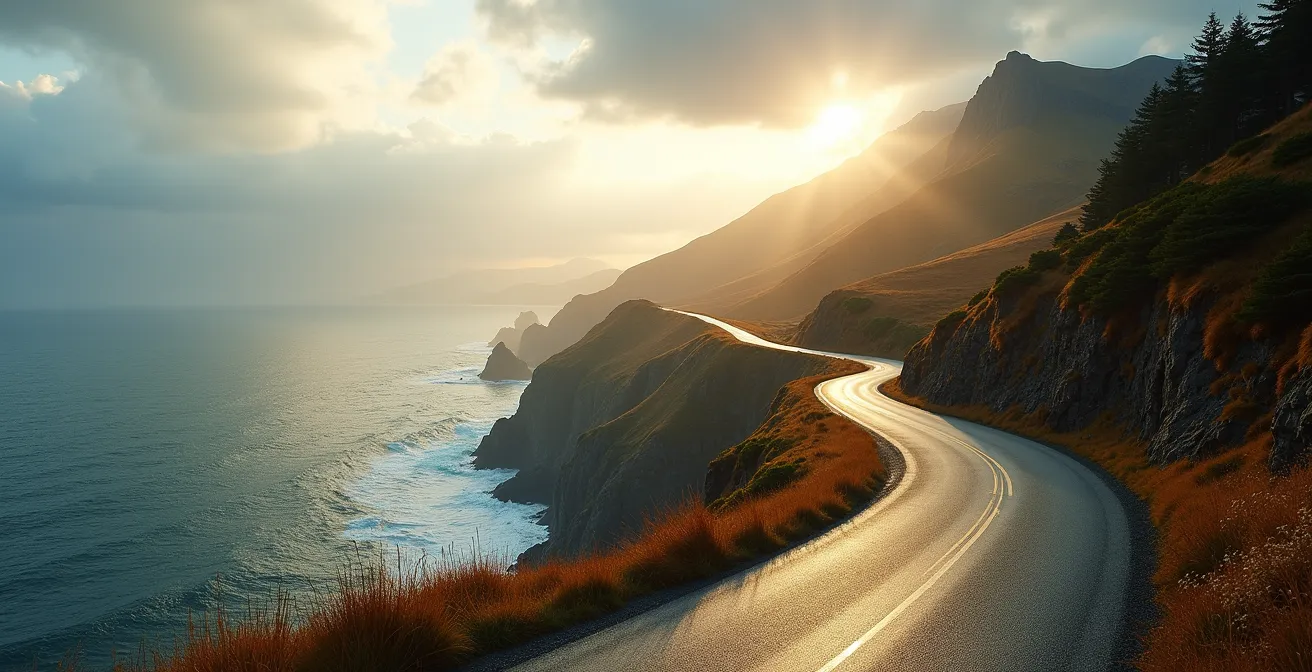
Choosing between the Cabot Trail and the Wild Atlantic Way is less about which is more beautiful and more about which type of “driver friction” you’re willing to accept.
- Ireland’s Wild Atlantic Way offers raw, ancient beauty but comes with significant hidden costs (especially car rental insurance) and stressful, narrow roads.
- Nova Scotia’s Cabot Trail provides grand, accessible coastal vistas with a more relaxed, North American-style driving experience and predictable budgeting.
Recommendation: If you crave epic, accessible scenery on a reasonable budget, choose the Cabot Trail. If you’re an adventurous driver who thrives on challenge and seeks a deep, rugged cultural immersion (and has a flexible budget), the Wild Atlantic Way is your prize.
Every road tripper has seen the photos. The winding ribbon of asphalt clinging to a cliffside, the furious Atlantic crashing below. On one side of the ocean, you have Nova Scotia’s Cabot Trail, a jewel of the Canadian Maritimes. On the other, Ireland’s epic Wild Atlantic Way. Both promise the road trip of a lifetime, a constant reel of screensaver-worthy views. But as someone who’s put rubber to the road on both, I can tell you the postcards don’t show the full picture. They don’t prepare you for the white-knuckle stress of a 1.5-lane road or the shock of a car rental bill that doubles at the counter.
The common advice is to simply compare the top sights—Peggy’s Cove against the Cliffs of Moher, or the Cape Breton Highlands against the Ring of Kerry. But that’s missing the point. The real decision isn’t about the destinations; it’s about the journey itself. It’s about the practical, gritty reality of the driving experience. While this guide focuses on the core matchup between the Cabot Trail and the Wild Atlantic Way, we’ll also draw lessons from other legendary coastal routes, from Newfoundland’s rugged shores to British Columbia’s storm-battered coast, to give you a complete framework for choosing.
So, let’s look past the glossy brochures. This is the brutally honest, driver-focused breakdown you need. We’ll dissect the costs, the on-the-ground driving challenges, and the strategies for escaping the crowds to help you decide which of these legendary coastal drives is truly the right one for you.
Summary: Cabot Trail vs. Wild Atlantic Way: A Road Tripper’s Brutally Honest Comparison
- Why Is Renting a Car in Ireland 30% More Expensive Than in Nova Scotia?
- How to Drive on Narrow Irish Roads If You Are Used to Canadian Highways?
- Campervan vs. Compact Car: Which Is More Practical for Windy Coastal Roads?
- The Fog Mistake: Why You Should Never Plan Scenic Drives for Early Morning in July
- Off the Map: How to Find Secret Beaches Not Listed in Tourist Guides?
- Why You Should Skip Temple Bar and Eat in West Cork Instead?
- Peggy’s Cove vs. Tofino: Which Coast Offers Safer Vantage Points for Storm Watching?
- Exploring Newfoundland’s Rugged Coast: The 5 Safety Rules for Solo Hikers
Why Is Renting a Car in Ireland 30% More Expensive Than in Nova Scotia?
The first and most jarring piece of “driver friction” you’ll encounter is the cost, and Ireland delivers a gut punch right at the rental counter. While the base rental rates seem comparable, the final price in Ireland can easily be double or triple what you’d pay in Nova Scotia. The main culprit? Mandatory insurance. North American credit cards that offer Collision Damage Waiver (CDW) coverage are almost universally rejected by Irish rental agencies. They often require a specific, custom letter from your credit card company, which most travelers don’t have. This forces you to buy their expensive in-house insurance.
This isn’t a small upcharge. Multiple travelers report being forced to purchase expensive policies at the counter despite declining them online. It’s common for insurance to add over €400 for just six days, effectively doubling the rental cost. This practice is so prevalent it feels less like an option and more like a non-negotiable part of the rental process. Add in higher fuel prices and potential cross-border fees if you plan to visit Northern Ireland, and the financial gap widens significantly.
This table breaks down the sticker shock. While costs for a compact automatic in Nova Scotia are straightforward, the Irish equivalent is laden with expensive, often unavoidable add-ons.
| Cost Component | Ireland (EUR) | Nova Scotia (CAD) |
|---|---|---|
| Base Rental (Compact Auto) | €350-450 | $280-350 |
| CDW Insurance | €250-400 (mandatory) | $0 (credit card coverage) |
| Fuel per Litre | €1.60-1.80 | $1.30-1.50 |
| Cross-border fee | €34-50 | $0 |
| Total Estimated Weekly Cost | €700-900+ | $380-500 |
In contrast, renting a car for the Cabot Trail is a familiar, transparent process for any North American. Your credit card insurance is accepted, prices are as-advertised, and there are no surprise mandatory fees. For budget-conscious road trippers, this financial predictability gives the Cabot Trail a massive advantage before you even turn the key.
How to Drive on Narrow Irish Roads If You Are Used to Canadian Highways?
If the cost of the car in Ireland is the first shock, the roads themselves are the second. As a traveler, you have to appreciate the sheer audacity of Irish tourism. Travel blogger Sherry Ott from Otts World Travel Blog sums it up perfectly:
I have to hand it to the tourism department, because any destination that decides to take its smallest, winding, untraveled, narrow roads and market the hell out of it for tourists to come and drive on them has balls. Big f’ing balls. The US would never do this. We live in a land of shoulders, passing zones, and wide, spacious lanes.
– Sherry Ott, Otts World Travel Blog
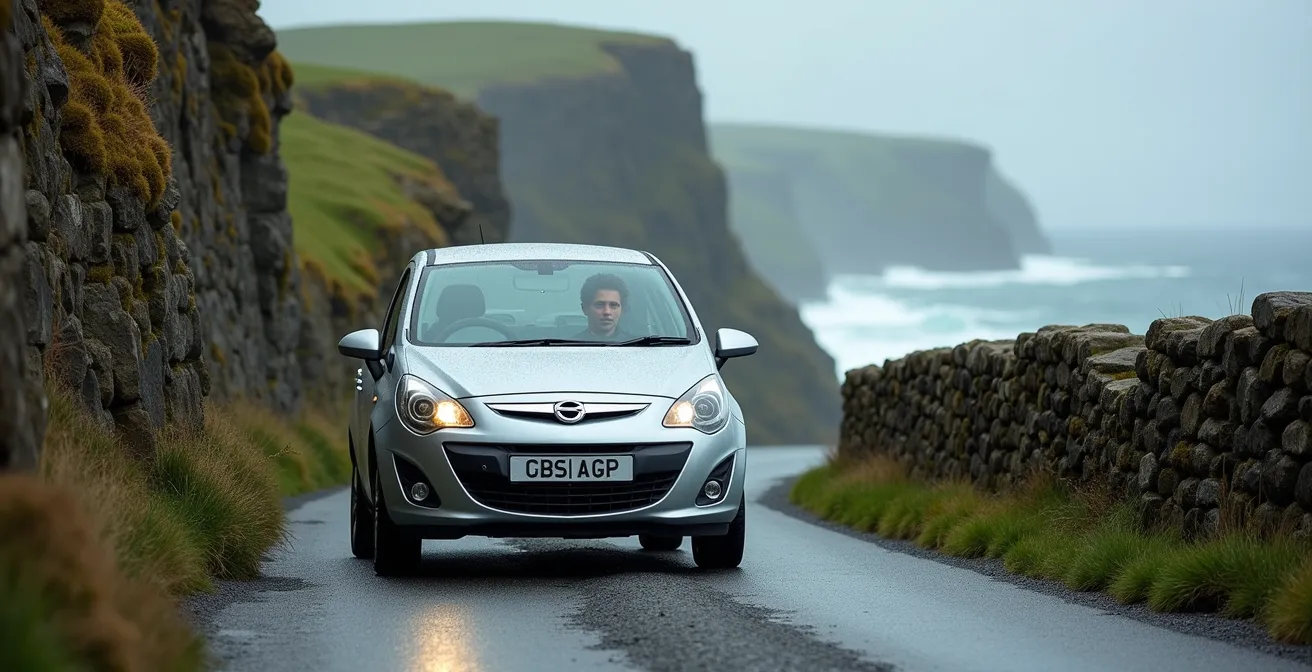
This is not an exaggeration. Many sections of the Wild Atlantic Way are what locals call “1.5-lane roads”—technically two-way but barely wide enough for one car, often bordered by ancient stone walls or a sheer drop. This is a world away from the wide, well-maintained highways of Canada, including the Cabot Trail. Driving here requires constant focus, a willingness to reverse for long stretches to a “passing place,” and an understanding of local driving etiquette that is the polar opposite of North American norms.
For instance, a flash of headlights in Canada often means “get out of my way.” In rural Ireland, it usually means, “Go ahead, I’m yielding to you.” Mastering this and other unwritten rules is key to survival. You must learn the single-finger “thank you” wave, accept that speed limits are merely suggestions (you’ll rarely hit the 100km/h limit on a rural road), and be prepared for locals in tractors or delivery vans to appear suddenly around a blind corner. Driving the Cabot Trail feels like a scenic version of your daily commute; driving the Wild Atlantic Way feels like a completely new skill to be learned, one that is both terrifying and exhilarating. The scenery-to-effort ratio is much higher in Ireland; the views are earned through concentration and nerve.
Campervan vs. Compact Car: Which Is More Practical for Windy Coastal Roads?
The romantic vision of a campervan road trip is powerful. Waking up to a new ocean view every morning seems like the ultimate freedom. However, on these specific coastal routes, the dream quickly collides with infrastructural realities. For the Wild Atlantic Way, a large campervan is, frankly, a terrible idea. The same narrow roads that challenge a small car become nearly impassable for a wider vehicle. High mountain passes like the Conor Pass are explicitly restricted for vehicles over a certain size, and even if it’s technically allowed, you will be the source of immense frustration for locals stuck behind you.
This is where a compact car is not just a recommendation, but a necessity. The agility to squeeze past oncoming traffic, fit into tiny parking spots at scenic lookouts, and navigate tight village streets is paramount. The image below perfectly captures the kind of space you’re working with—there is simply no room for error, or for a wide vehicle.
Furthermore, the freedom of “wild camping” is largely a myth in Ireland. Unlike Canada, where vast swaths of Crown Land are open for use, wild camping is illegal in Ireland without the express permission of the landowner. This means you’re restricted to official, often crowded, and expensive campsites, negating much of the cost savings and spontaneity a campervan is supposed to offer.
On the Cabot Trail, the situation is different. The roads are wider, and while still curvy, they are built to North American standards. A moderately sized campervan is perfectly manageable. Designated national park campgrounds are plentiful and beautiful. However, even here, a smaller vehicle or compact RV offers more flexibility for pulling over at spontaneous viewpoints. For both routes, but especially for Ireland, the rule is simple: go with the smallest, most nimble vehicle you can comfortably manage.
The Fog Mistake: Why You Should Never Plan Scenic Drives for Early Morning in July
There’s a universal road trip mistake that catches even seasoned travelers off guard on these routes: the “atmospheric gamble.” You picture a golden sunrise over the ocean, so you set your alarm for 5 a.m., eager to get the perfect shot before the crowds arrive. You get in your car, and you can’t see ten feet in front of you. Welcome to Atlantic coastal fog, a phenomenon that can completely derail your plans on both the Cabot Trail and the Wild Atlantic Way, especially in the summer months.
Experienced drivers on both coasts report that it’s common for dense morning fog to linger until 10 or 11 a.m., reducing visibility to near zero. Planning a drive through a marquee scenic section like the Cape Breton Highlands or the Slea Head Drive during these hours is not just pointless—it’s dangerous. You’re not just missing the view; you’re navigating treacherous, winding roads in a whiteout. Many a road tripper has driven the most beautiful stretch of their itinerary completely blind, a deeply frustrating experience.
The pro move is to flip your schedule. Use the foggy mornings for other activities. This is your chance to embrace the “local flow” and do something indoors. On the Cabot Trail, this could mean visiting the Alexander Graham Bell Museum in Baddeck. In Ireland, it’s the perfect time to explore the excellent Blasket Centre on the Dingle Peninsula or duck into a pub for a coffee and conversation. Save the epic scenic drives for the afternoon when the sun has had a chance to burn off the marine layer. The fog itself can even be an opportunity. Instead of fighting it, use it to your advantage for atmospheric photography, focusing on moody, close-up shots of the coastline shrouded in mist.
Off the Map: How to Find Secret Beaches Not Listed in Tourist Guides?
After navigating high costs, stressful roads, and unpredictable fog, you deserve a reward. The ultimate prize on both the Cabot Trail and the Wild Atlantic Way is the same: finding that perfect, secluded cove with no one else around. These places rarely appear in official guides or on “Top 10” lists. Finding them requires a different mindset and a different set of tools, shifting from a tourist to an explorer.

As the team at The Planet D travel blog notes about the Cabot Trail, the rewards are there for those willing to simply stop: “It’s rare to find beaches that are so pristine in this world. Few people stop to take a look so you will often have them all to yourself.” The same holds true for the thousands of inlets along the Wild Atlantic Way. The key is to look for the clues the average tourist misses: small, unmarked dirt roads leading toward the coast, gaps in stone walls with a faint footpath, or clusters of local cars parked for no apparent reason.
Your best friends in this quest are not tourist maps, but detailed topographical ones. For Ireland, this means using Ordnance Survey Ireland (OSI) maps, which show public rights-of-way and ancient roads called ‘boreens’ that often lead to incredible spots. In Nova Scotia, consulting provincial Public Land maps and local hiking association websites can reveal hidden access points. In both places, using the satellite view on Google Maps is a modern-day treasure map. Scan the coastline between the famous, crowded attractions. Look for that sliver of sand or that protected cove, then trace the roads back to see if you can get close. This proactive “itinerary audit” is how you transform a good road trip into an unforgettable one.
Action Plan: Auditing Your Route for Secret Spots
- Points of Contact: List all official tourist maps, apps, and guides for your planned route. These mark the places to avoid if you’re seeking solitude.
- Collecte: Inventory the officially marked “scenic viewpoints” and beaches. Note their parking capacity and reviews—if it’s famous, it’s likely crowded.
- Coherence: Confront these popular spots with your travel goals. Are you looking for easy-access infrastructure or the thrill of discovery? Be honest about your priorities.
- Mémorabilité/Emotion: Use satellite views on digital maps to meticulously scan the coastline *between* the official points. Look for unmarked paths, tiny coves, or unpaved roads leading to the water.
- Plan d’intégration: Prioritize 2-3 of these potential “secret spots” to investigate. Add significant buffer time to your daily schedule specifically for these spontaneous, exploratory detours.
Why You Should Skip Temple Bar and Eat in West Cork Instead?
The “driver friction” isn’t just about roads and costs; it’s also about navigating tourist traps. Every famous route has them. For the Wild Atlantic Way, the gravitational center of inauthenticity is Dublin’s Temple Bar. For the Cabot Trail, it’s the cluster of waterfront restaurants in Halifax. While not technically on the routes, they are the common start/end points. Here, you’ll find overpriced pints, generic “seafood platters,” and a version of local culture packaged for mass consumption.
The real flavor of a place is found where the locals eat. As one traveler shared about their experience in Ireland: “We skipped the tourist crowds and found authentic Irish cuisine in small West Cork villages. The artisanal cheeses like Gubbeen and Durrus, paired with locally smoked fish, offered a true taste of place that you’d never find in Dublin’s tourist quarter.” This perfectly mirrors the experience in Nova Scotia, where the unassuming fishing villages of the South Shore serve life-changing lobster rolls for a fraction of the price you’d pay in Halifax.
The choice to seek out authenticity is not just about a better experience; it’s also a smarter financial decision. The cost difference between a meal in a tourist hub and a meal in a small, local village is staggering. This is true for everything from a pint of beer to a full seafood dinner.
| Meal Type | Temple Bar/Halifax Waterfront | West Cork/South Shore Villages |
|---|---|---|
| Fish & Chips/Seafood Platter | €18-25 / $35-45 | €12-16 / $20-28 |
| Pint/Local Beer | €7-9 / $8-10 | €4.50-6 / $5-7 |
| Artisanal Cheese Board | €22-28 / $30-38 | €14-18 / $18-25 |
| Fresh Lobster Dinner | €45-60 / $65-85 | €28-35 / $38-48 |
The lesson is universal for any road trip: your best meals will almost always be found in the places that don’t have glossy menus or a marketing budget. Ask a gas station attendant, a shopkeeper, or a fisherman where they go for lunch. Those recommendations are worth more than any online review.
Peggy’s Cove vs. Tofino: Which Coast Offers Safer Vantage Points for Storm Watching?
For a certain type of traveler, a sunny day is a missed opportunity. The real show is the raw power of the ocean during a storm. Both of Canada’s coasts offer world-class storm watching, but their approach to safety highlights a crucial difference in philosophy. While our focus is on the Atlantic, it’s worth looking west to Tofino, British Columbia—Canada’s undisputed storm-watching capital—to understand the gold standard for safety.
In Tofino, storm watching is a developed tourist activity. Hotels offer “storm packages,” and there are well-marked, designated viewing platforms and trails designed to give you a spectacular, but safe, vantage point. The culture is one of deep respect for the ocean’s power. Now, compare this to Peggy’s Cove in Nova Scotia. It’s an iconic, beautiful place, but it’s also infamous for its danger. The smooth, dark rocks are slippery, and rogue waves have tragically swept unsuspecting visitors into the sea. Despite numerous warning signs, the temptation to get a closer look is strong, and the natural landscape offers little in the way of purpose-built safety infrastructure.
This contrast between managed and wild viewing experiences is also seen in Ireland. According to safety assessments that show different approaches, major sites like the Cliffs of Moher have designated, fenced viewing areas, but many other stunning viewpoints along the Wild Atlantic Way remain completely unfenced and exposed. The responsibility is placed almost entirely on the individual. The rule for storm watching on any of these wild coasts—be it Ireland, Nova Scotia, or Newfoundland—is the same: never turn your back on the ocean. Rogue waves are unpredictable. The safest vantage point is often from your car at a designated pull-off, or from inside a waterfront café, like those in Lahinch, Ireland, where you can watch the massive waves roll in with a warm drink in hand. No photo is worth your life.
Key Takeaways
- Budget Reality: Car rental in Ireland is significantly more expensive and complicated than in Nova Scotia due to mandatory, costly insurance.
- Driving Stress: The Wild Atlantic Way features extremely narrow, challenging roads requiring constant focus, whereas the Cabot Trail offers a more relaxed, North American-style driving experience.
- Authenticity Pays: On both routes, the best and most affordable food is found in small, local villages, not in major tourist hubs like Dublin’s Temple Bar or the Halifax waterfront.
Exploring Newfoundland’s Rugged Coast: The 5 Safety Rules for Solo Hikers
If the wildness of the Cabot Trail or the Wild Atlantic Way appeals to you, their rugged cousin in Newfoundland takes that spirit to a whole new level. The hiking here, especially in places like Gros Morne National Park or along the East Coast Trail, is world-class. But with greater wilderness comes a different set of safety considerations, particularly for the solo hiker. The risks here are distinctly North American and contrast sharply with those in Ireland.
In Ireland, the primary hiking danger along the coast is environmental: unfenced cliff edges, paths that become treacherously slippery and boggy after rain, and sudden, disorienting fog. The trails can be poorly marked, and emergency response is often handled by volunteer mountain rescue teams. On the Cabot Trail and especially in Newfoundland, the trail conditions are often better maintained, but the primary danger shifts to wildlife encounters. As travel writer Kate McCulley of Adventurous Kate bluntly puts it when discussing the Cabot Trail:
Keep an eye out for wildlife constantly, and if you see a moose, hit the breaks. Hitting a moose will likely kill you, as they are tall, weigh a ton, and will fall onto your windshield and crush you. It’s much more dangerous than hitting a deer.
– Kate McCulley, Adventurous Kate
This is not a theoretical risk; moose and black bears are common along these trails. For a solo hiker, this requires a level of situational awareness that’s different from simply watching your footing. The following table breaks down the primary risk factors when comparing a coastal hike in Ireland to one in the Canadian Maritimes.
| Risk Factor | Wild Atlantic Way | Cabot Trail |
|---|---|---|
| Primary Danger | Unfenced cliff edges, slippery paths | Wildlife encounters (moose, bears) |
| Weather Hazard | Sudden fog, sideways rain | Rapid weather changes, exposure |
| Emergency Contact | 112/999 – Mountain Rescue Ireland | 911 – Parks Canada rescue teams |
| Response Time | Volunteer-based, variable | Professional teams, faster response |
| Trail Conditions | Boggy, muddy, often unmarked | Well-maintained but steep grades |
The five safety rules for any solo hiker in this part of the world are therefore: 1. Inform someone of your route and expected return time. 2. Carry a satellite communication device (cell service is unreliable). 3. Make noise as you hike to avoid surprising wildlife. 4. Carry bear spray and know how to use it. 5. Never, ever feed or approach any wild animal. Respecting these rules is fundamental to enjoying the profound beauty of these wild places safely.
Ultimately, the choice between these two legendary drives comes down to your personality as a traveler and a driver. The Cabot Trail offers a majestic, accessible, and low-stress journey through grand scenery. The Wild Atlantic Way is a challenging, deeply immersive, and sometimes frustrating adventure that rewards you with a profound sense of place and accomplishment. Choose the path that matches your appetite for adventure—and your budget—and you can’t go wrong.