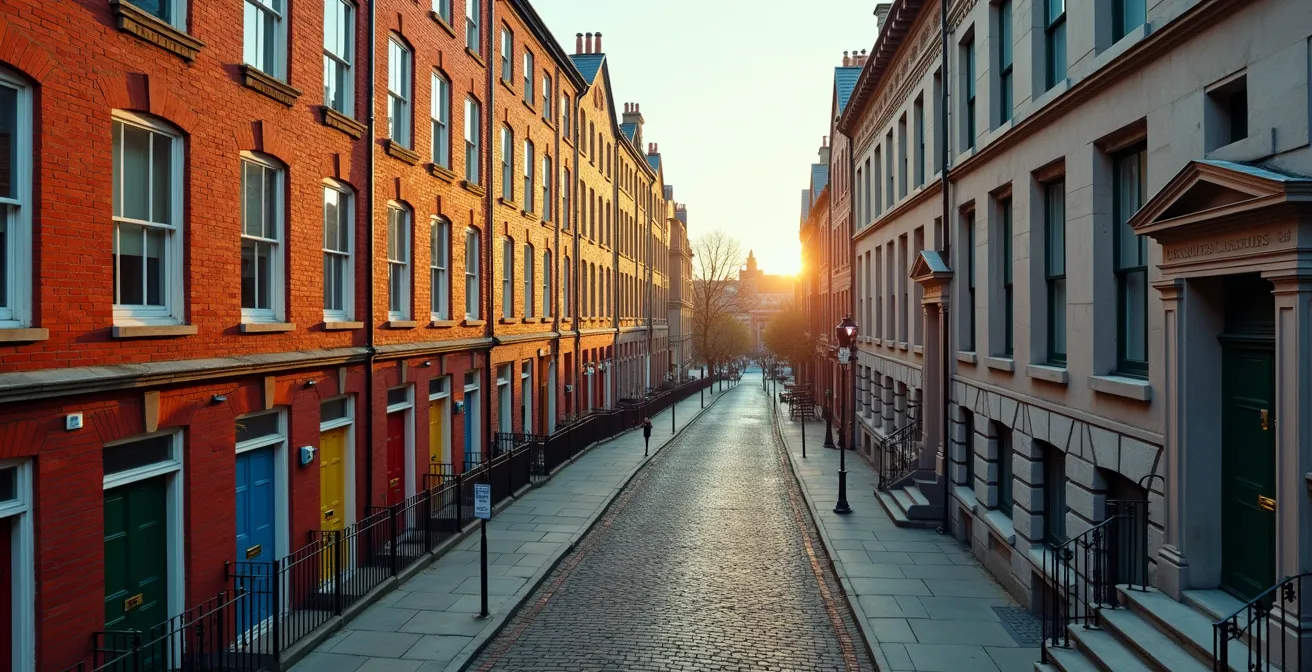
The best Georgian architectural walk isn’t found in the city with the most pristine buildings, but in the one with the most compelling story of survival and cultural reappropriation.
- Dublin’s strength lies in its “living heritage,” where a colonial architectural style has been actively reclaimed and integrated into a vibrant, modern capital.
- Montreal’s experience is defined by its “development scars,” where the immense loss of its Gilded Age mansions makes the surviving greystone treasures even more poignant.
Recommendation: Approach your walk not as a tourist seeing sights, but as an urban archaeologist reading the evidence. The clues to each city’s soul are found as much in what has vanished as in what remains.
For the architecture enthusiast, a stroll through Dublin’s ordered brick squares or Montreal’s stately Golden Square Mile presents a fascinating conundrum. At first glance, the task seems to be a simple comparison of aesthetics: the warm, colourful doorways of Dublin versus the imposing, grey limestone façades of Montreal. Both cities offer prime examples of Georgian design, a style defined by symmetry, proportion, and classical elegance that dominated the British Empire from the early 18th to the mid-19th century. Urban tourists and architecture lovers often find themselves weighing the visual appeal of one against the other, trying to declare a winner based on surviving structures.
This approach, however, misses the far more compelling narrative buried within the stone and brick. The conventional wisdom focuses on cataloguing famous buildings, but this merely scratches the surface. What if the true measure of a great architectural walk isn’t just about what you see, but about the stories the cityscape tells—stories of cultural identity, economic booms, and devastating losses? The real difference between Dublin and Montreal is not in their choice of building materials, but in their profoundly different philosophies of urban memory.
This analysis moves beyond a simple checklist of sights. We will delve into the architectural dialect of each city, examining how local history, climate, and culture shaped their unique take on the Georgian style. By exploring tales of catastrophic demolitions, the nuances of preservation, and the methods for uncovering hidden stories, we will determine which city offers not just a prettier walk, but a deeper, more meaningful engagement with its past. The key lies in understanding that one city showcases a living, breathing heritage, while the other presents a poignant lesson in what happens when preservation comes almost too late.
This guide provides a detailed framework for comparing the Georgian architectural heritage of both cities, offering insights that will transform your walk from a simple tour into a historical investigation.
Summary: A Tale of Two Georgian Cities
- Fanlights and Doorways: How to Spot Authentic Georgian Details?
- Guided Tour vs. Self-Guided App: Which Method Reveals More Hidden Stories?
- The Demolition Mistake of the 1960s That Changed Montreal’s Landscape Forever
- Open House Festivals: When Is the Best Time to Enter Private Heritage Buildings?
- Perspective Correction: How to Photograph Tall Buildings Without Distortion?
- Limewash vs. Modern Paint: Which Is Best for Preserving 18th Century Stone?
- René-Lévesque vs. Side Streets: Where Are the Best Viewing Spots with Less Crowd?
- Quebec City vs. Dublin: Comparing Preservation Tactics in Historic Colonial Districts
Fanlights and Doorways: How to Spot Authentic Georgian Details?
To the untrained eye, a Georgian building is simply old and symmetrical. Yet, the true architectural enthusiast knows the devil is in the details. Learning to read these details is like learning an architectural dialect; it allows you to understand the specific story of a place. The fanlight above a door, for instance, wasn’t just decorative. In Dublin, its intricate, web-like tracery often signaled the social standing of the original owner. In Montreal, some fanlights incorporated clan motifs like the thistle, a nod to the powerful Scottish merchants who built the Golden Square Mile.
The choice of primary building material tells an even bigger story. Dublin’s ubiquitous red brick was a practical and affordable local product. Montreal’s celebrated “greystone” is a specific type of Ordovician limestone, quarried directly from the island, giving the city its unique, austere grandeur. But these materials also posed different preservation challenges. Dublin’s porous brick must contend with damp sea air, while Montreal’s stone must endure punishing freeze-thaw cycles that can split masonry. This architectural conversation between style and environment is where the character of each city is forged. However, in Montreal, this conversation was violently interrupted. While Dublin’s Georgian core remains largely intact, it’s crucial to remember that only about 30% of the Golden Square Mile’s original mansions have survived, making each remaining detail a precious piece of evidence.
This comparative table breaks down the key material and stylistic differences, providing a foundational guide for your “facade archaeology.”
| Feature | Dublin | Montreal |
|---|---|---|
| Primary Material | Red brick | Greystone (Ordovician limestone) |
| Fanlights | Intricate tracery denoting social standing | Clan motifs (thistle for Scottish heritage) |
| Doorways | Colorful painted doors | Austere greystone entrances |
| Climate Challenge | Damp sea air | Freeze-thaw cycles |
Guided Tour vs. Self-Guided App: Which Method Reveals More Hidden Stories?
Once you can identify the basic features, the next question is how to uncover the human stories behind them. Modern technology offers a plethora of self-guided apps, providing facts, dates, and architectural terminology at your fingertips. These are invaluable for a baseline understanding. However, they often miss the intangible layer of history: the anecdotes, scandals, and oral traditions that bring a building to life. This is where the expertise of a human guide becomes irreplaceable. An app can tell you a building’s construction date; a guide can tell you about the secret lives lived within its walls.
This difference is particularly stark when comparing Dublin and Montreal. In Dublin, specialized walking tours are a cornerstone of the heritage experience. For instance, the case of Pat Liddy’s Walking Tours demonstrates this perfectly. Guides don’t just point out features; they share stories of the ‘Piano Nobile’—the grand first-floor reception rooms—and describe the often-primitive bathing practices of the Georgian elite, painting a vivid picture of daily life. This oral history is a form of living heritage that an app struggles to replicate. In Montreal, the grandeur was once just as palpable. In 1818, observer John Duncan remarked: “A number of very splendid mansions have lately been erected on the slope of the mountain, which would be regarded as magnificent residences even by the wealthy merchants of the mother country.” A guide can channel this historic awe, connecting you to a time when Montreal was the undisputed centre of Canadian commerce.
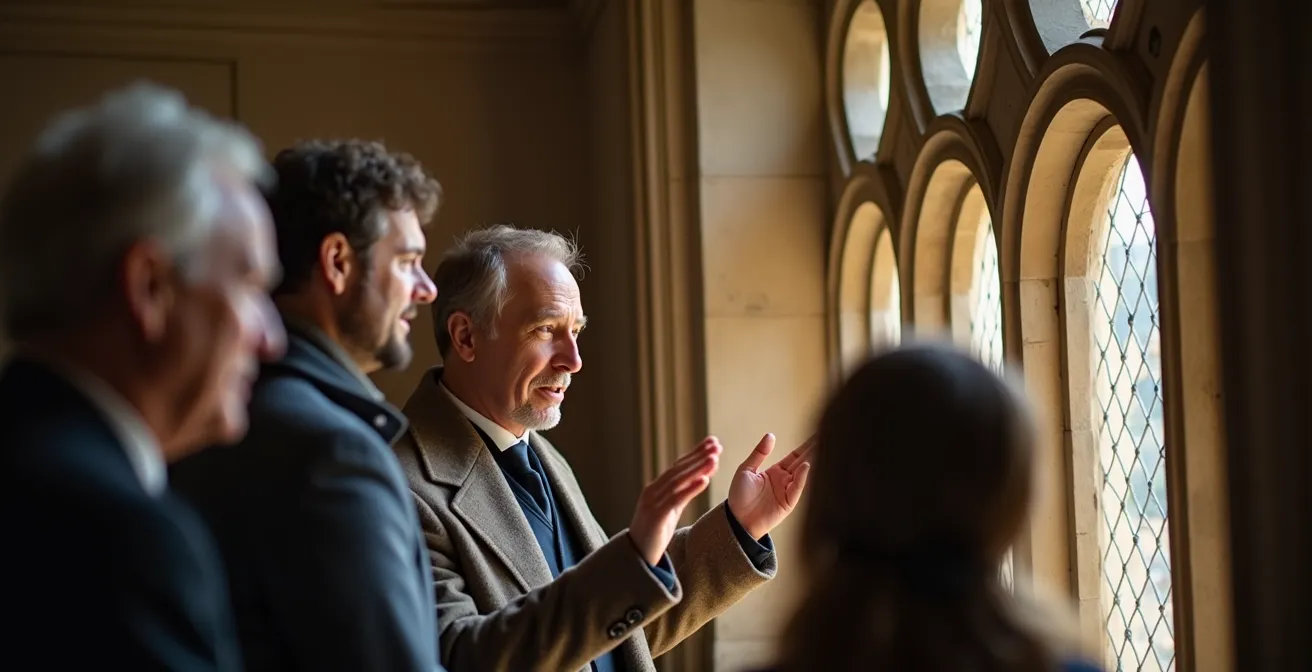
As the image suggests, the value of a guided tour lies in this human connection—the shared moment of discovery as a story unfolds against the backdrop of the very architecture it describes. While an app provides data, a guide provides context and narrative, transforming a collection of buildings into a cohesive urban story. For the richest experience, a hybrid approach is often best: use an app for the facts, but invest in a guided tour to uncover the soul.
The Demolition Mistake of the 1960s That Changed Montreal’s Landscape Forever
No comparison of Dublin and Montreal’s architecture is complete without confronting the elephant in the room: demolition. While Dublin experienced its own periods of neglect, its Georgian core largely survived the 20th century’s modernist fervor. Montreal was not so lucky. The city’s architectural story is not one of gentle aging, but of brutal amputation. The 1960s and 70s saw a wave of development that treated the city’s Gilded Age heritage as an obstacle rather than an asset. This period left deep “development scars” on the urban fabric, and understanding this history is key to appreciating what remains.
The most infamous example is the demolition of the Van Horne Mansion in 1973. This magnificent Second Empire-style mansion, a cornerstone of the Golden Square Mile, was torn down by developer David Azrieli to make way for a high-rise. The public outcry was immediate and furious. This single act of destruction served as a dramatic wake-up call, galvanizing the public and directly leading to the formation of Héritage Montréal, the city’s premier preservation advocacy group. The loss of the Van Horne Mansion is the foundational trauma of Montreal’s modern preservation movement; it was the mistake that finally forced the city and province to create a meaningful heritage protection framework.
The scale of the loss is staggering. As documented in preservation records, the wave of demolitions was so thorough that by 1983, only 5% of the original mansions south of Sherbrooke Street were still standing. When walking through Montreal today, one must therefore engage in an act of imagination, picturing the grand homes that once stood where glass towers now rise. This poignant sense of loss gives the surviving greystone mansions a profound gravity. They are not just beautiful buildings; they are survivors, testaments to a lost golden age.
Open House Festivals: When Is the Best Time to Enter Private Heritage Buildings?
Looking at façades is one thing; stepping inside a private heritage building is another experience entirely. Both Dublin and Montreal host “Open House” style events that grant the public rare access to buildings normally closed off. However, the nature and scale of these events reveal much about each city’s relationship with its architectural heritage. Dublin’s commitment to “living heritage” is on full display during its main festival, while Montreal’s more limited access reflects its ongoing struggle to balance development with preservation.
Dublin’s flagship event, Open House Dublin, is a massive, city-wide celebration held over nine days in October. It features over 200 events, with a strong emphasis on its Georgian core. This festival allows visitors to step inside everything from private homes and artist studios to government buildings like the Department of the Taoiseach, all housed in restored Georgian townhouses. Montreal offers similar opportunities, but they are often less frequent and part of broader cultural events like the “24h de Montréal,” with more limited access to the few remaining Golden Square Mile mansions, many of which are now institutional or commercial properties.
The following table highlights the key differences in public access, underscoring Dublin’s more integrated and celebratory approach to its built heritage.
| Event | Dublin | Montreal |
|---|---|---|
| Main Festival | Open House Dublin | 24h de Montréal |
| Timing | October (9 days) | Various dates (less frequent) |
| Focus | Strong Georgian architecture emphasis | Broader cultural focus |
| Private Buildings | 200+ events including government buildings | Limited access to Golden Square Mile mansions |
| Booking | Free, some require advance booking | Varies by event |
For the dedicated architecture lover, timing your visit to coincide with these festivals is ideal. However, it’s not the only way to gain access. Many historic buildings now serve public or commercial functions year-round, offering a different kind of immersive experience.
Action Plan: Accessing Georgian Heritage Year-Round
- Points of Contact: Identify publicly accessible heritage buildings in both cities (hotels, museums, university campuses, restaurants).
- Collect Existing Itineraries: Inventory your options. In Dublin, visit The Merrion Hotel (four restored townhouses) or the 14 Henrietta Street museum. In Montreal, explore the McGill University campus or the Canadian Centre for Architecture, housed in the former Shaughnessy House.
- Check for Coherence: Does the modern use of the building respect or clash with its original character? Dining in a converted Georgian building offers a different perspective than a formal museum tour.
- Assess Memorability: Which experience offers a more unique insight? Compare the feeling of staying in a Georgian hotel room versus attending a lecture in a historic university hall.
- Plan Your Integration: Prioritize your visits. Book museum tours in advance, make restaurant reservations, or simply plan a walk through McGill’s campus to admire its collection of former mansions.
Perspective Correction: How to Photograph Tall Buildings Without Distortion?
Capturing the grandeur of Georgian architecture presents a unique photographic challenge. The classic problem is perspective distortion, or “keystoning,” where tall buildings appear to fall backwards. As a historian of architecture, your goal is to document, and that means creating images that are not only beautiful but also accurate. Correcting this distortion can be done in-camera or in post-processing, but the best approach often starts with technique on the ground.
The urban layout of Dublin and Montreal dictates different photographic strategies. Dublin’s wide, planned squares like Merrion or Fitzwilliam Square are a gift to photographers. By positioning yourself centrally and further back, you can capture a symmetrical façade with minimal distortion, using a standard or slight telephoto lens. Montreal’s Golden Square Mile is more challenging. Its grandest buildings are often situated on narrower, busier streets like Sherbrooke, making it difficult to get enough distance. Here, a wider lens is necessary, but this exacerbates distortion. One effective technique is to use your phone’s panoramic mode vertically or to take multiple shots and stitch them together later, creating a high-resolution image that captures the full height without severe angling. Including human elements—a cyclist in Dublin, a student on the McGill campus—provides a crucial sense of scale, grounding the monumental architecture in everyday life.
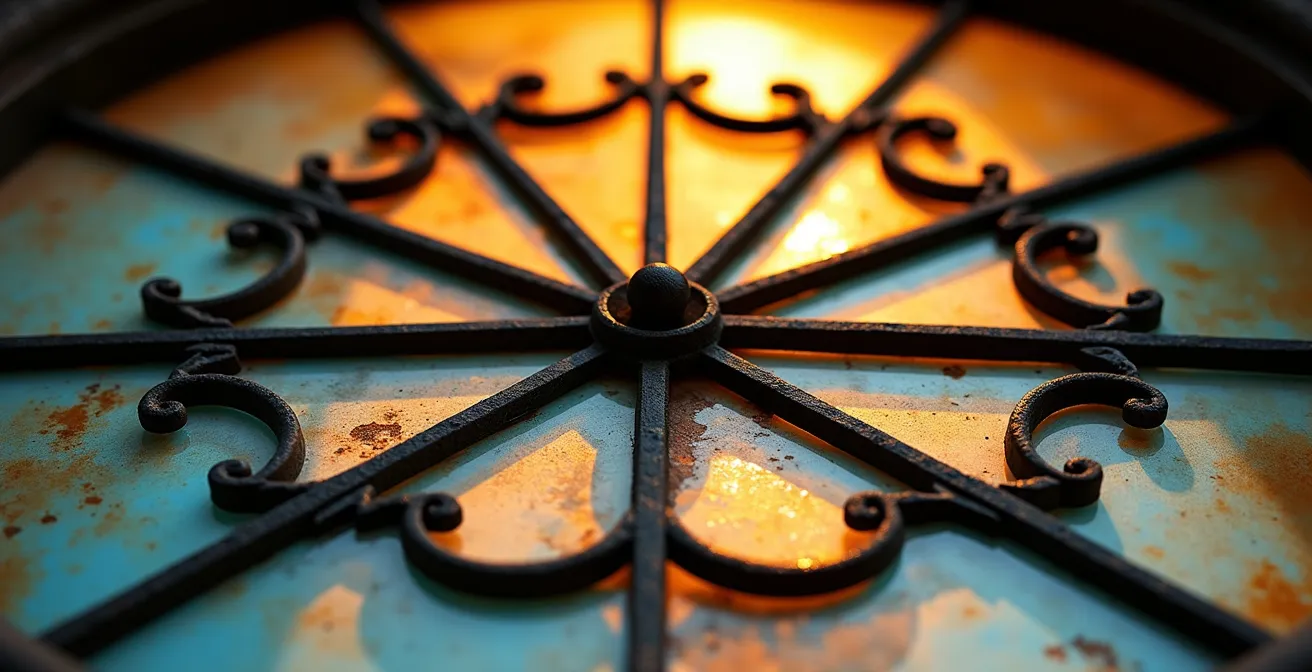
Beyond the grand facades, don’t forget the details that tell a story. In Dublin, seek out the original boot scrapers and coal holes in the pavement. In Montreal, use the reflections in the modern glass towers that have replaced historic mansions to create a poignant image of the old and new in dialogue. These detail shots, as seen in the intricate fanlight tracery above, are essential for a complete architectural portrait. They represent the “archaeology of the facade,” revealing craftsmanship and the patina of time.
Limewash vs. Modern Paint: Which Is Best for Preserving 18th Century Stone?
The long-term survival of a historic building depends heavily on using the right materials for its maintenance. This is where architectural history meets material science. A common preservation debate revolves around surface treatments: should one use traditional materials like limewash or modern, acrylic-based paints? The answer is not universal; it depends entirely on the building’s original materials and the local climate. The divergent approaches in Dublin and Montreal offer a perfect case study in climate-appropriate conservation.
In Dublin’s damp, maritime climate, the greatest enemy to its porous red brick is trapped moisture, which can lead to spalling (flaking) and salt damage. For this reason, the Irish Georgian Society’s conservation guidelines strongly advocate for the use of traditional limewash. Limewash is vapour-permeable, meaning it allows the brickwork to “breathe” and release moisture, preventing it from getting trapped within the wall. Modern paints, by contrast, often form an impermeable film that seals moisture in, accelerating decay. This commitment to traditional, breathable materials is a key reason for the excellent state of preservation of many Dublin townhouses.
Montreal faces a different primary threat: extreme freeze-thaw cycles. Water penetrating the greystone and its mortar joints freezes, expands, and breaks the masonry apart. While a breathable surface is still important, the most critical aspect of preservation is specialized “pointing”—the material used in the mortar joints. Using the wrong, overly hard modern mortar can prevent moisture from escaping through the joints, forcing it into the stone itself and causing catastrophic damage during a freeze. This highlights a critical point: successful preservation is not about making a building look new, but about respecting its original material properties and ensuring its longevity. Unfortunately, as Héritage Montréal noted in a recent assessment, this expertise is not always applied, stating that “Despite its importance, the Square Mile heritage ensemble does not have a designation or specific strategy to protect and promote its heritage over current urban development considerations.”
René-Lévesque vs. Side Streets: Where Are the Best Viewing Spots with Less Crowd?
The most famous architectural landmarks often suffer from their own popularity, with crowded streets making it difficult to truly appreciate and photograph them. To experience the Georgian character of Dublin and Montreal authentically, it’s essential to seek out alternative vantage points. Moving away from the main thoroughfares not only provides a more peaceful viewing experience but often reveals hidden architectural gems and unique perspectives missed by most tourists.
In Dublin, the grand squares like Merrion and Fitzwilliam are magnificent, but the real magic can be found in the quiet mews lanes that run behind them. Originally service lanes for stables and staff, these cobblestoned alleys now feature charming converted homes and offer unexpected, intimate views of the backs of the grand Georgian townhouses. Another hidden gem is the small, tranquil Huguenot cemetery at the end of Merrion Row, providing a quiet space to contemplate the history that surrounds you. In Montreal, while Sherbrooke Street is the main axis of the Golden Square Mile, its heavy traffic is a constant distraction. For a breathtaking panoramic view, head to the Kondiaronk Belvedere on Mount Royal. From here, you can look down upon the entire district, understanding its layout in relation to the city and the river. Another clever trick is to access the upper floors of the modern skyscrapers on René-Lévesque Boulevard; their public areas or restaurants can offer stunning, bird’s-eye views of the historic rooftops below, highlighting the stark contrast between old and new.
Many of these surviving mansions are no longer private residences. A significant portion of the area’s heritage is now under institutional stewardship. For example, McGill University owns 15 of the original Square Mile residences, making it the single largest custodian of historic homes in the district. Walking through its campus is, in effect, a curated tour of preserved architectural masterpieces, free from the bustle of the city streets.
Key Takeaways
- The architectural difference between Dublin and Montreal goes beyond materials; it reflects opposing philosophies of urban memory and preservation.
- Dublin embodies “living heritage,” where a colonial style has been successfully reclaimed and integrated into a vibrant, modern identity, with strong institutional and public support.
- Montreal’s architectural story is defined by loss and survival. The “development scars” from 20th-century demolitions make its remaining greystone mansions precious relics of a Gilded Age.
Beyond the Bricks: Understanding Two Models of Urban Preservation
Ultimately, the comparison between Dublin and Montreal’s Georgian architecture reveals two distinct models of how a post-colonial city can relate to its past. It’s a choice between curating a museum and nurturing a living capital. Neither is inherently superior, but they offer vastly different experiences for the architectural pilgrim. Dublin has chosen to embrace its Georgian inheritance, transforming what was once a symbol of foreign rule into a cornerstone of its national identity. Montreal, caught between its French and British legacies and the pressures of modern development, is still negotiating its relationship with its Anglophone architectural past.
To broaden the perspective, we can compare the “living capital” model of Dublin with the “museum-like” preservation model seen in nearby Quebec City. While not Georgian, Quebec City’s historic core is preserved under a UNESCO World Heritage designation, focusing on its “New France” identity and catering heavily to tourism. Dublin’s Georgian core, by contrast, is a dynamic center of government, commerce, and residence. This is a crucial distinction: one is a carefully preserved historical tableau, the other is history as an active, evolving part of daily life. Montreal’s Golden Square Mile sits uncomfortably between these two poles—not as comprehensively protected as Quebec City, nor as vibrantly integrated as Georgian Dublin.
The success of Dublin’s model is powered by a synergy between institutions like the Irish Georgian Society and enthusiastic public engagement, as celebrated by Councillor Jim O’Leary regarding Open House Dublin: “Open House Dublin is a calendar highlight… because of the wonderful opportunity it gives people to discover, explore and enjoy aspects of local architecture.” This civic pride is the lifeblood of living heritage.
| Aspect | Quebec City | Dublin Georgian Core |
|---|---|---|
| Preservation Model | UNESCO World Heritage ‘museum-like’ | ‘Living capital’ with active use |
| Primary Function | Tourism-focused preservation | Government, commerce, residence |
| Identity Focus | Preserving ‘New France’ identity | Reclaiming colonial architecture as Irish |
| Funding Source | Parks Canada, provincial funds | Irish Georgian Society, EU grants |
So, as you embark on your next architectural walk, look beyond the beauty of the facades. Ask yourself not just “what am I seeing?” but “what story is this city choosing to tell, and what has it chosen to forget?” Whether you are tracing the vibrant, complete sentences of Dublin’s streets or deciphering the fragmented, poignant paragraphs of Montreal’s, your walk has just become an act of urban archaeology. The richest experience awaits the historian who learns to read both the text and the erasures.