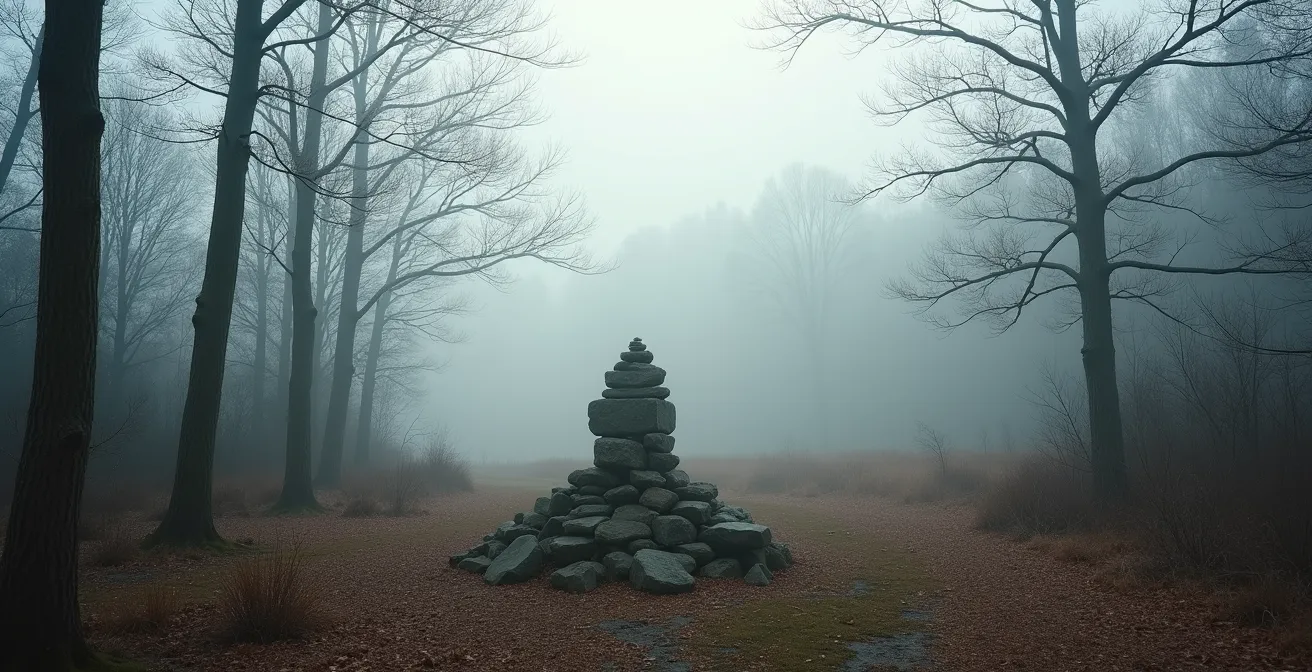
Contrary to popular belief, Southern Ontario Gothic isn’t just about ghost stories. It’s the literary echo of a specific trauma: the anxiety of Irish famine settlers, transposed onto a new, unforgiving landscape. This article unpacks how this inherited sense of displacement is the true ghost haunting Canadian literature, shaping its distinctively bleak and psychologically fraught character.
The literary landscape of Southern Ontario is often depicted as a place of stark contrasts: isolating farmhouses stand against vast, unforgiving winters, and tight-lipped communities harbour generations of unspoken secrets. This is the heartland of Southern Ontario Gothic, a genre that has given Canadian literature some of its most memorable and unsettling works. For decades, scholars and readers have pointed to the obvious influences—the harsh climate, the pioneer experience, and the importation of European ghost stories. These explanations, however, often remain on the surface.
While it’s true that Irish immigrants brought their rich folklore with them, this view misses the deeper psychological mechanism at play. What if the genre’s pervasive sense of dread isn’t just an aesthetic choice, but a direct literary inheritance? What if the key to understanding the haunted quality of this fiction lies not in the ghosts that populate the stories, but in the specific, historical trauma of displacement carried across the Atlantic by Irish settlers?
This article argues that the Southern Ontario Gothic is the literary manifestation of a transposed anxiety. It is the result of a cultural memory of dispossession, famine, and precarious survival in 19th-century Ireland being projected onto the Canadian wilderness. The deep-seated fears about land, identity, and security did not vanish upon arrival in the New World; they mutated, finding new expression in the face of a different, but equally challenging, environment. Through this lens, the genre transforms from a collection of spooky tales into a profound exploration of inherited trauma.
To understand this connection, we will explore the historical and thematic threads that bind these two worlds. We will examine the shared theme of survival, delve into the work of key authors, and see how the very landscape became a character embodying these deep-seated anxieties. This analysis will provide a new framework for interpreting this powerful Canadian literary tradition.
Table of Contents: How Irish Trauma Forged a Canadian Literary Genre
- Why Is “Survival in a Harsh Climate” a Shared Theme in Irish and Canadian Literature?
- Jane Urquhart’s Irish Roots: How Ancestry Shaped Her Historical Fiction?
- Historical Fiction vs. Reality: How Accurate Are Portrayals of Irish Settlers in Canadian Novels?
- The Landscape Mistake: How Authors Misrepresent the Irish Geography in Flashbacks
- How to Find and Support Self-Published Irish-Canadian Authors?
- Why Are “Ghost Estates” a Recurring Motif in Post-2008 Irish Novels?
- Church Records vs. Civil Registration: Understanding the Data Gap in Irish Genealogy
- How Does Contemporary Irish Literature Address the Trauma of Displacement?
Why Is “Survival in a Harsh Climate” a Shared Theme in Irish and Canadian Literature?
The theme of survival against a hostile environment is a cornerstone of both Irish and Canadian narratives, but it’s not a mere coincidence. It is a direct consequence of a massive historical migration driven by desperation. The scale of this movement is staggering; historical records show that between 1825 and 1845, 60% of all immigrants to Canada were Irish. They were not arriving as opportunistic adventurers but as refugees fleeing the cataclysm of the Great Famine and decades of rural poverty. They exchanged one form of precariousness for another, trading hunger and eviction for the brutal Canadian winter and the immense labour of clearing a wilderness.
Crucially, these immigrants arrived with a pre-existing literary framework for processing anxiety: the Irish Gothic. This tradition didn’t emerge from romanticizing medieval ruins, but from the very real fears of the Protestant Ascendancy, a minority group who felt their control over the land and the Catholic majority was perpetually under threat. Their literature is filled with crumbling Big Houses and spectral figures that allegorize a deep-seated fear of being overthrown and dispossessed. This “psychological haunting” was part of the cultural baggage carried to Canada.
When Irish settlers built their isolated log cabins in the dense forests of Ontario, they were not just battling the elements; they were re-enacting a familiar struggle for a secure foothold. The fear of starvation, the loss of home, and the shadow of death that defined their experience in Ireland were transposed onto the new landscape. The wind howling outside a cabin was not just weather; it was an echo of the wailing at a famine-era eviction. Thus, the theme of survival is not just about physical hardship; it’s about the endurance of a specific, inherited trauma in a new, and equally intimidating, setting.
Jane Urquhart’s Irish Roots: How Ancestry Shaped Her Historical Fiction?
No author better exemplifies the deep connection between Irish ancestry and Southern Ontario Gothic than Jane Urquhart. For her, this connection is not academic; it is personal. Biographical records confirm that her mother’s Irish ancestors were immigrants who arrived in Canada in the mid-nineteenth century during the Great Famine. This familial history is not just a backdrop but the very engine of her most powerful novels, such as *Away*. In her work, the past is not a distant country; it is an active, often malevolent force that shapes the present. Her characters are haunted not by literal ghosts, but by the powerful weight of memory and the unspoken stories of their ancestors.
Urquhart’s fiction is an act of literary archaeology, excavating the layers of memory embedded in the Ontario landscape. She focuses on what can be called “memory objects”—a piece of lace, a Gaelic phrase, a recurring dream—that serve as tangible links to a lost world. These fragments carry the emotional weight of the old country, grounding the abstract trauma of displacement in concrete, sensory details. The land itself becomes a repository of these memories, with a specific field or shoreline holding the psychic residue of past events.

The image of a weathered Celtic carving, its patterns eroded but still visible, serves as a powerful metaphor for this process. The stone represents the deep, ancient culture of Ireland, while its weathered surface speaks to the erosion and transformation it underwent through migration and assimilation. Urquhart’s genius lies in showing how these patterns—these deep-rooted cultural memories—persist beneath the surface of Canadian life, influencing the thoughts, fears, and destinies of her characters. Her work demonstrates that the Gothic sensibility is not just an aesthetic but a way of understanding history as a living, breathing presence.
Historical Fiction vs. Reality: How Accurate Are Portrayals of Irish Settlers in Canadian Novels?
While authors like Urquhart draw from a deep well of historical truth, it’s essential for students of literature to distinguish between artistic representation and historical fact. The reality of the Irish Famine migration was a horror that almost defies narrative. Archives from the Canadian Museum of Immigration at Pier 21 reveal that about 100,000 Irish emigrated in 1847 alone, a single year of catastrophic exodus. They fled on “coffin ships” where disease was rampant, arriving at quarantine stations like Grosse Isle as spectral figures, often the sole survivors of their families.
The Southern Ontario Gothic takes the emotional core of this experience—the profound sense of loss, isolation, and the proximity of death—and distills it into its narrative tropes. The isolated farmhouse is not just a building; it’s a symbol of the family unit’s fragile defense against an overwhelming external threat, be it a blizzard or the memory of starvation. The secrets buried by a family are often stand-ins for the collective, unspoken trauma of the Famine itself. While a novel might invent a specific family’s history, the emotional authenticity of their struggle is often deeply accurate.
For the discerning student, verifying the historical framework of a novel can be a rewarding exercise. It allows one to see precisely where an author adheres to the historical record and where they use creative license to amplify a story’s thematic resonance. This critical approach moves beyond passive reading and into active literary analysis, enriching one’s understanding of how history is transformed into art.
Action Plan: Verifying Historical Accuracy in Irish-Canadian Fiction
- Cross-reference characters with settler lists: Compare fictional family names and arrival timelines with historical documents like Peter Robinson’s Irish settlers lists from 1823-1825 to gauge authenticity.
- Investigate land acquisition narratives: Check how characters acquire land in the novel against the real processes documented in the Archives of Ontario’s land registry records.
- Examine sectarian tensions: If the novel portrays religious conflict, verify its plausibility by researching documented Orange Order activities in the specific Ontario towns mentioned.
- Validate emigration patterns: Match the fictional journey of emigration with actual passenger manifests and quarantine records from key ports and stations like Grosse Isle.
- Assess economic conditions: Compare the novel’s depiction of the settlers’ financial struggles with primary sources like the Canada Company Remittance Books (1843-1847).
The Landscape Mistake: How Authors Misrepresent the Irish Geography in Flashbacks
A common device in Southern Ontario Gothic is the flashback to Ireland, where the landscape of memory often clashes dramatically with the Canadian present. However, these literary flashbacks frequently commit a “landscape mistake.” They tend to present an idealized, romanticized version of Ireland—a land of rolling green hills, gentle mists, and quaint stone cottages. This isn’t just a failure of geographic accuracy; it’s a crucial psychological element of the genre. This idealized memory serves to heighten the brutal reality of the Canadian wilderness, making the trauma of displacement even more acute.
This idealization creates a false binary that fuels the settler’s sense of alienation. The remembered Ireland becomes a pastoral Eden, lost forever, while the Canadian landscape is cast as a purgatorial wilderness to be tamed and endured. This dynamic is a key component of the transposed anxiety. The complex social and economic hardships of Ireland are simplified into a single, romantic image, while all the attendant anxieties are projected onto the new environment, turning the landscape into an antagonist. This distinction is also rooted in the different functions of the Gothic in each country.
As critics have noted, the Irish Gothic tradition has a unique political dimension. In a piece for Travel Extra Ireland, it is highlighted how this literary form developed differently from its English counterpart:
The Irish Gothic is distinguished by its postcolonial inflection. Unlike the English Gothic, which often romanticised medieval ruins as symbols of aristocratic decay, Irish variants frequently allegorise the Protestant Ascendancy’s precarious dominion over a Catholic underclass.
– Travel Extra Ireland, How Ireland invented Gothic horror, some literary shivers for Halloween
The contrast between the remembered landscape and the experienced one is a powerful engine of Gothic fiction, starkly illustrating the psychological chasm created by emigration.
This table, based on data from historical settlement patterns highlighted by studies on Irish migration to Canada, illustrates the stark differences that fueled this literary tension.
| Aspect | Irish Memory (Idealized) | Canadian Reality (Harsh) |
|---|---|---|
| Climate | Gentle mists, soft rains | Brutal winters, extreme temperatures |
| Terrain | Rolling green hills, pastoral fields | Dense forests, rocky soil, vast wilderness |
| Settlement Pattern | Ancient villages with stone cottages | Isolated log cabins in clearings |
| Agricultural Conditions | Small but fertile plots | Large tracts requiring clearing |
How to Find and Support Self-Published Irish-Canadian Authors?
While foundational authors like Jane Urquhart and Robertson Davies define the canon of Southern Ontario Gothic, the tradition is alive and well, often thriving outside of mainstream publishing. For students and enthusiasts looking to explore contemporary expressions of the Irish-Canadian experience, the world of small presses and self-published authors offers a wealth of material. These writers are often the ones conducting the most interesting experiments with form and theme, directly engaging with the legacy of displacement in a 21st-century context.
Finding these voices requires a more proactive approach than simply browsing a chain bookstore. It involves engaging with the literary communities that nurture them. This means following specialized journals, joining academic foundations, and exploring online communities where readers and writers converge. Small presses, both in Canada and Ireland, are often the first to champion new talent that explores diasporic identity. Supporting these authors is not just an act of consumption; it’s an investment in the continued vitality and evolution of this unique literary tradition.
By seeking out these works, you gain a more complete and nuanced picture of how Irish heritage continues to shape Canadian literature. You move from the established classics to the living, breathing edge of the conversation, discovering how new generations of writers are reinterpreting the old themes of haunting, memory, and landscape for our modern times.
Your Roadmap: Discovering Contemporary Irish-Canadian Literature
- Follow specialized journals: Subscribe to publications like The Green Book: Writings on Irish Gothic, Supernatural and Fantastic Literature from Swan River Press to stay on top of new scholarship and fiction.
- Join academic networks: Explore the Canadian Association for Irish Studies (CAIS) for access to academic resources, author networks, and calls for papers.
- Engage with online reader communities: Join Goodreads groups or social media forums dedicated to Irish diaspora fiction and Canadian Gothic literature to find recommendations and discussions.
- Monitor key small presses: Keep an eye on the catalogues of publishers like Goose Lane Editions in Canada and New Island Books in Ireland, who frequently publish works on this theme.
- Use social media hashtags: Follow tags like #IrishCanadianLit, #CanLit, and #DiasporaFiction on platforms like X and Instagram to discover self-published authors and reviews.
Why Are “Ghost Estates” a Recurring Motif in Post-2008 Irish Novels?
The theme of architectural anxiety—the idea of the house as a site of psychological instability and economic ruin—is not confined to the 19th-century Canadian log cabin. It finds a powerful modern echo in contemporary Irish fiction through the motif of “ghost estates.” These are the sprawling, half-finished housing developments that litter the Irish landscape, relics of the 2008 economic crash. In the hands of modern Irish writers, these empty houses become the new Gothic castles, symbols of a different kind of dispossession: not from famine, but from failed speculative dreams.
These ghost estates are a potent symbol of a nation haunted by economic trauma. They represent a future that never arrived, a promise of prosperity that turned into a landscape of decay. The anxieties they evoke are eerily similar to those of their 19th-century counterparts: the fear of debt, the insecurity of ownership, and the chilling emptiness of an abandoned home. This demonstrates the incredible persistence of this cultural anxiety about land and property, which has been a central theme in Irish literature for centuries.
This connection shows that the Southern Ontario Gothic is not a historical artifact but part of a living, evolving literary continuum that spans the Atlantic. The specific manifestation of the anxiety changes with the times, but the underlying fear remains the same.
Case Study: Architectural Anxiety Across Centuries
Scholarly collections on Irish Gothic literature have explored this very continuum. As detailed in critical analyses, there is a direct thematic line connecting historical and contemporary anxieties. The 19th-century struggle to clear land and build a farm in the Ontario wilderness and the 21st-century speculation on housing developments in post-crash Ireland are presented as different expressions of the same deep-seated cultural fears about land, ownership, and security. Both scenarios result in a landscape dotted with “haunted” architecture—the isolated cabin or the empty suburban house—that embodies a profound sense of failure and displacement.
The ghost estate is the modern equivalent of the crumbling Big House or the isolated pioneer homestead, a physical manifestation of a national psychological crisis. It proves that the Gothic mode is a flexible and enduring tool for exploring the trauma of displacement, whether that displacement is caused by famine or financial collapse.
Church Records vs. Civil Registration: Understanding the Data Gap in Irish Genealogy
The “haunting” in Southern Ontario Gothic is not just thematic; it is also archival. For anyone trying to trace the real stories of Irish settlers, the historical record is notoriously fragmented and filled with spectral gaps. Understanding these gaps is key to appreciating why fiction so often steps in to fill the void. The most significant challenge lies in the difference between state-enforced civil registration and inconsistent church records. In Ireland, civil registration of births, marriages, and deaths only became mandatory in 1864, long after the main waves of Famine-era emigration.
Before that, survival of a record depended entirely on the diligence of individual parish priests and the physical survival of their ledgers through centuries of conflict and neglect. The 1922 fire at the Public Record Office in Dublin during the Irish Civil War was a catastrophic event, destroying centuries of genealogical data in a single blaze. This has left a profound silence in the archives, a space of unknowing that fiction often rushes to populate with stories.
Furthermore, the data is skewed by sectarian divides. As genealogical records indicate, about sixty percent of the Canadian Irish were Protestant. As part of the dominant political class, their records were often better kept and more likely to be integrated with official documentation. In contrast, Catholic records, often kept in secret during the era of the Penal Laws, were more vulnerable to being lost or destroyed. This archival silence, this inability to fully reconstruct the past, is a deeply Gothic concept. It mirrors the genre’s obsession with buried secrets and the irretrievable nature of lost histories, making the act of writing historical fiction a form of séance with the ghosts of the archives.
Key Takeaways
- Inherited Trauma is the Engine: The core of Southern Ontario Gothic is not just bleak aesthetics but the transposed psychological trauma of 19th-century Irish settlers.
- The Landscape is an Antagonist: The harsh Canadian wilderness became a screen onto which settlers projected their inherited anxieties about land, security, and survival.
- A Living Tradition: This theme of displacement and architectural anxiety continues in contemporary Irish fiction, notably with the “ghost estate” motif, linking past and present.
How Does Contemporary Irish Literature Address the Trauma of Displacement?
The trauma of displacement remains a powerful force in Irish literature, but its expression has evolved significantly. While 19th-century narratives focused on the raw, physical displacement of emigration, contemporary writers often explore a more subtle, psychological form of alienation. They grapple with what it means to be culturally displaced within a rapidly modernizing, globalized Ireland, a place that can feel alien even to those who never left. The Gothic mode has proven to be an essential tool for this exploration, providing a language to articulate these complex feelings of identity crisis.
As scholar Jarlath Killeen has argued, the Gothic has always served this function in Ireland. It provides a framework for making sense of profound societal upheaval.
Irish writers often turned to the Gothic for images and narratives which would enable them to find new ways of articulating a stable identity in the midst of tremendous change.
– Jarlath Killeen, The Emergence of Irish Gothic Fiction
This holds true today. The psychological Gothic, with its focus on internal fragmentation, unreliable memory, and identity crises, is perfectly suited to exploring the anxieties of modern Irish life. The “haunting” is no longer just an ancestor’s ghost in a crumbling house; it is the feeling of being a stranger in one’s own culture, the ghost of a past identity lingering in a present it no longer recognizes.
This evolution shows the remarkable adaptability of the Gothic. From the physical horrors of the coffin ship to the psychological alienation of the Celtic Tiger’s collapse, it provides a consistent yet flexible lens through which to examine the enduring Irish experience of displacement.
| Period | Type of Displacement | Literary Response |
|---|---|---|
| 19th Century | Physical emigration to colonies | Gothic haunting of abandoned homesteads |
| Early 20th Century | Political exile and partition | Fragmented narratives and lost identities |
| Post-2008 | Economic emigration and internal alienation | Ghost estates and failed futures |
| Contemporary | Cultural displacement within modernizing Ireland | Psychological Gothic and identity crisis |
By tracing this line from the Famine ships to the ghost estates, and from the Ontario wilderness to the modern Irish psyche, we see that Southern Ontario Gothic is not a regional anomaly. It is a vital chapter in a transatlantic story of trauma, resilience, and the enduring power of literature to give voice to the ghosts of history.
Frequently Asked Questions About Irish-Canadian Heritage and Literature
Why are there gaps in Irish church records before 1864?
Civil registration only began in 1864 in Ireland. Before this, records depended on individual parishes, many of which were destroyed during conflicts or lost in the 1922 fire at the Public Record Office.
How did the Penal Laws affect record-keeping for Irish Catholics?
The Penal Laws effectively disenfranchised Catholics both politically and economically, leading to unofficial or hidden religious ceremonies that were often not recorded in official documents.
What role do ship manifests play in filling genealogical gaps?
Ship manifests, particularly from quarantine stations like Grosse Isle, sometimes provide the only documentation of Irish immigrants, though names were often misspelled or anglicized.