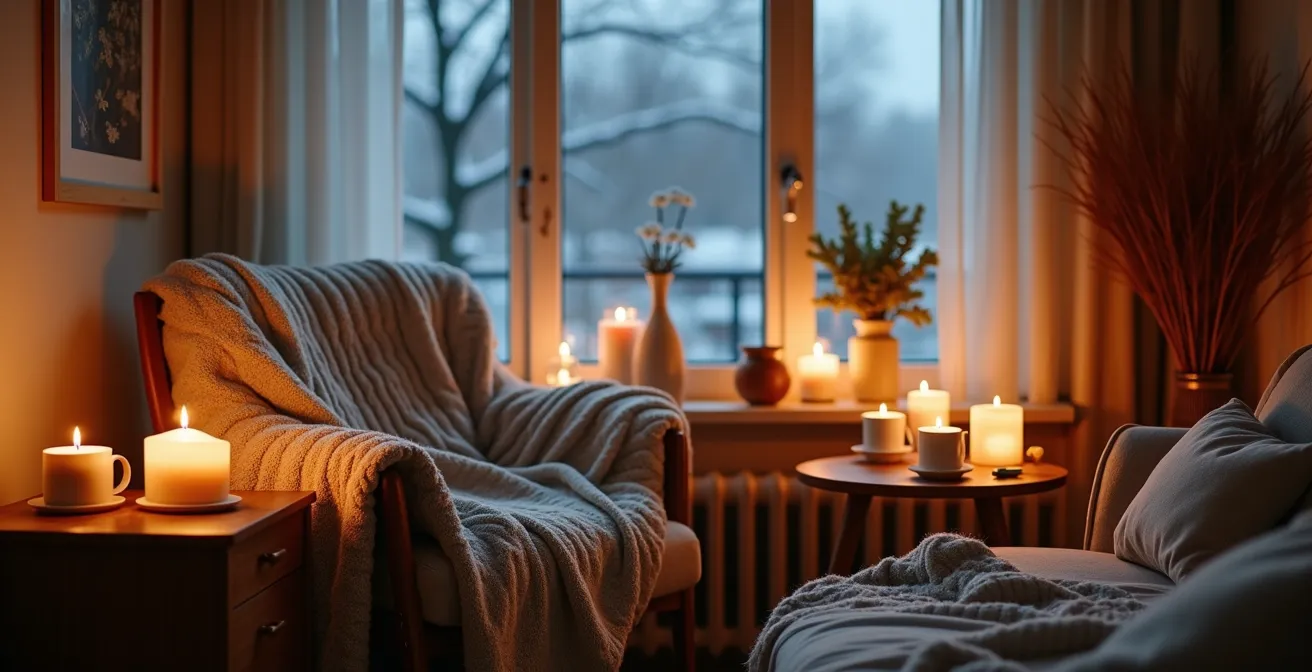
A drafty Canadian rental feels like a constant battle against the cold, but creating a ‘koselig’ sanctuary is about strategy, not just stuff.
- Master thermal layering with the right materials, like moisture-wicking wool over synthetics.
- Implement “light zoning” with specific Kelvin temperatures to fight winter darkness and support your circadian rhythm.
- Use rituals like fika and principles like friluftsliv to actively manage cabin fever and mental well-being.
Recommendation: Transform your space by focusing on these functional Nordic principles that work with your rental’s limitations, not against them.
The feeling is all too familiar for Canadian renters: a persistent, creeping chill that no amount of cranking the thermostat can seem to fix. It seeps through old window frames and under the front door, a constant reminder of the winter outside. In the face of this, the popular advice is often to simply pile on more blankets and light a few candles, chasing a generic version of “hygge.” But this approach often misses the point, especially when dealing with the damp, penetrating cold characteristic of many Canadian regions, from the Atlantic coast to the Pacific shores.
This isn’t about just adding layers; it’s about understanding the science of warmth and well-being. The Norwegian concept of koselig—a deep sense of coziness, contentment, and connection—offers a more strategic path forward. It’s not a shopping list, but a mindset. It’s about creating a functional sanctuary that actively pushes back against the cold and dark, using principles perfected in climates that understand long winters all too well.
Instead of fighting a losing battle with generic solutions, what if the key was to embrace a toolkit of Nordic wisdom? This guide moves beyond the platitudes to explore the practical, science-backed strategies behind koselig. We’ll delve into the thermal properties of materials, the psychology of light, and the power of ritual to transform your drafty rental from a place of endurance into a genuine haven of warmth and comfort.
This article will guide you through the functional principles of Nordic living, adapted specifically for the realities of a Canadian rental. From choosing the right textiles to mastering your home’s lighting and embracing the outdoors, you’ll find actionable advice to create a truly restorative space.
Summary: Creating a Cozy Sanctuary in a Drafty Canadian Rental
- Wool vs. Fleece: Which Throw Blanket Material Retains Heat Better?
- Fika Breaks: How to Implement a Coffee Ritual in a High-Stress Office?
- Friluftsliv: How to Enjoy the Outdoors When It’s Raining Sideways in November?
- The “Lagom” Schedule: How to Say No to Overcommitment?
- Comfort Food: Why Is Porridge the Ultimate Nordic Breakfast for Energy?
- Optimizing Your Home Lighting for Short Winter Days: Lessons from Galway
- Kelvin Scale: Why Should You Never Use 5000K Bulbs in the Living Room?
- How to Use “Biophilic Design” to Combat Cabin Fever in Small Apartments?
Wool vs. Fleece: Which Throw Blanket Material Retains Heat Better?
When the air is damp and chilly, not all blankets are created equal. The default choice for many is a soft, synthetic fleece throw, but for the specific challenge of a drafty, humid environment, this can be a mistake. The key to true thermal comfort lies in moisture management, and this is where wool proves its superiority. Fleece, being a plastic-based textile, does not breathe well. It can trap a thin layer of perspiration against your skin, leading to a clammy, cold feeling even under the blanket.
Wool, on the other hand, is a master of thermoregulation. It is a natural, breathable fiber with an incredible capacity for managing moisture. In fact, research shows that wool can absorb up to 30% of its weight in moisture without feeling wet to the touch. It actively wicks dampness away from your body and allows it to evaporate, keeping you dry and, therefore, much warmer. This is particularly crucial in coastal Canadian climates where humidity remains a factor even in winter.
Investing in a quality wool blanket, like those traditionally made in Atlantic Canada, isn’t just about adding a layer; it’s about deploying a piece of thermal technology. The natural lanolin content in virgin wool adds a layer of water resistance, and the crimp of the fibers creates millions of tiny air pockets that trap body heat far more effectively than the flat structure of fleece.
This table breaks down the key differences, showing why wool is the strategic choice for a drafty rental.
| Property | Wool | Fleece |
|---|---|---|
| Insulation when wet | Maintains warmth | Loses insulating properties |
| Moisture management | Wicks moisture naturally | Can feel clammy |
| Breathability | Excellent temperature regulation | Limited breathability |
| Fire resistance | Naturally flame retardant | Highly flammable |
| Static electricity | Does not retain static | Builds static charge |
So, while a fleece blanket might offer a feeling of initial softness, a wool throw is a long-term investment in genuine, breathable warmth—an essential first step in building your koselig fortress.
Fika Breaks: How to Implement a Coffee Ritual in a High-Stress Office?
In the modern work-from-home era, the lines between office and sanctuary have blurred, especially when you’re cooped up in a small apartment all winter. The Swedish tradition of fika offers a powerful antidote. It’s often translated as a “coffee and cake break,” but it’s fundamentally a social ritual: a mandated, intentional pause designed to foster connection and mindfulness. In a high-stress environment, implementing fika is not about another task on your to-do list; it’s about reclaiming your time and mental space.
The key is to create a physical and mental separation from your workspace. Even in a small rental, designate a specific “Fika corner”—a comfy chair away from your desk, perhaps by a window. This ritual is about deliberately stepping away from the screen and the pressures of productivity. It’s a moment to savor a warm drink and a small treat, allowing your mind to downshift. As Swedish Michelin-starred chef Magnus Nilsson notes, these moments are crucial for socializing and decompressing.

As you can see, creating this separation doesn’t require a lot of space, just intention. The act of preparing a quality beverage, arranging a pastry on a plate, and sitting in a different spot signals to your brain that it’s time to rest. This structured pause can prevent burnout and, paradoxically, make the hours you do work more focused and productive. It’s a small act of self-care that builds a rhythm of rest into an otherwise relentless day.
Your Fika Implementation Plan
- Schedule the Break: Set a fixed time in your calendar, like 10 a.m. and 3 p.m., to create a consistent routine.
- Designate a Zone: Choose a comfortable spot away from your desk, even if it’s just a single armchair, to be your dedicated Fika corner.
- Go Analog: Put your phone away, close the laptop, and remove all digital distractions. This time is for a mental reset.
- Prepare the Ritual: Use a favorite mug and plate. The quality of the experience matters more than the snack itself.
- Connect or Reflect: If possible, share the moment with a housemate or a quick video call with a colleague. If alone, use the time for quiet reflection.
By integrating fika into your day, you’re not just taking a break; you are cultivating a moment of koselig, a small, warm island of peace in the midst of a stressful workday.
Friluftsliv: How to Enjoy the Outdoors When It’s Raining Sideways in November?
Cabin fever is a real affliction in the depths of a Canadian winter, especially when you’re confined to a small rental apartment. The natural instinct is to hide from the grim weather, but the Nordic philosophy of friluftsliv (literally “free air life”) offers a radical alternative: embrace it. This isn’t about embarking on epic arctic expeditions; it’s about changing your mindset towards the outdoors and recognizing that a small dose of nature, in any weather, is essential for mental well-being.
The core of this philosophy is perfectly captured by a famous Norwegian proverb, which insists that attitude and preparation are everything.
There is no such thing as bad weather, only bad clothing!
– Norwegian proverb
Applying this to life in a Canadian city means redefining what “going outside” looks like. It doesn’t have to be a two-hour hike. It can be a 15-minute “micro-dose” of the outdoors. A brisk walk around the block on a blustery day, focusing on the feeling of the wind on your cheeks. A moment spent storm-watching from a sheltered balcony or park bench. Even just stepping outside to feel the rain for a minute can break the monotony and reset your senses. The goal is to punctuate your day with fresh air and natural light, however bleak it may seem.
For renters, this means actively seeking out the small pockets of nature available to you. Scour Google Maps for a nearby parkette you’ve never visited. Take your next phone meeting while walking around your neighbourhood, bundled up against the elements. The key is to make these outdoor moments a non-negotiable part of your routine, just like brushing your teeth. It’s about fighting the inertia that keeps you indoors and recognizing that your apartment feels much more koselig when you have a real reason to come back in from the cold.
This shift in perspective transforms the weather from an enemy to be defeated into a dynamic part of your environment, making your cozy apartment a true refuge to return to.
The “Lagom” Schedule: How to Say No to Overcommitment?
While koselig is about creating a feeling of abundance in comfort, its Swedish cousin, lagom, is about finding the beauty in “just enough.” In a world that glorifies “hustle culture,” lagom is the gentle art of moderation, balance, and sustainability. For someone trying to create a peaceful sanctuary at home, this principle is most powerfully applied to your schedule. A koselig home is impossible to enjoy if you are constantly stressed, overcommitted, and rushing.
Saying “no” is a core tenet of the lagom schedule. It’s about recognizing your finite energy and protecting it fiercely. In a Canadian winter, when energy levels naturally dip due to less sunlight and colder temperatures, this becomes a critical survival skill. It means auditing your commitments—both social and professional—and asking, “Is this truly necessary? Does this bring me joy or drain my resources?”
Practicing lagom means scheduling “nothing” into your calendar. Block out evenings with no plans other than to read a book, listen to music, or simply exist in the cozy space you’ve created. It means resisting the urge to fill every moment with productivity or social activity. This isn’t about being lazy or antisocial; it’s a strategic allocation of energy. It’s understanding that rest is not a reward for hard work, but a necessary component of it.
This principle extends to your digital life. A lagom approach means setting firm boundaries with notifications, emails, and social media. It might mean designating “no-screen” hours in the evening to allow your mind to unwind. By curating your time and commitments as carefully as you curate your living space, you create the mental quiet needed for a true sense of koselig to flourish. You can’t import coziness if your mind is still cluttered with a thousand obligations.
Ultimately, a lagom schedule ensures you have the time and mental bandwidth to actually inhabit and enjoy the warm, restorative environment you’re working so hard to build.
Comfort Food: Why Is Porridge the Ultimate Nordic Breakfast for Energy?
The feeling of koselig often starts from within, and on a dark, cold Canadian morning, nothing sets the tone quite like a warm, nourishing breakfast. While sugary cereals or a quick piece of toast might be tempting, the Nordic tradition points to a more powerful and sustained source of energy: porridge. This humble dish of cooked oats is the ultimate comfort food for a reason, and the science behind it is key to understanding its place in a koselig lifestyle.
The power of porridge lies in its composition. Oats are a complex carbohydrate, meaning they are packed with slow-release energy. Unlike the quick spike and subsequent crash you get from simple sugars, the energy from porridge is distributed steadily over several hours. This prevents the mid-morning slump and provides the sustained fuel your body needs to stay warm and your brain needs to stay focused. It’s the physiological equivalent of a slow-burning log in a fireplace, providing consistent warmth and power.
The ritual of preparing porridge is also inherently koselig. The act of slowly stirring the oats on the stove, watching them thicken, and inhaling the warm, earthy scent is a mindful, grounding start to the day. It’s a moment of deliberate creation in a warm kitchen before you have to face the cold world outside. Customizing your bowl with toppings like cinnamon (which helps regulate blood sugar), berries (for antioxidants), or a drizzle of maple syrup (a classic Canadian touch) transforms it from a simple meal into a personal moment of comfort.

This simple breakfast is more than just food; it’s a strategic tool. Starting your day with a foundation of sustained energy makes you more resilient to both the physical cold and the mental challenges of a long winter day. It’s a small, delicious act that has a profound impact on your overall sense of well-being.
By embracing this Nordic breakfast staple, you’re not just eating; you’re arming yourself with the energy needed to thrive, making your entire day feel more balanced and comfortable.
Optimizing Your Home Lighting for Short Winter Days: Lessons from Galway
One of the biggest challenges of a Canadian winter is the darkness. The short days and long nights can have a significant impact on mood and energy levels. In places with similarly damp, grey winters, like Galway, Ireland, mastering interior lighting is not just a matter of design; it’s a matter of well-being. The key is to move beyond a single, harsh overhead light and create strategic “light zones” that support your body’s natural circadian rhythm.
The first rule is to use multiple, low-level light sources. Instead of illuminating the entire room with one fixture, create intimate “pools of light” using table lamps, floor lamps, and task lighting. This creates contrast, depth, and a sense of intimacy that is central to koselig. Place a reading lamp by a comfy chair, a small lamp on a side table, and another on a bookshelf. This approach allows you to tailor the light to your activity and mood.
Secondly, pay close attention to the warmth of your light bulbs, measured on the Kelvin scale. During the day, and especially in work areas, a neutral light around 4000K can help with focus. However, as evening approaches, it’s crucial to shift to warmer hues. Harsh, blue-toned light in the evening can disrupt your body’s production of melatonin, the hormone that regulates sleep. In fact, research indicates that using 5000K light at night suppresses melatonin, making it harder to wind down and rest properly.
For a truly koselig atmosphere in living areas and bedrooms, aim for bulbs in the 2200K to 2700K range. This is the colour of candlelight or a sunset, and it sends a powerful signal to your brain that it’s time to relax. Smart bulbs are a renter’s best friend here, as they can be programmed to automatically shift from cooler tones during the day to warm, amber light in the evening. Finally, maximize what little natural light you have by placing a large mirror on the wall opposite your main window. It will bounce light around the room, making the space feel brighter and larger, even on the greyest of days.
This conscious use of light does more than just make your apartment look nice; it actively supports your mental and physical health through the long winter months.
Kelvin Scale: Why Should You Never Use 5000K Bulbs in the Living Room?
Understanding the Kelvin (K) scale is perhaps the single most impactful, low-cost change a renter can make to transform their apartment’s atmosphere. Think of it as the “temperature” of light, not in terms of heat, but in colour. A low Kelvin number signifies a warm, yellowish-orange light (like a flame), while a high number indicates a cool, bluish-white light (like a clear noon sky). Using the wrong Kelvin temperature in the wrong space can sabotage any attempt at a koselig feeling.
A 5000K bulb, often marketed as “daylight,” is intensely blue-toned and clinical. This type of light is excellent for tasks requiring high concentration and colour accuracy, such as in a workshop, a hospital, or a design studio. It mimics the bright, energetic light of midday, which is why it’s so effective at promoting alertness. However, having that same stimulating light in your living room in the evening is a recipe for disaster. It creates a sterile, unwelcoming environment that feels more like an office than a sanctuary.
More importantly, as we’ve seen, this blue-spectrum light actively interferes with your biology. It signals to your brain that it’s still the middle of the day, suppressing melatonin production and making it difficult to transition into a restful state. This can lead to poor sleep quality and a general feeling of being “wired” and unsettled. Essentially, a 5000K bulb in your living room is telling your body to be wide awake when you’re trying to relax.
For a living room, bedroom, or any space intended for relaxation, the goal is to replicate the warm, gentle light of sunset. This means choosing bulbs with a Kelvin rating between 2200K and 3000K. – 2200K: The colour of a vintage Edison bulb or candlelight. Extremely warm and intimate, perfect for a cozy reading nook or accent lamp. – 2700K: The standard for “warm white.” It’s inviting and comfortable, ideal for general living room and bedroom lighting. – 3000K: A slightly crisper warm white. A good middle-ground for kitchens and bathrooms where you want a welcoming feel but slightly more clarity.
By consciously choosing warm-toned bulbs for your relaxation zones, you are taking direct control of your home’s emotional and biological impact, creating a true haven for rest.
Key takeaways
- True warmth in a drafty rental comes from moisture-wicking materials like wool, not just insulation.
- Creating “light zones” with specific, warm Kelvin temperatures (2200-2700K) is crucial for relaxation and sleep.
- Nordic principles like fika, friluftsliv, and lagom are not just aesthetic but are functional tools for managing stress, cabin fever, and energy.
How to Use “Biophilic Design” to Combat Cabin Fever in Small Apartments?
When you’re stuck inside for long stretches, the sterile, right-angled world of an apartment can start to feel oppressive. Biophilic design is the practice of connecting with nature from within our built environments, and it’s a powerful tool against the winter blues, also known as cabin fever. It’s based on the idea that humans have an innate tendency to seek connections with nature. Fulfilling this need is essential for our psychological well-being, especially when the weather makes it hard to get outside.
This goes far beyond simply buying a few houseplants (though that is an excellent start!). It’s about incorporating natural patterns, textures, and materials into your living space. Swap out a plastic bathmat for one made of bamboo or stone. Choose a wool blanket with its natural texture over a synthetic one. Use wooden cutting boards and ceramic bowls in the kitchen. These small points of contact with natural materials ground us and provide a subtle, sensory richness that man-made materials lack.
Patterns are another key element. Look for textiles—cushions, rugs, or curtains—with patterns that mimic nature, such as leaves, waves, or floral prints. Even artwork depicting landscapes can have a restorative effect. The goal is to break up the monotony of flat, painted walls with the organic complexity found in the natural world. This connection to nature became even more vital during periods of isolation, as a contributor to Lonely Planet observed.
When society was shut down in March, nature was open, 24/7. Nature is where we went to disconnect from daily stress, uncertainty and crammed apartments – demonstrating how biophilic connection becomes even more crucial during isolating winter months.
For renters, biophilic design offers a wealth of non-permanent solutions. Use removable wallpaper with a botanical print on an accent wall. Bring in a small tabletop water fountain for the soothing sound of running water. Forage for pinecones, stones, or branches on your short walks and arrange them in a bowl on your coffee table. These small acts weave the essence of the outdoors into the fabric of your home, making it feel less like a box and more like a natural shelter.
By intentionally curating these connections to the natural world, you create a space that is not only visually appealing but also deeply restorative to your mind and spirit.