In summary:
- Focus your budget on a skilled caller; they are the most critical element for a beginner-friendly event.
- Use a curated Spotify playlist instead of a live band to save money without sacrificing energy.
- Design the event schedule to maximize social interaction, especially during the tea break.
- Actively recruit beyond your usual circle by making your event explicitly welcoming to all, regardless of experience or heritage.
- Choose your venue based on the floor surface—a key detail that can make or break the night.
There’s a magic that happens when people come together, a spark that flies in a room filled with music and laughter. As a community organizer, you’re constantly searching for that spark—an event that doesn’t just entertain but genuinely connects people. You’ve likely considered potlucks, movie nights, or game tournaments. But what if the most powerful tool for building community is a centuries-old tradition that gets everyone, and I mean everyone, on their feet?
A céilí (pronounced ‘kay-lee’) is an Irish social dance event, a world away from a ‘session’ where musicians play for each other. The céilí is all about participation. It’s structured, guided, and designed for beginners. The common advice for hosting one often involves finding a great band and a big hall, which can quickly make a small budget feel impossible. But what if the secret to a truly successful, soul-lifting céilí wasn’t about spending more, but about spending smarter? What if the “scrappiness” of a sub-$500 budget was actually a strategic asset, forcing you to focus on what truly matters: the social architecture of the event.
This guide is built on that very principle. We’ll break down how to make strategic, low-cost choices that don’t just save money, but actively amplify the social connection that makes a céilí so special. It’s not about cutting corners; it’s about building an engine of connection, one dance step at a time.
For those who prefer a visual introduction, the following video captures the vibrant energy and spirit of a traditional céilí, perfectly complementing the practical advice in this guide.
This article will guide you through the essential strategic decisions you’ll face. We’ll cover everything from managing the music and the absolute necessity of a caller, to subtle details like floor surfaces and break timing, all designed to help you create a memorable and inclusive event on a shoestring budget.
Summary: Your Guide to a Budget-Friendly Céilí
- Why Are Céilí Dances the Best Ice-Breakers for New Community Groups?
- Live Band vs. Spotify Playlist: How to Manage Music for a Céilí on a Budget?
- Caller vs. No Caller: Why You Absolutely Need an Instructor for a Beginner Crowd
- The Floor Surface Mistake That Can Ruin Your Dance Event
- Timing Your Céilí: When to Schedule the Tea Break to Maximize Socializing?
- Traditional vs. Celtic Rock: Which Lineup Strategy Sells More Tickets?
- The Selection Bias: How to Recruit Participants Beyond the “Usual Suspects”?
- How to Organize a Profitable Celtic Music Festival in a Small Canadian Town?
Why Are Céilí Dances the Best Ice-Breakers for New Community Groups?
A céilí is more than a dance; it’s an engine of connection. Unlike other social events where people can remain in their familiar cliques, a céilí is structured to gently dismantle social barriers. The very format of the dances—longways sets, circles, and squares—requires participants to interact with multiple people. You’re constantly changing partners, moving up and down the set, and sharing a smile with a stranger. It’s a structured, low-pressure way to meet half the room in a single song.
The secret is that the dance itself provides the script for the interaction. There’s no need for awkward small talk. The shared goal is simply to get through the dance together, and the inevitable missteps become moments of shared laughter, not embarrassment. This creates what we can call a high participation dividend; the value comes from the collective, joyful effort, not from flawless execution. It’s a space where expertise gaps dissolve. As demonstrated by the Notre Dame Céilí Band’s model, you can have All-Ireland champions and complete novices in the same room, all contributing to the same vibrant energy.
This built-in inclusivity is its superpower. The message “no partner needed, no experience required” is fundamental. It removes the two biggest fears that keep people glued to their chairs. When a community group is new or trying to integrate newcomers, a céilí provides a “frictionless welcome,” an activity where everyone starts on a level playing field. It’s no surprise that some first-time community céilís can draw over 400 attendees, proving the powerful appeal of a truly open social event.
Ultimately, a céilí doesn’t just ask people to be in the same room; it gives them a fun, collaborative project to do together, forging bonds far more effectively than any mixer ever could.
Live Band vs. Spotify Playlist: How to Manage Music for a Céilí on a Budget?
The music is the heartbeat of a céilí, and the question of a live band versus a recorded playlist is often the biggest budget decision you’ll make. A great live band is an incredible experience, but they can easily consume your entire $500 budget and more. For a community event focused on beginners and social connection, this is not a strategic use of your limited funds. The answer, for the ingenious organizer, is a well-curated Spotify playlist combined with a good speaker system.
This isn’t a “lesser” option; it’s a smarter one. A playlist gives you total control over the tempo and type of tune. For a beginner crowd, you need reels and jigs played at a steady, moderate pace—not at the lightning-fast speed of a performance-oriented band. You can carefully select tracks that are clear, rhythmic, and the correct length for teaching. Bands like The Kilfenora Céilí Band, the Tulla Céilí Band, or Canada’s own The Bards are excellent sources for playlist-ready tracks.
By saving hundreds of dollars on a band, you free up funds for the single most important element: the caller. Furthermore, this keeps your ticket price incredibly accessible. Many standard community céilí events charge around $10 for adult admission, with discounts for youth, a price point made possible by avoiding the high cost of a live band. This low barrier to entry is critical for attracting the diverse crowd you’re hoping to build.
Think of it as strategic scrappiness. You’re not just cutting a cost; you are reallocating that resource to the part of the event that delivers the highest social return on investment. A good playlist is perfectly effective, while a great caller is utterly essential.
Caller vs. No Caller: Why You Absolutely Need an Instructor for a Beginner Crowd
If you take only one piece of advice from this guide, let it be this: do not skimp on the caller. A caller (or dance instructor) is the pilot of your entire event. They are the single most critical investment you will make. Trying to host a beginner céilí without a caller by using YouTube videos or just letting people “figure it out” is a recipe for confusion, frustration, and an empty dance floor after two songs.
The caller’s job is not just to shout instructions. They are the architect of the social experience. A good caller can:
- Translate the Dance: They break down complex movements into simple, clear language, often avoiding jargon.
- Build Confidence: They walk everyone through the dance multiple times without music, ensuring everyone feels capable before the tune starts.
- Create a Safe Space: They turn mistakes into moments of shared laughter, reminding everyone that the goal is fun, not perfection.
- Manage the Floor: They are experts at spotting and gently encouraging “wallflowers” to join in, ensuring no one is left behind.
As the Notre Dame Céilí Band’s events page promises, the key is that “All dances will be called and taught, and no previous experience is required!” This promise is delivered entirely by the caller.
This is where the money you saved on a live band should go. A good caller might cost between $150 and $300, making them your biggest expense, but also your most valuable asset. They are the difference between a chaotic gathering and a truly magical, inclusive social dance.

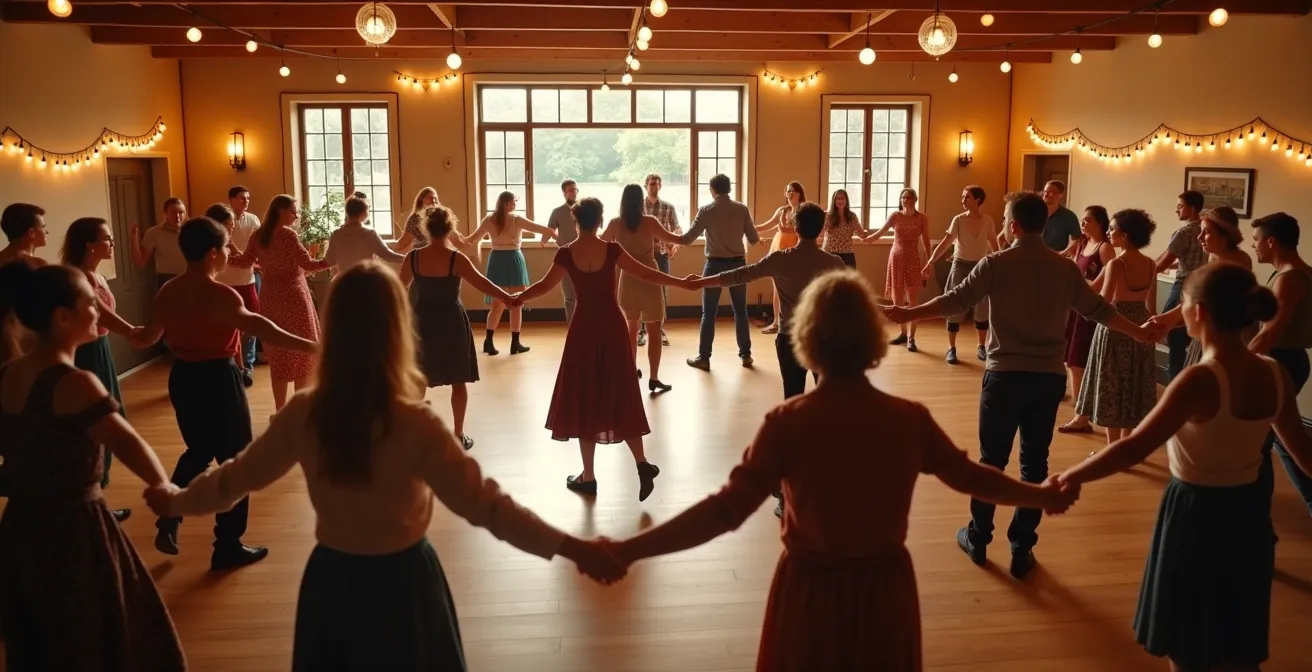
Look at the focus and joy in the image above. That connection is facilitated by a human guide who can adapt in real-time to the energy of the room. The caller is your quality control, your host, and your community-builder all in one. Find a good one by asking for recommendations from local Irish or Scottish cultural societies or dance groups.
In the architecture of a successful céilí, the caller is the foundation. Every other choice is built upon the confidence and structure they provide.
The Floor Surface Mistake That Can Ruin Your Dance Event
You’ve got the music, you’ve booked the caller, and people are excited. But there’s a silent partner in your event’s success or failure: the floor. Choosing a venue with the wrong type of floor is one of the most common and disastrous mistakes an organizer can make. It’s not just about aesthetics; it’s about safety, comfort, and the very ability to perform the dance steps.
Céilí dancing involves a lot of sliding, stepping, and turning. A surface with too much grip (like carpet) can be a major trip hazard and is murder on the knees. A surface that’s too slick (like highly polished concrete or linoleum) can lead to slips and falls. The ideal surface is a sprung hardwood floor, which has the perfect combination of slide and grip while providing cushioning for the joints. This is why so many community dances are held in older legion halls, Masonic lodges, or church basements—they often have beautiful, well-maintained wood floors.
Before you book any hall, inspect the floor personally. Don’t take anyone’s word for it. The Céilí of the Valley Society, for example, successfully hosts events at a VFW Hall, a testament to how finding the right pre-existing community space is key. When you promote the event, you can also offer advice on footwear. Suggesting closed-toe shoes with a smooth, non-rubber sole can help participants adapt to a less-than-ideal floor. Definitely advise against high heels or heavy boots.
This table gives a clear breakdown of what to look for and what to avoid. It shows how a seemingly small detail has a major impact.
This handy guide, based on an analysis from experienced dance organizers, can help you evaluate potential venues.
| Surface Type | Grade | Safety Rating | Cost to Remedy |
|---|---|---|---|
| Sprung Hardwood | A+ | Excellent – knee protection, ideal grip | N/A – ideal surface |
| Polished Wood | B | Good – may need slight wax adjustment | $20-30 dance wax |
| Linoleum/Marmoleum | C | Acceptable – can be slippery | $30-40 rosin/talcum powder |
| Polished Concrete | D | Poor – hard on joints, variable grip | $100+ for temporary flooring |
| Carpet | F | Unacceptable – trip hazard, no slide | $200+ cardboard/plywood overlay |
Paying attention to this detail won’t just prevent injuries; it will enable your guests to dance with more confidence and joy, which is the entire point of the evening.
Timing Your Céilí: When to Schedule the Tea Break to Maximize Socializing?
The structure of the evening—its pacing and flow—is a core part of your event’s social architecture. A common mistake is to treat the break as a simple afterthought. But for an ingenious organizer, the tea break is a powerful, intentional tool for deepening social connections. The question isn’t just *if* you should have a break, but *when* you should have it to achieve the maximum social benefit.
Don’t schedule it too early; people are just warming up. Don’t schedule it too late; people will be exhausted and ready to leave. The sweet spot is about 60-90 minutes into the event. By this point, you’ve done a few simple, high-energy dances like the Walls of Limerick. People have broken a sweat, shared a few laughs with strangers, and are feeling a sense of accomplishment. They are primed for conversation. This is when you announce the break for tea, coffee, and snacks.
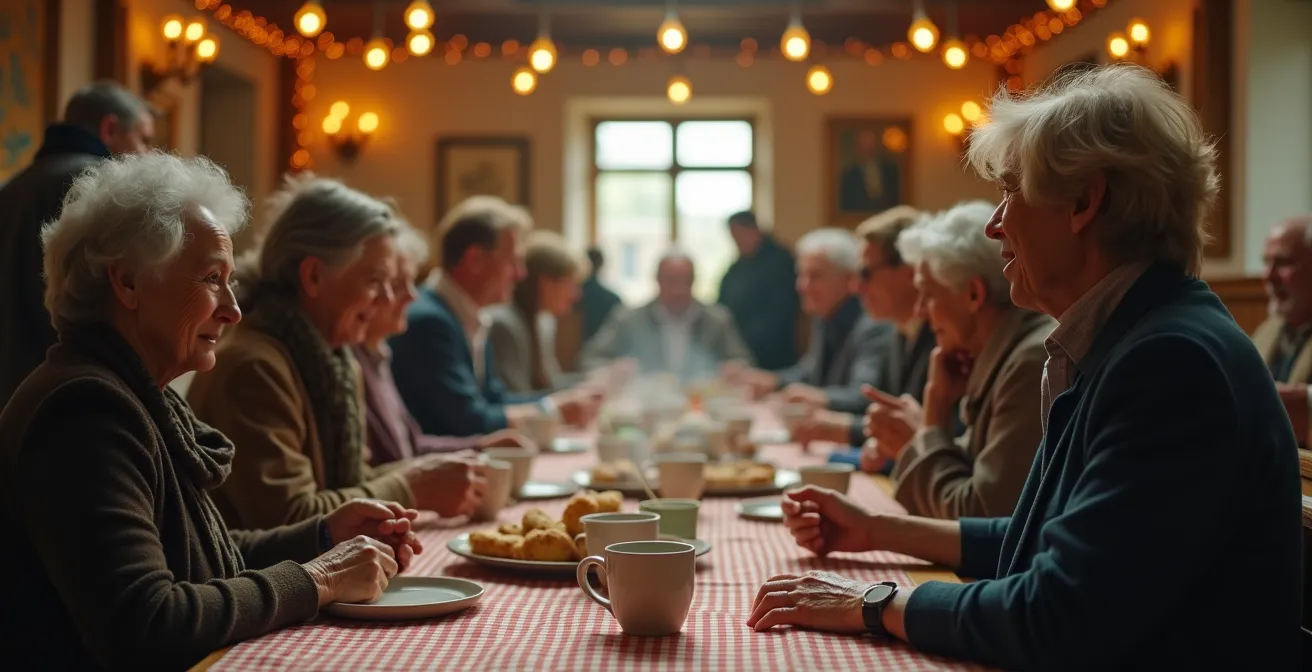
This break is where the connections forged on the dance floor are solidified. The conversation is no longer “Which way do we go now?” but “Where are you from?” or “Wasn’t that fun?” It’s a chance for people to catch their breath, rehydrate, and chat with their new acquaintances in a relaxed setting. Having a table with simple, complimentary refreshments (a cost easily covered in your $500 budget) creates a natural gathering point. This moment is just as important as the dancing itself for your community-building goals.
Successful community céilís often run for about 3 to 3.5 hours. For example, a common schedule might be a lesson at 7:45pm followed by dancing until 11pm. A break around 9:00pm fits perfectly into this flow. As most successful community céilís run for a similar duration, this structure is a proven model for maintaining energy and engagement throughout the night.
Your 3-Act Céilí Evening Structure
- Act 1 (First 60-90 minutes): Start with a brief lesson on basic steps, followed by 2-3 simple, high-energy dances to get everyone moving and comfortable.
- Act 2 (The 30-minute break): Announce the tea break. Use this time for community announcements or even a short solo performance (like a song or a step-dance) to entertain people as they mingle.
- Act 3 (Final 60 minutes): Return to the floor for slightly more complex (but still accessible) dances, building to a well-known, high-energy finale like the Siege of Ennis to end the night on a high.
By thoughtfully timing your break, you transform it from a simple pause into a central feature of your community-building engine.
Traditional vs. Celtic Rock: Which Lineup Strategy Sells More Tickets?
When curating your playlist, you’ll face a choice: stick to purely traditional tunes or mix in some contemporary Celtic rock and fusion? While your personal taste might lean one way, the strategic choice depends on your primary goal. If you aim to build the widest possible coalition of newcomers, a “gateway song” strategy can be incredibly effective.
This approach involves starting with music that feels familiar to a broader North American audience. For a Canadian crowd, this could mean dropping a well-known reel from a band like Great Big Sea. In an Irish or American context, a track from The Pogues or Flogging Molly could serve the same purpose. These familiar sounds act as an auditory welcome mat, signaling to newcomers that this event is for them, too. It lowers the perceived cultural barrier and makes the traditional music that follows feel more accessible.
The key is balance. You can start with a crossover piece, then move into a set of pure, traditional jigs and reels for the core dancing, and end the night with another high-energy fusion piece. This strategy respects the tradition while actively inviting in a wider audience. However, it’s important to note that a purely traditional approach, when done well, is also a proven model for success. The Portland Irish community’s monthly céilís, featuring skilled traditional musicians, demonstrate that authenticity itself is a powerful draw for a dedicated community.
For a first-time community event under $500, the hybrid approach is often the wisest bet. It maximizes your chances of attracting a large, diverse crowd, which in turn generates the energy and ticket sales needed to make the event a sustainable success.
The Selection Bias: How to Recruit Participants Beyond the “Usual Suspects”?
One of the biggest challenges in community organizing is breaking out of our own bubble. It’s easy to create an event that only attracts people who are already “in the know”—the same faces you see at every gathering. A successful céilí, however, depends on actively recruiting a diverse mix of ages, backgrounds, and experience levels. This requires a conscious strategy to create a frictionless welcome, removing every possible barrier to participation.
It starts with your messaging. Every flyer, social media post, and email must explicitly state the magic words: “No partner needed. No experience required. All are welcome.” You have to assume people will feel anxious about coming alone or not knowing the steps. Your job is to preemptively soothe that anxiety. The Céilí of the Valley Society’s mission statement puts it perfectly:
Céilí of the Valley Society is open to everyone, Celtic heritage or not. All activities are inclusive. We welcome all people.
– Céilí of the Valley Society, Organization Mission Statement
Next, your outreach needs to be hyper-local and targeted. Go beyond just posting on your own Facebook page. Put up flyers at the public library, the local community center, and university international student associations. Partner with newcomer welcome centers or ESL programs. Reach out to other local cultural organizations for cross-promotion. Your pricing structure is also a powerful outreach tool. Research shows that successful inclusive pricing models charge around $10 for adults, $5 for students, and let children in for free. This signals that you are serious about being a family-friendly, multi-generational event.
By making your welcome explicit and your outreach broad, you transform your céilí from a niche cultural event into a true community-wide celebration.
Key takeaways
- The caller is your most critical investment; their skill determines the success of a beginner-focused event.
- Strategic scrappiness—like using a playlist to fund a great caller—is the key to a successful budget céilí.
- Inclusivity must be an active strategy, embedded in your messaging, pricing, and outreach to attract participants beyond your immediate circle.
How to Organize a Profitable Celtic Music Festival in a Small Canadian Town?
While your immediate goal is a single, successful céilí for under $500, it’s wise to think of this event as a seed. A recurring, well-loved community céilí is the perfect foundation for something much bigger, like an annual Celtic festival. The key is shifting from a one-off event mindset to a sustainable, revenue-positive model. Profitability isn’t about getting rich; it’s about creating a self-sustaining event that can grow year after year.
The first step is building a loyal base. As shown by Salem’s Céilí of the Valley, starting with consistent, low-cost weekly or monthly classes and dances builds the community and the audience needed for a larger annual festival. Your initial $500 céilí is your proof of concept. If it’s a success, you can immediately plan the next one, creating a series. This is where you can begin to diversify your revenue beyond just ticket sales.
Consider a “Pay-What-You-Can” model with a suggested donation to remain inclusive while potentially increasing per-person revenue. You can also look into micro-sponsorships from local businesses ($100-200 each) who want to be associated with a positive community event. As you grow, you can also explore grant funding. In Ireland, for instance, community organizations can access grants ranging from €5,000-25,000. Similar local, provincial, and federal grants for arts and culture exist across Canada—they just require some research and a proven track record, which your initial céilís will provide.
This table outlines some of the financial models you could adopt as you scale up your event from a single céilí into a recurring series or festival.
As you plan for growth, this comparative analysis of revenue models for sustainable céilí series can provide a valuable roadmap.
| Revenue Model | Typical Amount | Pros | Cons |
|---|---|---|---|
| Fixed Ticket Price | $15-25/person | Predictable revenue | May exclude some participants |
| Pay-What-You-Can | $10-15 suggested | Inclusive, builds goodwill | Unpredictable revenue |
| Membership Model | $25/month | Recurring revenue | Requires ongoing value |
| Micro-Sponsorships | $100-200 per sponsor | Community investment | Requires outreach effort |
Your first $500 céilí is the most important step. By running it with strategic ingenuity and a focus on social connection, you’re not just throwing a party; you’re planting an oak tree that can grow into a cornerstone of your town’s cultural life.