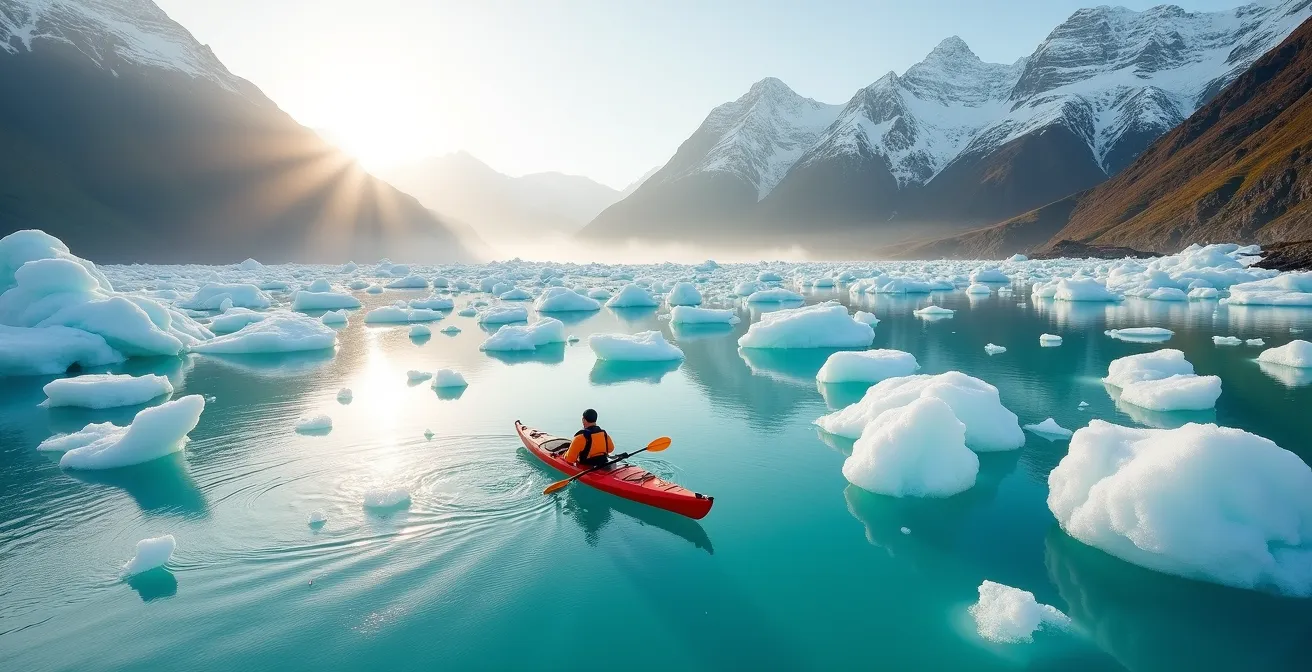
The primary danger of glacial lake kayaking isn’t slow-onset hypothermia, but the instant, deadly “gasp reflex” of cold water shock.
- A thick wetsuit is insufficient; only a drysuit provides meaningful survival time against incapacitation.
- Standard rescue skills, like rolling, often fail due to rapid muscle failure in freezing water.
Recommendation: Your survival depends less on enduring the cold and more on preventing immersion and managing the first 60 seconds if you do go in.
Picture it: a mirror-still, turquoise lake at the foot of a towering glacier in the Canadian Rockies. The scene is silent, majestic… and lethally cold. Many kayakers, even experienced ones, think they’re prepared. They pack layers, a thick wetsuit, and tell themselves they’ll just paddle hard to stay warm. They worry about hypothermia, that slow, creeping chill that sets in over time.
But what if I told you, as a certified instructor, that hypothermia is rarely the killer in these situations? The real threat is a series of rapid, counter-intuitive physiological traps—like the involuntary gasp for air that can drown you in seconds, or the muscle failure that renders your rescue skills useless long before you feel truly cold. These dangers are particularly acute whether you’re navigating the meltwaters of British Columbia or the cold northern Atlantic off the coast of Ireland.
This guide goes beyond the basic advice. We will dissect the science of cold shock, explain why a drysuit is a non-negotiable investment, and reveal the critical mistakes that even experts make. The goal is to equip you with the knowledge to paddle these magnificent landscapes with respect, not fear.
To help you navigate these critical safety topics, this article is structured to build your knowledge from the most immediate dangers to long-term preparation. Here is what we will cover.
Summary: A Guide to Safe Kayaking in Glacial Waters
- Why Is the “Gasp Reflex” the Real Killer in Cold Water Kayaking?
- Dry Suit vs. Thick Wetsuit: Which Investment Is Mandatory for Glacial Waters?
- The Rolling Mistake: Why Your Standard Pool Roll Won’t Work in Freezing Water
- How to Read Glacial Ice Calving Signs Before It’s Too Late?
- Satellite Phone vs. PLB: Which Safety Device Should You Carry on Remote Lakes?
- The “After-Drop” Danger: Why You Feel Colder 10 Minutes After Getting Out?
- The GPS Mistake That Strands 50 Hikers a Year on the East Coast Trail
- How to Start Cold Water Dipping in the Atlantic Without Risking Cardiac Arrest?
Why Is the “Gasp Reflex” the Real Killer in Cold Water Kayaking?
When you imagine falling into glacial water, you likely picture a slow descent into shivering and eventual hypothermia. The reality is far more sudden and violent. The primary killer is the cold shock response, an uncontrollable physiological reaction to sudden immersion in water below 15°C (59°F). The first and most dangerous part of this response is an involuntary gasp for air, followed by hyperventilation. If your head is underwater during that gasp, you can drown instantly, regardless of your swimming ability.
This initial shock is not a matter of mental toughness; it’s a hardwired reflex. The Canadian Safe Boating Council highlights the “1-10-1 Principle” of cold water immersion. The “1” stands for the first minute, where you must fight to get your breathing under control. In this phase, you can experience a 600% to 1000% increase in your breathing rate. Panicking and inhaling water is the greatest risk. Surviving this first minute is your only priority.
Once you control your breathing, the clock starts on phase two: the next “10” minutes. During this window, you still have meaningful muscle function to attempt self-rescue. This is your critical window to get back in your kayak or onto a stable surface. After 10-15 minutes, cold incapacitation begins to set in, robbing you of the strength and coordination needed for even simple tasks. A local boater who capsized near Sidney, BC, learned this firsthand; despite wearing a PFD, the cold water quickly robbed him of his strength, turning a manageable situation into a dire emergency.
The final “1” represents the one hour before you are likely to become unconscious due to hypothermia. This demonstrates that the immediate dangers of cold shock and incapacitation will confront you long before the core body temperature drop becomes the main problem. Focusing solely on hypothermia is a fatal oversight; surviving the first minute is the real battle.
Dry Suit vs. Thick Wetsuit: Which Investment Is Mandatory for Glacial Waters?
A common and dangerous misconception is that a thick neoprene wetsuit, like those used for surfing or diving, offers adequate protection in glacial water. While a wetsuit can reduce the initial shock, it works by trapping a thin layer of water against your skin, which your body must heat. In water that is near freezing, this process is woefully insufficient and provides a false sense of security. The only responsible choice for glacial kayaking is a full drysuit.
Unlike a wetsuit, a drysuit keeps you completely dry. It uses waterproof gaskets at the neck, wrists, and ankles to create a seal. You wear insulating layers underneath, which trap air, not water. This layer of trapped air is what provides true thermal protection and dramatically extends survival time. As the National Center for Cold Water Safety bluntly states, a wetsuit may protect from the initial cold shock, but it does little to delay incapacitation.
This is not a matter of comfort, but of survival mathematics. The data on survival times makes the choice clear. While a wetsuit might extend your functional time in the water slightly compared to no protection, a drysuit offers an exponential increase in safety.
This following comparison starkly illustrates the difference in a paddler’s prognosis after capsizing in cold water, based on their gear choice. The data, adapted from discussions among cold-water paddlers, shows that a drysuit isn’t just better—it’s in a completely different category of safety equipment, as shown in this recent comparative analysis.
| Protection Type | Water Temp (50°F/10°C) | Survival Time |
|---|---|---|
| No Protection | 50°F/10°C | 1 hour |
| Wetsuit | 50°F/10°C | 6 hours |
| Drysuit (with insulation) | 50°F/10°C | 36 hours |
Investing in a trilaminate or Gore-Tex drysuit is the single most important decision you will make. It’s not an optional upgrade; it is the mandatory price of admission for safely kayaking on glacial lakes.
The Rolling Mistake: Why Your Standard Pool Roll Won’t Work in Freezing Water
For many kayakers, a reliable roll is the ultimate self-rescue skill and a point of pride. You practice in a warm pool, perfecting your hip-snap and paddle placement until it becomes muscle memory. The mistake is assuming this “pool roll” will be there for you when you capsize in 2°C water. In a real-world glacial lake scenario, your beautifully rehearsed roll is likely to fail for reasons that have nothing to do with your technique.
The primary saboteur is cold water incapacitation. As we discussed, you have a very short window of meaningful movement. Experts at Paddling.com note that muscle incapacitation happens very quickly in cold water, often within 5 to 15 minutes. However, the fine motor skills and explosive power needed for a roll are among the first things to go. Your hands, submerged in icy water, will quickly become numb and weak, making it nearly impossible to maintain a proper grip on your paddle.
Case Study: The Expert’s Failed Roll
The National Center for Cold Water Safety documents a chilling case where an experienced paddler, wearing a high-quality drysuit, capsized in cold water. Despite his expertise, he completely lost the use of his hands. His fingers wouldn’t function, his grip failed, and he was unable to execute his roll. This failure led to a wet-exit and a dangerous swim to shore. It’s a stark reminder that even with the right body protection, unprotected hands can be the weak link that breaks the entire safety chain.
Furthermore, the psychological shock, the weight of waterlogged gear, and the disorientation of being upside down in a dark, frigid environment create a “combat” scenario your pool practice never simulated. This is why you must treat your roll as a bonus, not a primary safety plan. Your strategy should be built around paddle-float re-entry and other techniques that are less reliant on explosive power and fine motor control. Always wear high-quality neoprene gloves or pogies to protect your hands, as they are your most critical tool for self-rescue.
How to Read Glacial Ice Calving Signs Before It’s Too Late?
Paddling close to the face of a glacier is an awe-inspiring experience, but it’s also akin to sitting at the base of an unpredictable, collapsing skyscraper. Glacial calving—when large chunks of ice break off the terminus—is a primary environmental hazard. The danger isn’t just the falling ice itself, but also the massive displacement waves that can capsize a kayak hundreds of meters away.
Reading the glacier’s mood is a critical skill. You must learn to differentiate between the benign sounds and the warning signs of an imminent, major event. Safe glacier viewing is an active, not passive, activity. You must constantly listen and watch for clues.
Key signs of instability include:
- Auditory Cues: Learn to distinguish the gentle popping and crackling of melting ice from the sharp, deep “gunshot” cracks that signal a major fracture deep within the glacier. A sudden increase in noise or a loud booming sound is a red alert to move away quickly.
- Visual Warnings: Scan the glacier face for new, dark blue fracture lines that weren’t there before. A sudden increase in small ice debris falling into the water at the base can also signal that a larger, overhanging section is becoming unstable.
- Safe Distance: The most important rule is to maintain a significant buffer zone. A common guideline is to stay a distance of at least 1.5 to 2 times the height of the glacier face. This is often difficult to judge from the water, so be conservative and always err on the side of caution.
“It was the most intense thing I have ever experienced. We know we were way too close, and that we are lucky we didn’t get hurt.”
– Kayaker recounting a near-miss with a collapsing glacier in Alaska
Remember, a calving event can launch ice “projectiles” and create waves that travel much farther than you’d expect. Approaching a glacier requires constant vigilance and a deep respect for its immense and unpredictable power. Never paddle directly underneath an overhanging ice shelf.
Satellite Phone vs. PLB: Which Safety Device Should You Carry on Remote Lakes?
When you’re paddling on a remote glacial lake in the Canadian wilderness or a secluded Irish lough, your smartphone is often just a camera. Cellular service is a luxury you cannot depend on. In an emergency, your lifeline is a satellite communication device. The choice, however, isn’t as simple as just buying one. You need to understand the crucial differences between a Personal Locator Beacon (PLB), a satellite communicator, and a satellite phone.
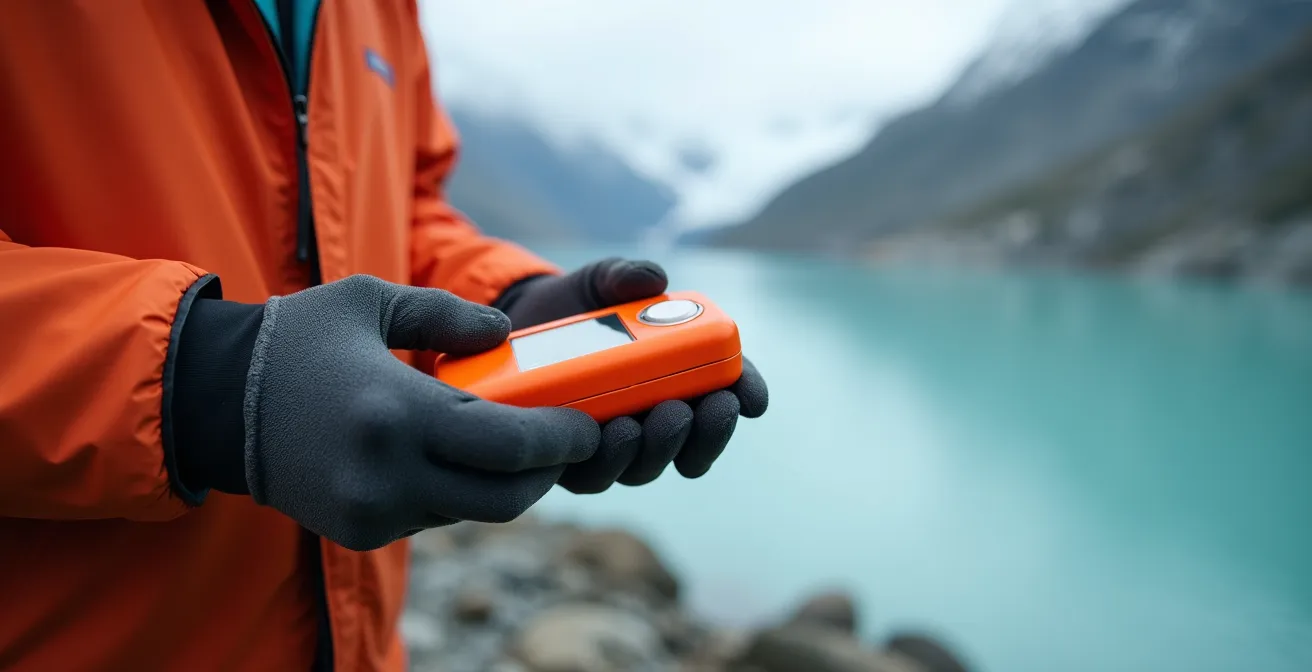
A Personal Locator Beacon (PLB) is a one-trick pony, but it’s a life-saving trick. When activated, it sends a powerful, one-way distress signal with your GPS coordinates to a global rescue network. It’s for life-threatening situations only. There’s no “cancel” button and no way to provide context. It’s a simple, reliable “SOS” button.
A satellite communicator (like a Garmin inReach or Zoleo) is often the best choice for kayakers. It allows for two-way text messaging via satellite. This is invaluable. You can trigger an SOS, but you can also communicate the nature of your emergency (“kayaker with dislocated shoulder, stable but needs evac”) to rescuers. You can also send “I’m OK” messages to family, get weather updates, and cancel a false alarm. The ability to provide context can drastically change the rescue response.
A full satellite phone allows for voice calls. While this seems ideal, they are often bulky, have limited battery life in extreme cold, and can be overkill for most situations. Their primary advantage is the immediacy of voice, which can be critical in complex medical emergencies where detailed information must be relayed. The following table breaks down the core differences.
| Device Type | Best For | Communication | Battery Life |
|---|---|---|---|
| PLB | Life-threatening emergencies only | One-way distress signal | 24+ hours transmission |
| Satellite Communicator | Complex rescue situations | Two-way text messaging | Variable (days to weeks) |
| Satellite Phone | Voice communication needs | Full voice calls | Limited in extreme cold |
For most remote kayakers, a two-way satellite communicator offers the best balance of safety, utility, and cost. It turns a simple SOS into an informed conversation with your rescuers.
The “After-Drop” Danger: Why You Feel Colder 10 Minutes After Getting Out?
You’ve survived the capsize. You’re out of the water, on shore, and the immediate danger seems over. Paradoxically, this is one of the most dangerous moments. You will start to feel colder, perhaps shivering violently, minutes *after* you’ve been “rescued.” This terrifying phenomenon is called after-drop, and it’s a critical stage to manage correctly.
After-drop occurs because when you’re in cold water, your body reflexively constricts blood vessels in your arms and legs (vasoconstriction) to protect your vital organs and keep your core warm. When you get out of the water, your body starts to relax. The constricted vessels open up, allowing cold, stagnant blood from your extremities to flow back to your core. This influx of cold blood causes your core body temperature to continue to drop, even though you are no longer in the water.
Managing this phase improperly can lead to collapse or even cardiac arrest. The key is gentle, passive rewarming. Vigorous action is your enemy.
The biggest danger is allowing cold people to warm up standing in a hot shower – this can precipitate post-rescue collapse.
– Dr. Oakley, Hypothermia, Frostbite, and Other Cold Injuries
Rubbing the skin, moving around too much, or applying intense external heat (like a hot shower or fire) can accelerate this dangerous flow of cold blood. The correct protocol is slow and steady. Get out of wet clothes gently, put on dry layers (especially on the head and torso), get into a shelter or sleeping bag, and sip warm, sugary drinks. Let your body rewarm itself from the inside out. Understanding after-drop is understanding that the rescue isn’t over just because you’re on dry land.
The GPS Mistake That Strands 50 Hikers a Year on the East Coast Trail
In the age of smartphones, it’s easy to believe you have a reliable navigator in your pocket. This over-reliance on consumer electronics is a critical mistake in remote environments, a lesson learned the hard way by dozens of hikers each year on Canada’s rugged East Coast Trail. For a kayaker on a glacial lake, the same mistake can have even more severe consequences. The problem is twofold: a lack of signal and, more insidiously, battery failure in the cold.
Standard lithium-ion batteries, found in all smartphones and many GPS devices, perform very poorly in near-freezing temperatures. The chemical reactions that generate power slow down dramatically. A phone that showed 80% battery at the start of your paddle can suddenly die, leaving you without a map, compass, or primary communication device. According to safety experts from the Huron River Water Trail, smartphone batteries can deplete up to 50% faster in the cold. Keeping your device in an inside pocket close to your body heat is essential, but it’s not a foolproof solution.
The bigger issue is assuming you’ll have a signal to download maps or make a call. Glacial valleys and remote coastlines are notorious dead zones. Cellular reliance becomes a critical safety error in these areas. You must operate under the assumption that your phone will not work for navigation or communication. This means carrying dedicated, non-digital tools: a physical map in a waterproof case and a reliable compass. And, crucially, knowing how to use them.
Your GPS and phone are conveniences, but your map and compass are your true navigation lifelines. The satellite communicator (PLB or other) is for emergencies, not for finding your way back to the launch point. Don’t let a dead battery turn a beautiful day into a search-and-rescue operation.
Key takeaways
- The “gasp reflex” from cold shock is a more immediate threat than hypothermia. Controlling your breathing in the first minute is paramount.
- A drysuit is mandatory for glacial water. A wetsuit offers insufficient protection against rapid muscle incapacitation.
- Skills like rolling, perfected in warm water, are unreliable in real-world cold emergencies due to loss of muscle function and psychological shock.
How to Start Cold Water Dipping in the Atlantic Without Risking Cardiac Arrest?
The best way to prepare your body for the shock of cold water is not just through gear, but through gradual, controlled exposure. Cold water dipping, or acclimatization, is a powerful technique practiced by swimmers in places like the cold North Atlantic. It can help reduce the severity of the cold shock response, giving you a crucial edge if you ever capsize unexpectedly. However, this process must be undertaken with extreme care to avoid the very dangers you’re trying to mitigate, such as cardiac arrest.
The goal is to teach your body to manage the shock. Research from Transport Canada shows that the cold shock response peaks at water temperatures between 10-15°C (50-59°F). You don’t need to train in glacial water to get the benefits. Starting in the late summer or early autumn, when water is cool but not frigid, is the ideal approach.
The key is a progressive and partnered approach. Never train alone. Start with very short immersions (30-60 seconds) in water shallow enough to stand in, focusing solely on controlling your breathing. Don’t try to swim or perform tasks. Just be in the water and breathe through the initial shock. Over weeks, you can slowly increase your duration. This methodical training tells your nervous system that this sensation is not a death sentence, which can help moderate the intensity of the gasp reflex and hyperventilation.
Your Action Plan: Progressive Cold Water Acclimatization
- Start early: Begin your training in early autumn when the water is still relatively mild (15-20°C).
- Partner up: Always practice with a buddy at a recognized, safe swimming location. Never train alone.
- Focus on breath: Start with immersions of only 30-60 seconds, concentrating entirely on calming your breathing.
- Increase gradually: Over several weeks, add 30 seconds to your immersion time per session. Listen to your body.
- Stay shallow: Always practice in water where you can easily stand up to ensure safety.
This training doesn’t make you immune to the cold. It simply gives you a better chance of managing the first, most critical minute of an accidental immersion, allowing your brain to stay in control and begin self-rescue procedures.
To truly prepare for your next cold-water expedition, the next logical step is to begin a structured acclimatization and gear-check process, ensuring every piece of equipment and every practiced skill is ready for the harsh reality of glacial waters.