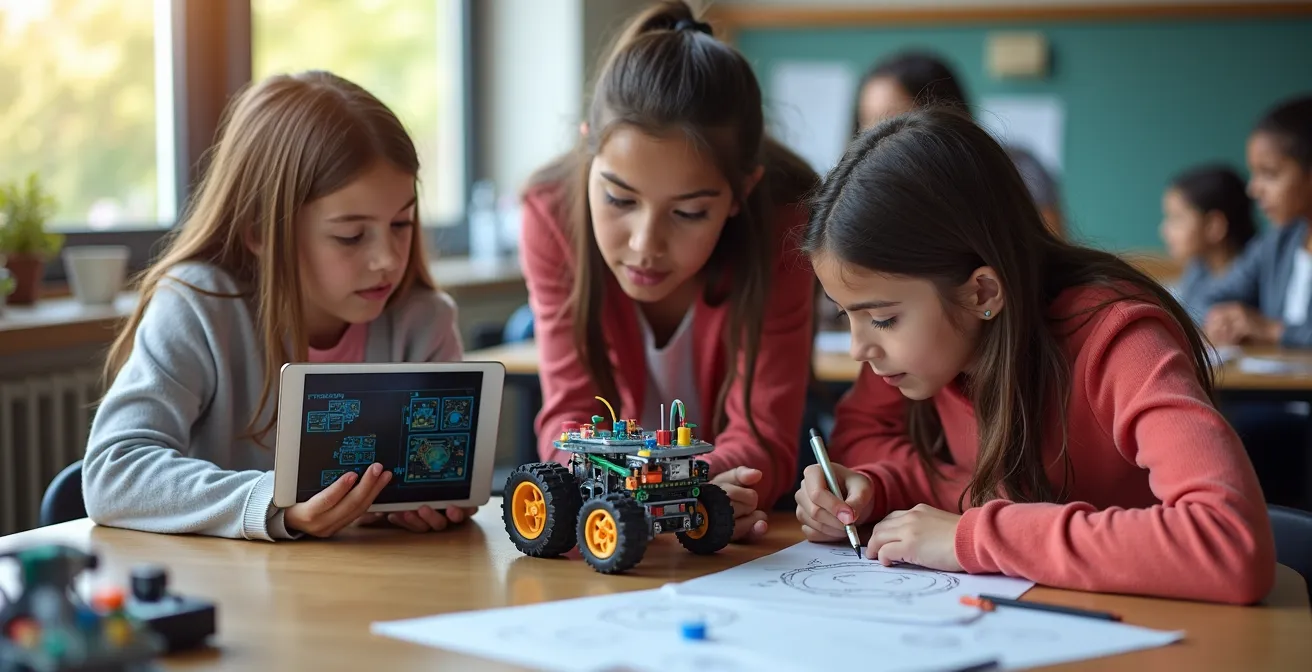
The common advice to simply “find role models” or “make STEM fun” is failing because it treats symptoms, not the cause.
- Keeping girls engaged requires building a complete supportive ecosystem—connecting creative arts, collaborative projects, and real-world problem-solving.
- Success depends on shifting focus from high-pressure, individual competition to team-based, creative engineering that builds both skills and confidence.
Recommendation: Instead of searching for a single magic bullet, systematically integrate the different strategies in this guide to create a resilient and encouraging environment that nurtures her long-term interest in STEM.
For many parents and teachers, it’s a frustratingly familiar story. A bright, curious girl who once loved building things and asking “why?” suddenly hits middle school, and her passion for science, technology, engineering, and math (STEM) begins to fade. You’re told to find her a female role model or sign her up for a coding class, but these one-off solutions often fail to stick. This drop-off isn’t a simple change of heart; it’s a systemic issue fueled by subtle societal stereotypes, a lack of confidence, and educational models that can feel isolating and overly competitive.
The “leaky pipeline,” where girls progressively abandon STEM pathways, is a well-documented problem. But what if the conventional fixes are looking in the wrong place? What if the key isn’t just about adding more activities, but about fundamentally changing the environment in which she learns and grows? The solution lies not in isolated interventions, but in building a holistic and interconnected STEM ecosystem. This approach weaves together creativity, collaborative play, structured mentorship, and a reframing of core subjects like math to build a resilient foundation of both competence and confidence.
This guide moves beyond generic advice to provide a concrete framework for parents and educators in Ireland and Canada. We will deconstruct the problem and provide actionable strategies to build a supportive ecosystem that nurtures, rather than discourages, a girl’s natural curiosity. From harnessing the power of the arts to finding the right mentorship programs, you will learn how to create a pathway that keeps her engaged and empowered through these critical years and beyond.
To help you navigate these solutions, this article breaks down the core components of a successful STEM ecosystem. Explore the sections below to understand how each piece contributes to a powerful, supportive whole.
Summary: A Guide to Building a STEM Ecosystem
- STEAM vs. STEM: Why Adding ‘Arts’ Improves Engineering Creativity?
- Minecraft Education: Is It Really Learning or Just Playing Video Games?
- Role Models: How to Find a Female Mentor for Your Aspiring Engineer Daughter?
- Robotics Club vs. Coding Camp: Which Builds Better Problem-Solving Skills?
- Math Prerequisites: The Calculus Course That Most Students Forget to Take
- How to Incorporate 5 Gaelic Phrases into Your Daily Family Routine?
- Competition School vs. Performance Troupe: Which Path Leads to a Professional Career?
- How to Build a Ivy-League Education Curriculum Using Only Free Open Courseware?
STEAM vs. STEM: Why Adding ‘Arts’ Improves Engineering Creativity?
The first step in building a robust STEM ecosystem is to broaden our very definition of what it includes. For too long, STEM has been perceived as a world of rigid logic, black-and-white answers, and technical precision—a perception that can alienate creative thinkers. The move to add ‘A’ for Arts, transforming STEM into STEAM, is not a dilution of scientific rigor; it’s a vital enhancement that fosters the number one skill needed for true innovation: creative problem-solving.
Engineering and design are inherently creative fields. They require imagining solutions that don’t yet exist, visualizing complex systems, and communicating ideas effectively. The arts—whether it’s drawing, music, or storytelling—train these exact skills. They teach students to embrace ambiguity, iterate on ideas, and think about user experience and aesthetics. This integration is particularly powerful for engaging girls, who may not see themselves in the narrow, stereotypical image of a lone coder in a dark room but can connect deeply with creating something that is both functional and beautiful.
The data powerfully supports this connection. A compelling Microsoft study revealed that girls engaging in arts and crafts are 75% more likely to later pursue computer science. This isn’t a coincidence. It’s evidence that a holistic education that values creativity alongside technical skills creates more resilient and interested future engineers. Organizations like Stemettes, which provides mentoring across the UK and Ireland, understand this, promoting a vision of STEM that is creative, colourful, and collaborative, making it far more appealing and accessible.
Minecraft Education: Is It Really Learning or Just Playing Video Games?
Once we embrace creativity, the next question is how to apply it. One of the most powerful—and often misunderstood—tools in the modern educational toolkit is Minecraft. To the untrained eye, it might look like just another video game. But when used intentionally, Minecraft: Education Edition is a sophisticated sandbox for developing foundational STEM skills, from systems thinking and spatial reasoning to project management and even basic coding.
The key is shifting the goal from “playing” to “building with purpose.” Instead of aimless survival mode, structured challenges turn the game into a powerful learning environment. Imagine tasking a student with recreating a historical Irish landmark like Newgrange or designing a sustainable city grid that reflects Canadian urban planning principles. Suddenly, the game is a medium for research, design, collaboration, and execution. Students aren’t just placing blocks; they are solving complex logistical and engineering problems in a low-stakes, high-engagement setting.
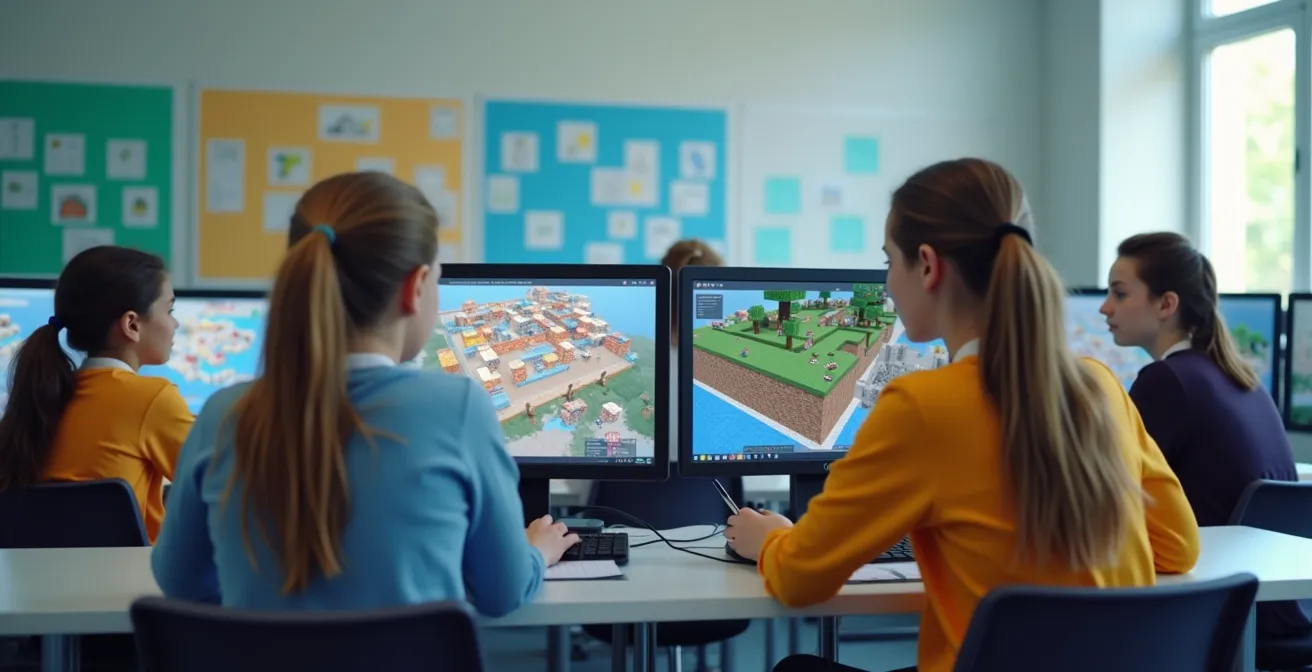
As the image above illustrates, this kind of learning is inherently collaborative. Students work together, negotiate roles, and communicate complex ideas to bring a shared vision to life. Furthermore, Minecraft’s “redstone” mechanic serves as a tangible, visual introduction to electrical circuits and programming logic. Creating a simple automated door with redstone uses the same if-then logic that underpins languages like Python. It’s not just playing a game; it’s building a mental model of how computational thinking works in the real world, making abstract concepts concrete and accessible.
Role Models: How to Find a Female Mentor for Your Aspiring Engineer Daughter?
A supportive curriculum is foundational, but the human element is what truly ignites and sustains passion. The advice “find a role model” is everywhere, but it’s often vague. It’s not enough to simply see successful women in STEM; girls need a mentorship pipeline—a structured way to connect, interact, and learn from women who are just a few steps ahead of them on the path. These relationships demystify career paths, provide crucial encouragement, and create a tangible sense of belonging.
Effective mentorship isn’t about finding a single, perfect, high-powered executive. It’s about building a network of support. This can include a university student who can talk about college life, a junior engineer who can share what her first job is *really* like, and a senior leader who can provide a long-term perspective. This multi-layered approach makes mentorship far more accessible and relatable. In Canada, for instance, programs like Actua’s National Girls Program are built on this model, engaging 10,000 girls annually not just with workshops but with critical mentorships that build confidence.
Fortunately, both Ireland and Canada have a growing number of organizations dedicated to creating these connections. Corporate initiatives like IBM STEM for Girls Canada actively host events and ambassador programs to engage youth directly with professionals. The key is to move from passive hope to active searching. This involves tapping into formal programs, leveraging university networks, and even using professional platforms like LinkedIn to find local women in STEM who are open to sharing their journey. The goal is to show your daughter that there isn’t just one path, but many, and that there is a community of women ready to support her along the way.
Your Action Plan: Connecting with STEM Mentors
- Register for formal programs: Sign up for established mentorship initiatives like I-WISH in Ireland or the Society for Canadian Women in Science and Technology (SCWIST) in Canada.
- Connect with universities: Reach out to Women in STEM societies at major universities such as UCD and Trinity in Ireland, or Waterloo and McGill in Canada, to find student mentors.
- Leverage social networks: Follow and respectfully connect with local female STEM professionals on LinkedIn to learn about their work and career paths.
- Attend events: Participate in virtual or in-person events organized by local chapters of engineering and tech associations.
- Join national initiatives: Enroll in large-scale programs like Actua’s National Girls Program, which offers a built-in network of role models and peers.
Robotics Club vs. Coding Camp: Which Builds Better Problem-Solving Skills?
With a foundation of creativity and mentorship in place, the next layer of the ecosystem is extracurricular activities. Parents are often faced with a choice: a competitive robotics club or an intensive coding camp? The question isn’t which activity is “better,” but rather which *environment* best fosters the skills we want to develop. The answer for most middle school girls lies in choosing collaboration over isolated competition.
Coding camps can be excellent for deep-diving into a specific language, but they can sometimes reinforce the stereotype of the lone programmer. Robotics clubs, by their very nature, are team-based. A successful robot requires mechanical engineers, electrical engineers, programmers, project managers, and designers all working together. This environment teaches systems thinking—the ability to see how different parts fit together to create a functioning whole. It also builds crucial soft skills like communication, compromise, and shared leadership, which are highly valued in the modern tech workplace.
The Canadian Association for Girls in Science (CAGIS) exemplifies this philosophy. Their approach is not just about teaching science but about creating fun, hands-on, behind-the-scenes adventures. They focus on providing non-stereotyped role models and exposing girls to a wide variety of STEM topics in a collaborative setting. This multi-faceted approach has been proven by research to be more effective at engaging under-represented groups. It shifts the focus from “Am I the smartest person in the room?” to “What can we build together?” This shared goal and distributed responsibility can dramatically lower the pressure and increase the enjoyment, making it more likely that a girl will stick with the activity long-term.
Math Prerequisites: The Calculus Course That Most Students Forget to Take
No STEM ecosystem is complete without addressing the biggest elephant in the room: math. The fear and anxiety surrounding math are often the primary reasons girls disengage from STEM. In Ireland, the gap is stark: at the CAO level, an analysis showed that while STEM courses had a 50:50 gender balance overall, breakdowns revealed that over 40% of males chose tech-heavy courses compared to just 19% of females. This gap is often rooted in a crisis of confidence in math.
The traditional response is more tutoring and more drills, especially for high-level courses like calculus. But the real prerequisite that most students miss is not a specific course; it’s a foundational skill: computational thinking. This is the ability to break down complex problems into smaller, manageable parts, recognize patterns, and design logical, step-by-step solutions. It’s the thought process of a computer scientist, and it can be taught long before a student ever sees a derivative.
Instead of forcing a path toward calculus, focus on building these underlying skills. Visual programming tools like Scratch allow girls to develop logical thinking by creating stories and games. 3D modeling software develops crucial spatial reasoning. You can even apply these concepts in the real world: use a trip to the store to calculate unit prices and budget constraints, or track the stock performance of a local company to practice data analysis. These activities reframe math from an abstract, intimidating subject into a practical tool for solving interesting problems.

As this image of hands-on, collaborative problem-solving suggests, the goal is to make math tangible and cooperative. By focusing on computational literacy and real-world application, you build a genuine, durable confidence that will serve her far better than rote memorization of formulas, preparing her for whatever math challenges lie ahead.
How to Incorporate 5 Gaelic Phrases into Your Daily Family Routine?
At first glance, learning a language like Irish Gaelic or Canadian French might seem entirely unrelated to a STEM education. However, integrating language learning into your family routine is a surprisingly effective and creative way to build a core cognitive skill that is essential for coding: pattern recognition. Both language and programming are rule-based systems built on syntax, structure, and logic.
When a child learns a new language, they are training their brain to identify grammatical patterns, understand sentence structure, and apply rules consistently. This is the exact same mental muscle used to understand the syntax of Python or the logical flow of a Java program. You can make this connection explicit and fun. For example, when exploring a new gadget, ask in Irish, “Cén chaoi a n-oibríonn sé?” (How does it work?). Before starting a weekend science project, say in French, “Faisons une expérience” (Let’s do an experiment).
You can take this a step further by turning it into a mini-tech project. Use a simple tool like Scratch to build a family quiz app that incorporates these phrases, or use a no-code platform like Thunkable to create a simple translator for scientific terms. By doing this, you are not just teaching vocabulary; you are demonstrating that the patterns in language are analogous to the patterns in code. As research published by Taylor & Francis highlights, language learning develops pattern recognition skills that are directly transferable to computational thinking. It’s a holistic approach that shows how different fields of knowledge connect, strengthening the overall learning ecosystem.
Key Takeaways
- The “leaky pipeline” for girls in STEM is a systemic problem that one-off solutions like a single coding camp cannot fix.
- A holistic “STEM ecosystem” approach, which integrates arts (STEAM), collaborative play, and mentorship, is far more effective at building long-term interest and confidence.
- Shifting the focus from individual, high-pressure competition to collaborative, team-based projects is crucial for making STEM environments more welcoming and engaging for middle school girls.
Competition School vs. Performance Troupe: Which Path Leads to a Professional Career?
In the performing arts, students often face a choice: join a high-stakes “competition school” focused on individual awards, or a “performance troupe” focused on collaborative shows. This metaphor provides the perfect framework for understanding the final, crucial choice in designing a STEM ecosystem: do we prioritize individual excellence or collaborative achievement? While both have value, for preparing girls for a successful and fulfilling career in tech, the performance troupe model is superior.
The world of professional STEM is a team sport. Major breakthroughs—from developing vaccines to launching rockets—are the result of massive, coordinated teams of specialists. Yet, traditional STEM education often over-emphasizes individual competition through events like math olympiads. These can be great for high-achievers who thrive under pressure, but they can also be intensely discouraging for many others, reinforcing the idea that you either “have it” or you don’t. Collaborative projects, like a robotics team, mirror the real world of work far more accurately.
This table, based on an analysis of learning styles, breaks down the key differences and their career implications. It shows how the collaborative model builds the very skills—communication, teamwork, and systems thinking—that are most in-demand by modern employers.
| Learning Style | Individual Competition (Math Olympiads) | Collaborative Projects (Robotics Teams) |
|---|---|---|
| Primary Skills | Speed, accuracy, individual excellence | Communication, teamwork, systems thinking |
| Pressure Level | High individual pressure | Shared responsibility |
| Career Preparation | Research, specialized roles | Team leadership, project management |
| Best For | Building deep technical expertise | Developing interpersonal skills |
| Employer Value | Technical proficiency proof | Collaboration experience |
As a report from NSTA highlights, different approaches prepare students for different futures. By choosing environments that prioritize collaboration, we are not just making STEM more enjoyable; we are actively preparing girls for leadership roles in their future careers. The Association for Middle Level Education powerfully summarizes this imperative:
Middle school educators should promote activities that encourage female students to engage in STEM education to build the self-esteem and confidence that will carry them through college and into lucrative STEM careers.
– Association for Middle Level Education, AMLE STEM Education Guidelines
How to Build a Ivy-League Education Curriculum Using Only Free Open Courseware?
Building a supportive STEM ecosystem doesn’t require an Ivy-League budget. With the wealth of high-quality, free resources available online, any parent or teacher can curate a personalized and powerful “discovery pathway” for a middle schooler. The final step is to bring all these elements together into a cohesive plan that guides a girl from basic principles to real-world application, all using free open courseware and tools.
The goal is not to replicate a formal university curriculum but to create a structured journey of exploration that builds skills incrementally. A well-designed pathway might start with the fundamentals of coding logic using a visual tool like Scratch, then move into 3D design and spatial reasoning with Tinkercad. From there, it could introduce data visualization using a free graphic design tool like Canva, showing her how to tell a story with numbers. This builds a versatile and practical skillset.
The next level involves tapping into the world-class education offered for free by top universities. Platforms like edX host introductory courses from institutions across the globe, including Ireland’s University College Dublin and Trinity College, and Canada’s University of Toronto. A student can explore topics from astrophysics to environmental science at her own pace. The final step in this pathway is to move from learning to contributing. She can start contributing to beginner-friendly open-source projects on platforms like GitHub or even schedule virtual coffee chats with university STEM students to learn about their experiences, closing the loop on the mentorship pipeline.
By thoughtfully weaving together creativity, collaboration, mentorship, and a renewed approach to core subjects, we can build a resilient ecosystem that does more than just plug a “leaky pipeline.” We can cultivate a generation of confident, capable, and passionate female innovators in Ireland, Canada, and beyond. Your role as a parent or educator is not just to encourage, but to be the architect of this supportive environment.