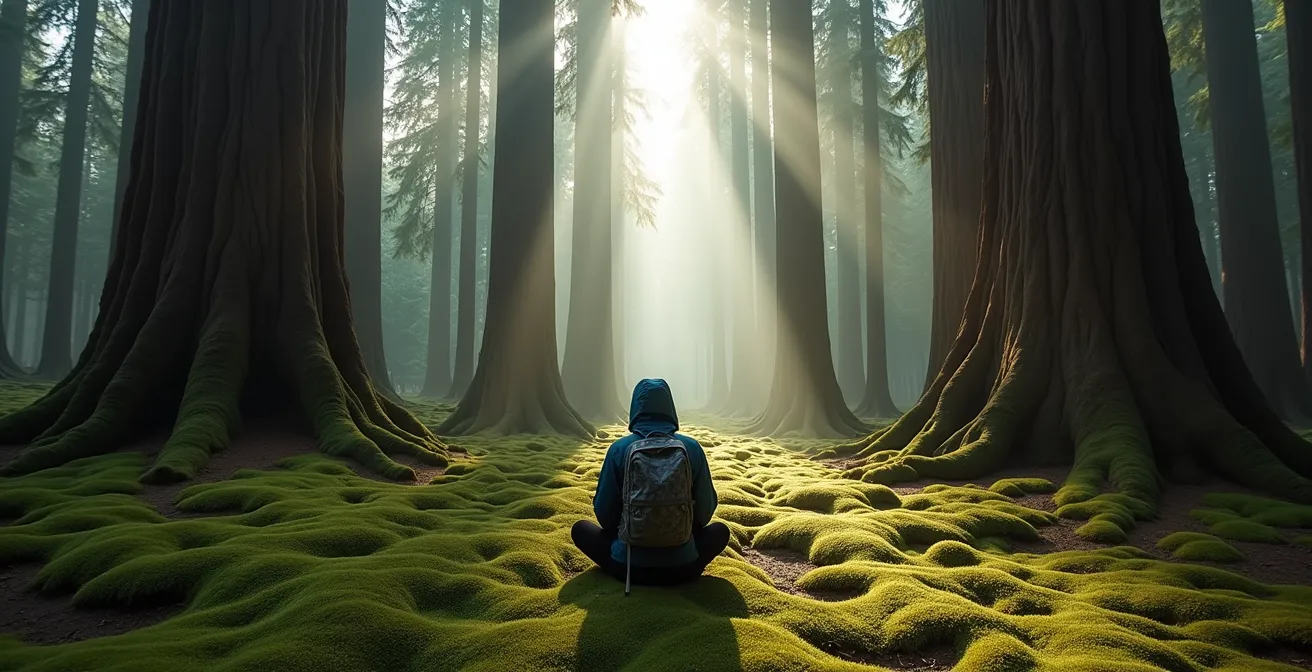
In summary:
- A true forest retreat is less about location and more about reducing physical and mental baggage through logistical minimalism.
- For Irish travelers, renting gear in B.C. and buying supplies locally is more cost-effective and practical than bringing everything.
- Achieving deep solitude requires choosing remote locations over popular spots and safely disconnecting from all digital devices.
- Maintaining the benefits of silence post-retreat involves integrating small, nature-focused habits into your daily urban life.
The hum of the city, the endless notifications, the weight of executive decisions—it creates a deep-seated exhaustion that a typical sun-and-sand holiday rarely touches. You feel a pull towards something quieter, something ancient. The old-growth rainforests of British Columbia call to you, promising a silence so profound it feels like a physical presence. Many guides will point you to luxury lodges or list the most famous, crowded parks. They’ll tell you to disconnect, but won’t show you how to do so without feeling anxious or unprepared.
But what if the key to a transformative silent retreat wasn’t about spending a fortune or following the tourist trail? What if it was about an intentional act of subtraction? This guide is built on a different philosophy: a profound, budget-conscious solo journey is achieved not by what you add, but by what you consciously leave behind. It is an exercise in logistical minimalism for the international traveler and a practice of psychological surrender to the quiet rhythm of the wild.
We will explore the science behind why these forests are so restorative, provide practical comparisons for finding true solitude, and offer a clear roadmap for packing light and camping respectfully. This is your guide to orchestrating a journey from Ireland to the heart of B.C.’s wilderness, ensuring the peace you find there follows you back home.
This article will guide you through the essential steps and considerations for planning your journey. Below is a summary of the topics we will cover to help you prepare for an experience of deep solitude and connection.
Summary: A Guide to Your B.C. Forest Retreat
- Why Does 3 Days in an Old-Growth Forest Lower Blood Pressure More Than a Beach Vacation?
- Cathedral Grove vs. Avatar Grove: Which Offers a Better Solitary Experience?
- The “Just in Case” Mistake: What Not to Pack for a Minimalist Forest Retreat
- How to camp near protected trees without incurring a $1,000 fine?
- The Post-Retreat Crash: How to Maintain Your “Zen” When Returning to Downtown Toronto?
- Leave No Trace: How to Camp on Coastal Moss Without Destroying the Ecosystem?
- Paper Maps and Film Cameras: How to Travel Without a Smartphone in 2024?
- How to Practice Shinrin-yoku in Winter Conditions Without Getting Frostbite?
Why Does 3 Days in an Old-Growth Forest Lower Blood Pressure More Than a Beach Vacation?
The restorative power of an old-growth forest is not mere folklore; it is a measurable physiological phenomenon. While a beach vacation offers relaxation through sun and sound, a forest immersion works on a deeper, chemical level. The air in ancient forests, particularly those with conifers like Douglas fir and cedar, is rich in airborne aromatic compounds called phytoncides. These are essential oils released by trees to protect themselves from pests and disease.
When we walk through these forests and breathe in, we are inhaling these powerful compounds. Research has shown that exposure to phytoncides can significantly decrease stress hormone levels (like cortisol), lower blood pressure, and boost the activity of our natural killer (NK) cells—a vital part of the immune system that fights off infection and tumors. The effect is so potent that it has given rise to the formal practice of Shinrin-yoku, or “forest bathing,” in Japan.
Unlike the open, sun-drenched environment of a beach, the canopied, complex ecosystem of an old-growth forest engages all our senses in a gentle, non-demanding way. The fractal patterns in ferns, the damp smell of moss, the filtered light—it all contributes to a state of “soft fascination” that allows our directed-attention abilities to rest and recover. This is the profound difference: a beach relaxes the body, but an ancient forest actively restores the mind.
Cathedral Grove vs. Avatar Grove: Which Offers a Better Solitary Experience?
You watch your guests come in drained and see them filling up on green.
– Sarah Cruse, General Manager, Clayoquot Wilderness Lodge
For an international traveler seeking solitude, choosing the right grove in British Columbia is a critical decision. It’s a choice not just between trees, but between accessibility and tranquility. Two famous examples on Vancouver Island, Cathedral Grove and Avatar Grove, illustrate this perfectly. While both offer awe-inspiring ancient trees, they provide vastly different experiences for the burned-out executive in search of quiet.
Cathedral Grove (MacMillan Provincial Park) is incredibly accessible, located directly off a major highway. This convenience, however, is its downfall for solitude. It’s often crowded, with a constant flow of tourists and the noise of traffic nearby. For someone from Ireland who has traveled thousands of miles for peace, it can be a profound disappointment. In contrast, Avatar Grove, near the remote town of Port Renfrew, requires navigating unpaved logging roads, which often deter casual visitors and may even violate standard rental car agreements.
This logistical hurdle is precisely what preserves its sanctity. The reward for the effort is a deeply quiet, almost mystical experience among gnarled, ancient cedars, including the famed “Canada’s Gnarliest Tree.” The lack of crowds means you can sit for an hour without seeing another soul. The following comparison breaks down the key factors for an international visitor aiming for a genuine silent retreat.
The choice ultimately depends on your priority. For a quick, impressive glimpse of big trees, Cathedral Grove suffices. But for the deep, restorative solitude that justifies a transatlantic journey, the effort to reach Avatar Grove is an investment that pays immense dividends in peace, as this comparative analysis for visitors highlights.
| Criteria | Cathedral Grove | Avatar Grove |
|---|---|---|
| Accessibility | Right off Highway 4, paved parking | Requires unpaved logging roads |
| Rental Car Compatibility | Yes – standard vehicles | May violate rental agreements |
| Crowd Levels | High in summer/weekends | Very low year-round |
| Best Solitude Times | Early morning (before 8am) | Anytime |
| Safety for Solo Travelers | High – well-marked trails | Moderate – remote location |
| Ancient Tree Experience | 800-year-old Douglas Firs | Canada’s gnarliest tree |
The “Just in Case” Mistake: What Not to Pack for a Minimalist Forest Retreat
For an Irish traveler planning a B.C. wilderness retreat, the greatest packing mistake is not forgetting an item, but bringing too many. The “just in case” mindset, born from a desire for security, ironically becomes a physical and mental burden. A truly minimalist retreat begins with logistical minimalism: a conscious decision to travel light and source non-essentials locally. This philosophy not only saves on exorbitant airline baggage fees but also shifts your mindset from one of over-preparation to one of resourceful adaptation.
Leave the bulky camping gear, spare jackets, and heavy survival equipment at home. Instead, focus on a core set of high-quality, versatile items: merino wool layers, a reliable rain shell, a durable journal, and good hiking boots. Everything else can be rented or purchased upon arrival in Vancouver or Victoria. Stores like MEC (Mountain Equipment Co-op) offer high-quality gear rentals, while Canadian Tire and Real Canadian Superstore provide affordable supplies and food—options unfamiliar to most European visitors but key to a budget-conscious trip.
This approach forces you to confront the difference between a genuine need and a perceived one. You don’t need an axe or a complex water filtration system for a short retreat in established areas. You need comfort and the mental space to be present. By shedding the weight of unnecessary gear, you are already beginning the process of decluttering your mind before you even step foot on the trail.

This curated layout embodies the philosophy of the retreat. Each item is chosen for its function and sensory quality, not for a hypothetical emergency. The goal is to support an experience of quiet contemplation, not to conquer the wilderness. By focusing on quality rain gear (non-negotiable in B.C.) and simple comfort items, you are prioritizing the true purpose of your journey. Embracing this buy-on-arrival strategy is the first step toward psychological surrender.
How to camp near protected trees without incurring a $1,000 fine?
The desire to sleep among giants is powerful, but in British Columbia, it is governed by strict regulations designed to protect these fragile, ancient ecosystems. “Wild camping” or “dispersed camping” as it might be understood in parts of Europe is not a free-for-all. BC Parks enforcement has stringent penalties, including a potential maximum fine of $1,000 for illegal camping in protected areas. For an international visitor, a misunderstanding of land use rules can lead to a costly and stressful end to a silent retreat.
The key is understanding the three main types of land: National Parks, Provincial Parks, and Crown Land. National Parks (like Pacific Rim National Park Reserve) are federally managed, have the strictest rules, and require a Parks Canada Discovery Pass for entry. Camping is only permitted in designated, pre-booked campgrounds. Provincial Parks are managed by the B.C. government, and camping is similarly restricted to official sites booked through the Discover Camping reservation system. These sites often open for booking 2-4 months in advance and fill up instantly for peak season.
Crown Land offers the most flexibility for dispersed camping, but it is also the most complex to navigate. It requires detailed maps to identify permissible zones and a strong understanding of Leave No Trace principles. For a first-time visitor from Ireland, attempting to navigate Crown Land regulations without local knowledge can be risky. The safest and most respectful approach is to secure a reservation at a designated campground within a Provincial or National Park, which often serve as excellent, quiet bases for exploring nearby old-growth trails.
The Post-Retreat Crash: How to Maintain Your “Zen” When Returning to Downtown Toronto?
The transition from the profound silence of a B.C. forest to the sensory onslaught of a major city—be it Dublin, or a Canadian hub like Toronto—is often the most challenging part of the journey. This “re-entry friction” can feel like a sudden crash, where the calm and clarity you cultivated evaporates within hours. The key to preserving your inner peace is not to try and replicate the retreat, but to integrate its essence into your urban environment.
The goal is to find your “urban grove.” Instead of mourning the loss of the wilderness, proactively seek out small pockets of nature in your daily life. This could be a mindful walk through Dublin’s Phoenix Park on your way to work, a quiet moment spent observing a single tree in St. Stephen’s Green, or simply listening to the sound of rain against your window instead of turning on a podcast. It’s about shifting your perception to find the restorative qualities of nature that exist even in a concrete landscape.
Create a sensory anchor to your retreat. This could be the scent of cedarwood essential oil, the taste of the herbal tea you drank in your tent, or the feel of a smooth stone you carried back. When stress levels rise, engaging this anchor can transport you back to that state of calm. Schedule “do-nothing” time in your calendar—short, five-minute blocks where you simply sit and breathe without a screen. This practice mimics the unstructured stillness of the forest and builds your resilience against the constant demands of executive life.

Maintaining your zen is an active practice of connection. It’s about recognizing that the forest didn’t give you something you didn’t have; it simply quieted the noise so you could hear yourself. By intentionally creating small moments of quiet connection back home, you carry the spirit of the old-growth forest with you.
Leave No Trace: How to Camp on Coastal Moss Without Destroying the Ecosystem?
The coastal temperate rainforests of B.C. are carpeted with thick, vibrant blankets of moss. To the untrained eye, this lush ground cover can look like the perfect natural mattress for a tent. This is a critical misunderstanding of a fragile and ancient ecosystem. The guidance from those who protect these lands is direct and uncompromising.
Camping on this moss is like pitching your tent on a 100-year-old, living tapestry. You don’t.
– Parks Canada Forest Conservation Guide, Take a dip with Parks Canada in the forest
This is not hyperbole. These moss mats can take decades or even centuries to develop. The weight of a tent, or even repeated foot traffic, can crush the delicate structures, expose the soil to erosion, and destroy a habitat that supports countless insects and microorganisms. The guiding principle of ecosystem etiquette goes beyond the standard “pack it in, pack it out.” It requires you to recognize that some surfaces are simply not for human use.
The core tenet of camping respectfully in these environments is to travel and camp only on durable surfaces. A durable surface is one that can withstand use without being damaged. This includes established trails, rock, gravel, dry grasses, or snow. In the coastal rainforest, your primary options are exposed rock slabs or the bare, compacted soil found at the base of large trees where nothing else grows. In designated camping areas, this means using the provided wooden or gravel tent pads without exception. If you are in a more remote area and cannot find a durable surface, the correct Leave No Trace action is not to make do, but to move on until you find a suitable spot.
Your Checklist for Identifying Durable Camping Surfaces
- Exposed Rock: Look for large, flat rock slabs or barren, rocky outcrops. These are the most durable surfaces available.
- Bare Soil: Identify patches of compacted, bare ground, often found at the base of very large trees where the dense canopy prevents growth.
- Designated Pads: In any established campground, use only the official tent pads. Never set up your tent on the surrounding vegetation.
- Vegetation Check: Avoid any surface with visible moss, lichen, or delicate wildflowers. If it’s green and soft, it’s off-limits.
- The Doubt Rule: If you are unsure whether a surface is durable, assume it is not. The most responsible choice is to camp only in clearly designated sites.
Paper Maps and Film Cameras: How to Travel Without a Smartphone in 2024?
The idea of a digital detox is central to a silent retreat, but the practicalities can be daunting. Our smartphones have become our maps, cameras, communication tools, and safety nets. Letting go requires a conscious act of psychological surrender, supported by reliable analog alternatives. This is not about being a luddite; it’s about replacing digital dependency with intentional, tactile tools that enhance presence rather than distract from it.
First, address the safety concern. For a solo traveler from Ireland in the B.C. backcountry, being without a communication device is unwise. The solution is not your phone, but a dedicated satellite messenger or Personal Locator Beacon (PLB). These devices work where there is no cell service, allowing you to send pre-set “I’m okay” messages or trigger an SOS in a true emergency. Crucially, they lack the distracting features of a smartphone. A compelling fact for international travelers is that over 90% of Vancouver outdoor shops rent satellite messengers for a low daily rate, making safety accessible without a large investment.
Replace your phone’s GPS with a high-quality paper map and a compass. The act of navigating this way forces you to engage with the landscape on an intimate level—to read contour lines, identify landmarks, and pay attention to your surroundings. It transforms travel from a passive dot-on-a-screen to an active, mindful process. For capturing memories, swap the endless digital roll of your phone for a film camera. With a limited number of exposures, each shot becomes a deliberate choice. You begin to see the world with a photographer’s eye, composing and waiting for the right light, fully present in the moment you wish to remember.
Case Study: Digital Detox Success at Clayoquot Wilderness Lodge
The practice of swapping screens for nature is not just a fringe idea; it’s a core component of high-end wellness experiences. Bridget Harrison, an editor for The Times, documented her family’s transformative digital detox at the remote Clayoquot Wilderness Lodge. By trading their phones and devices for activities like hiking, horseback riding, and wildlife spotting in the B.C. wilderness, they reconnected with each other and the environment on a profound level, proving that a true luxury experience is one of presence, not connectivity.
Key takeaways
- The health benefits of a forest retreat are scientifically-backed, stemming from airborne phytoncides that reduce stress and boost immunity.
- True solitude requires logistical planning, favoring remote, less-accessible groves over popular, convenient ones.
- A minimalist approach to packing, focusing on renting gear locally in B.C., reduces both physical and mental burdens for international travelers.
How to Practice Shinrin-yoku in Winter Conditions Without Getting Frostbite?
While summer is the most popular time for a forest retreat, the winter season in coastal British Columbia offers a unique and powerful form of solitude. The crowds are gone, the air is crisp, and a layer of snow or frost transforms the landscape into a hushed, monochromatic world. Many assume the cold negates the benefits of forest bathing, but this is a misconception. In fact, research confirms that winter forest exposure maintains significant health benefits, with studies suggesting up to 40-50% of the positive effects are still achievable.
The key to a safe and restorative winter practice is not endurance, but smart preparation. For an Irish traveler accustomed to a damp, mild winter, the B.C. cold requires a specific layering strategy. The “3 Ws” are your rule: a Wicking base layer (merino wool is ideal) to pull moisture away from your skin, a Warm mid-layer (like fleece) to insulate, and a Waterproof and windproof outer shell to protect you from the elements. Insulated, waterproof boots are non-negotiable and can be rented at a place like MEC in Vancouver to save precious luggage space.
Instead of long, continuous hours of exposure, practice Shinrin-yoku in shorter intervals. A pattern of 10 minutes of slow, mindful walking followed by 5 minutes of stillness allows your body to stay warm while still giving you ample time to connect with your surroundings. Focus on low-elevation coastal trails, such as those near Sooke on Vancouver Island, which are often snow-free even in deep winter. Packing a few chemical hand warmers (easily found at Canadian Tire) can be a small but significant comfort, allowing you to remain still and present for longer without the distraction of biting cold.
Frequently Asked Questions About Camping in B.C.
What’s the difference between National Parks, Provincial Parks, and Crown Land?
National Parks require Parks Canada permits and have the strictest regulations. Provincial Parks need BC Parks reservations made through the ‘Discover Camping’ system. Crown Land allows for dispersed camping with fewer restrictions but requires detailed knowledge of specific zones to ensure you are camping legally.
How far in advance should Irish visitors book campgrounds?
For the peak season (June-September), you should aim to book highly sought-after campgrounds like Green Point in Pacific Rim National Park 4 to 6 months in advance. Most other provincial park frontcountry sites open for booking 2 months ahead of the date and can fill up within minutes for popular locations and weekends.
Are there First Nations protocols to observe?
Yes, it is crucial to remember that you are a visitor on unceded ancestral lands. You can use resources like Native-Land.ca to identify whose territory you are on. The most fundamental form of respect is to practice Leave No Trace principles with meticulous care, leaving the land exactly as you found it, if not better.