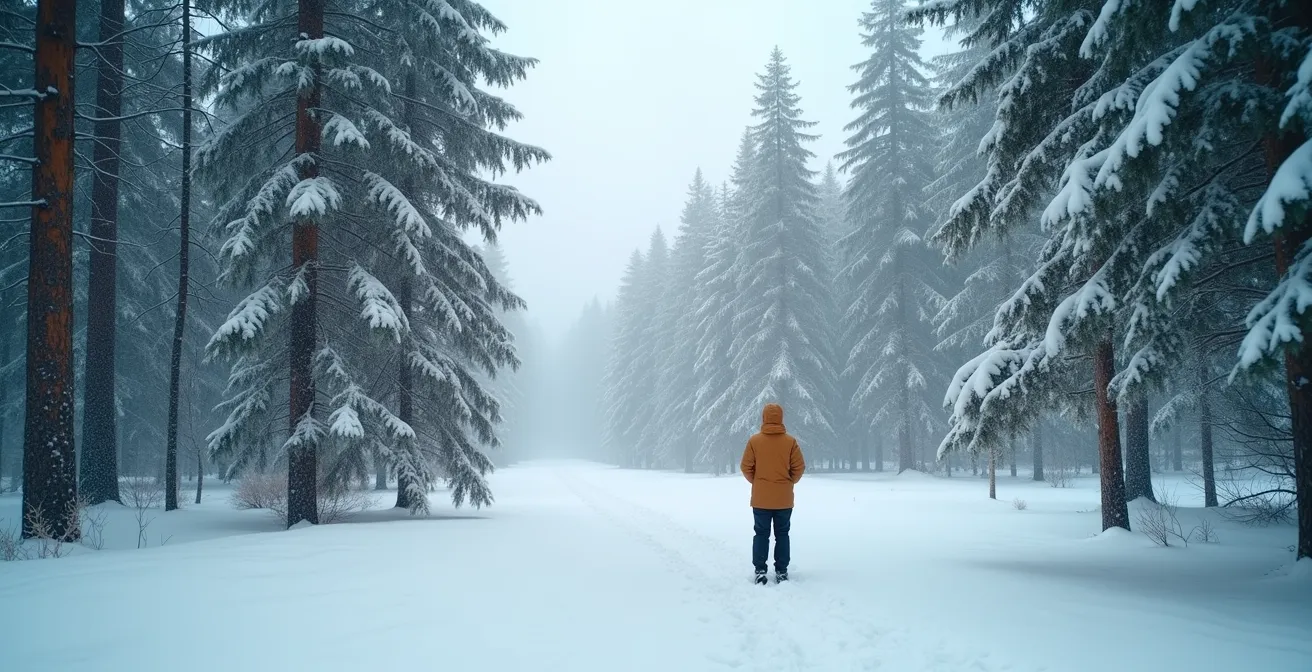
The extreme cold of a Canadian or Irish winter isn’t an obstacle to Shinrin-yoku; it’s an opportunity for a more potent form of practice, provided you master the unique physics and physiology of a frozen landscape.
- Effective layering isn’t about bundling up; it’s a dynamic system of venting during movement and insulating during stillness to prevent the ‘chill trap’ of sweat.
- Winter transforms the forest’s sensory profile, dampening sound and heightening visual textures, while evergreen trees release powerful, health-boosting phytoncides year-round.
Recommendation: Begin by committing to just five minutes outside. This small step overcomes the initial mental barrier and allows you to build a resilient and deeply rewarding winter nature therapy habit.
The first heavy snowfall blankets the landscape, muffling the world in a profound silence. For many who have discovered the restorative power of Shinrin-yoku, or forest bathing, this moment brings a sense of loss. The biting wind and sub-zero temperatures of a Canadian or Irish winter seem to slam the door on a practice built around gentle walks and sensory immersion. The common advice is to simply “dress warm,” but this often leads to a cycle of overheating on the approach, followed by a dangerous, sweat-induced chill the moment you pause for mindful observation. The mental hurdle of facing the cold can feel just as daunting as the physical discomfort.
But what if this perspective is wrong? What if the winter forest, far from being a barren wasteland, offers a unique and even more powerful environment for nature therapy? The key isn’t to endure the cold, but to understand and work with it. It requires shifting our strategy from simple warmth to active thermal regulation, and from listening for distant birdsong to observing the intricate calligraphy of frost on a pine needle. This guide moves beyond the basics to give you the specific techniques needed to transform your winter from a season of indoor confinement to one of profound connection.
We will explore the science behind why winter practice feels different, how to adapt your senses, and which forests offer the most benefits. You’ll learn to build mental resilience, choose the optimal time of day for your walk, and master the art of layering to avoid the common “overheating trap.” Finally, we will touch upon the ultimate expression of cold therapy: safe cold water immersion.
Contents: A Guide to Winter Shinrin-yoku
- Why Is “Slow Walking” More Difficult in -20°C Weather?
- Visual vs. Auditory: Which Sense Should You Prioritize When Snow Dampens Sound?
- Pine vs. Deciduous: Which Forest Air Contains More Phytoncides in Winter?
- The “It’s Too Cold” Excuse: How to Build the Mental Resilience to Go Outside?
- Lunch Break vs. Early Morning: When Is the Best Light for Winter Therapy?
- The Layering Trap: How to Avoid Overheating When High-Output Training in Cold?
- Why Does 3 Days in an Old-Growth Forest Lower Blood Pressure More Than a Beach Vacation?
- How to Start Cold Water Dipping in the Atlantic Without Risking Cardiac Arrest?
Why Is “Slow Walking” More Difficult in -20°C Weather?
The signature “slow walk” of Shinrin-yoku, effortless in summer, becomes a conscious effort at -20°C. This difficulty arises from a combination of physiological and physical factors. Physiologically, your body initiates vasoconstriction, narrowing blood vessels in your extremities to conserve core heat. This reduces blood flow to your leg muscles, making them feel stiffer and less responsive. Your metabolism also works harder just to stay warm, consuming energy that would otherwise be used for movement.
Physically, the ground itself presents a new challenge. Walking on uneven, compacted snow or breaking through crust requires more muscular engagement and balance than walking on a soft dirt path. Each step is less predictable. This increased physical demand forces you out of the meditative, flowing state of a summer walk and into a more deliberate, and often strenuous, mode of movement. The body’s focus shifts from gentle sensory awareness to the basic mechanics of locomotion and stability.
Furthermore, the sheer bulk of winter clothing can restrict movement, altering your natural gait. The mind, instead of being free to wander and observe, becomes preoccupied with navigating the terrain and managing the body’s response to the cold. Acknowledging this increased difficulty is the first step; the solution lies not in forcing the same slow pace, but in adapting the practice to a “mindful winter stride” that accepts and works with these new physical realities.
Visual vs. Auditory: Which Sense Should You Prioritize When Snow Dampens Sound?
When you enter a snow-covered forest, the first thing you notice is the silence. Snow’s texture is highly sound-absorbent, creating what is known as the ‘Winter Stillness Effect‘. This acoustic dampening drastically reduces the auditory information you receive, making it an ideal time to shift your primary focus from hearing to sight. The world, stripped of auditory clutter, invites a deeper visual exploration.
This sensory shift allows you to focus deeply on the subtle sounds that remain—the whisper of wind through pine boughs, the faint crackle of ice, or the soft crunch of your own footsteps. However, the real opportunity is in the visual feast. The landscape is a study in monochrome, texture, and light. Your invitation is to notice the intricate patterns of bark against white snow, the delicate architecture of a frozen spiderweb, or the way low winter sun reflects off ice crystals. This is a practice of micro-observation, finding a universe of detail in a seemingly simplified world.
The quality of light is also unique. Sunlight reflecting off the snow illuminates the forest from below, creating a bright, diffuse glow that can have a powerfully positive effect on mood, especially during the short days of a northern winter. Instead of straining to hear, allow your eyes to lead. Let them trace the curve of a snow-laden branch or marvel at the complex geometry of frost.
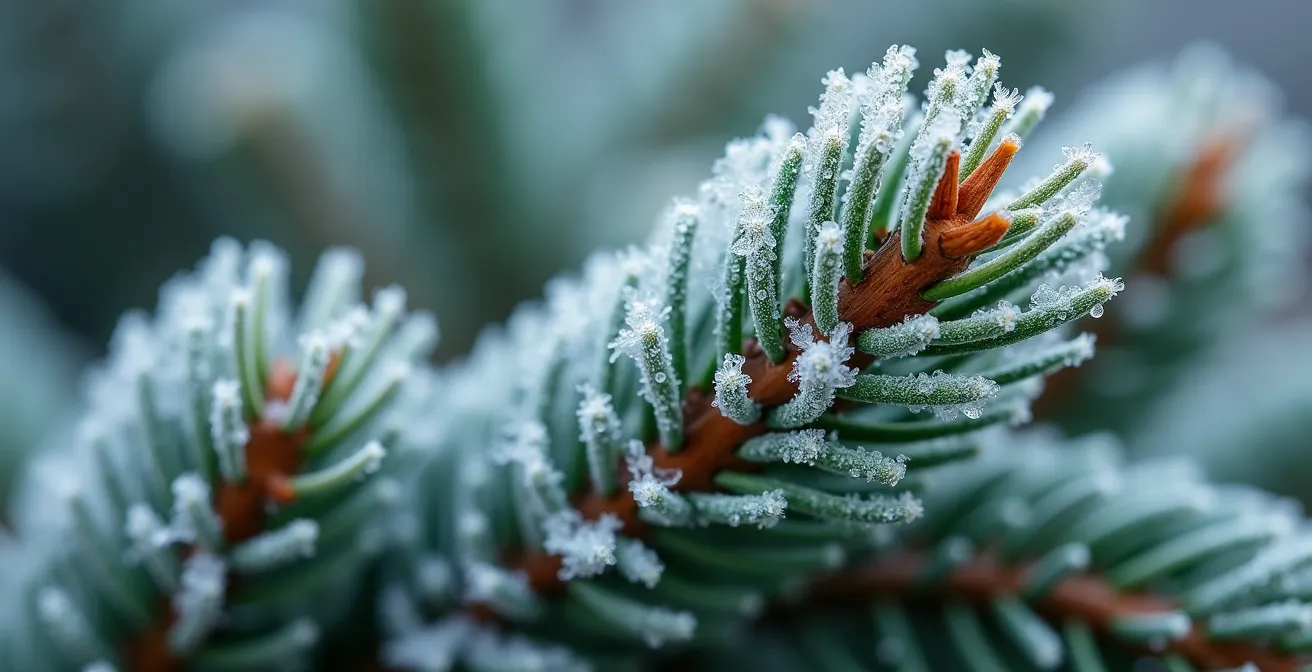
As this image shows, the visual texture of winter is a world unto itself. The practice becomes less about the grand vista and more about the intimate landscape. By prioritizing your visual sense, you are not losing the forest’s input; you are simply tuning into a different, more subtle frequency that is only available in the heart of winter.
Pine vs. Deciduous: Which Forest Air Contains More Phytoncides in Winter?
While a walk in any forest is beneficial, the choice between a coniferous and a deciduous forest becomes critically important in winter. The answer lies in phytoncides, the aromatic compounds released by trees that are responsible for many of Shinrin-yoku’s health benefits, including reduced stress and a boosted immune system. In winter, coniferous (or evergreen) forests are the clear winners for phytoncide exposure.
Deciduous trees, like maples and oaks, become dormant in winter and their phytoncide production drops to minimal levels. In contrast, conifers such as pine, spruce, and fir continue to produce these volatile compounds year-round. Specific phytoncides like α-pinene and β-pinene, known for their anti-inflammatory and bronchodilator effects, are consistently present in the air of a pine forest, regardless of the season. In fact, some research on forest atmosphere compounds confirms that coniferous forests maintain a steady output of these vital chemicals while deciduous emissions fade.
For practitioners in Canada and Ireland, this means actively seeking out stands of pine, spruce, or fir for your winter walks. The Boreal forests of Canada and the Scots Pine stands or Sitka Spruce plantations in Ireland become natural pharmacies during the colder months. Choosing an evergreen forest ensures that you are not only getting the psychological benefits of the walk but also inhaling a potent dose of immune-supporting natural chemicals.
The table below breaks down the types of phytoncides you can expect to find and where to best access them in Canada and Ireland, helping you make a strategic choice for your next winter forest bath.
| Tree Type | Primary Winter Phytoncides | Health Benefits | Best Locations (Canada/Ireland) |
|---|---|---|---|
| Pine Trees | α-pinene, β-pinene | Anti-inflammatory, bronchodilator, sleep-promoting | Canada: Boreal forests; Ireland: Scots Pine stands |
| Spruce/Fir | α-pinene, camphene | Stress reduction, improved circulation | Canada: Balsam Fir forests; Ireland: Sitka Spruce plantations |
| Cedar | Hinokitiol, α-pinene | Antimicrobial, immune boost | Canada: Western Red Cedar (BC); Ireland: Limited availability |
| Deciduous (dormant) | Minimal in winter | Limited phytoncide benefits | Focus on visual/sensory aspects instead |
The “It’s Too Cold” Excuse: How to Build the Mental Resilience to Go Outside?
The biggest obstacle to winter forest bathing is often not the cold itself, but the mental barrier we build against it. The thought of leaving a warm home for a freezing landscape can be paralyzing. Building mental resilience is about reframing the experience and using simple psychological tools to overcome that initial inertia. It’s not about being tough; it’s about being strategic.
One of the most effective techniques is the “5-Minute Rule.” Commit to just five minutes outside. Anyone can handle five minutes. This simple commitment bypasses the brain’s resistance to a large, daunting task (“an hour-long walk in the cold”). More often than not, once you are outside and have overcome the initial shock, those five minutes will naturally stretch into ten, twenty, or more. The hardest part is simply crossing the threshold.
Another powerful tool is reframing the cold as a beneficial “hormetic stress.” Short, controlled exposure to cold is not just something to be endured; it’s a stimulus that triggers adaptive responses in your body, improving resilience, circulation, and even mood. In Canada, this is often linked to the concept of “earning your coziness“—the feeling of warmth and comfort (hygge) is amplified tenfold after a brisk walk in the cold. In Ireland, one might connect to a sense of Celtic stoic spirit, framing the winter walk as an act that builds character and mental clarity.
Remember that even short durations of nature exposure are impactful; studies show that spending just 2 hours a week out in nature has been shown to improve overall health and well-being. This can be broken down into smaller, manageable winter walks. The key is consistency, not duration. Start small, reframe the challenge as a benefit, and you will build a practice that thrives all winter long.
Your Action Plan: Build a Winter Walking Habit
- Commit to just 5 minutes outside – the mental barrier to starting is often the highest hurdle.
- Practice ‘habit stacking’ by linking your winter walk to an existing daily ritual like morning coffee.
- Frame cold exposure as beneficial ‘hormetic stress’ that triggers adaptive responses improving resilience.
- For Canada: Embrace ‘earning your coziness’ – the hygge feeling is amplified tenfold after a cold walk.
- For Ireland: Connect to the Celtic stoic spirit – frame winter walking as building character and achieving mental clarity (‘Imbas forosnai’).
- Start with a threshold exercise: enter the forest with a clear intention and take three deep breaths to transition from daily life.
Lunch Break vs. Early Morning: When Is the Best Light for Winter Therapy?
In the low-light conditions of a northern winter, timing your forest bath is not just a matter of convenience; it’s a strategic decision that affects both physiological and psychological well-being. The best time depends on your primary objective: are you seeking a biological boost to combat seasonal affective disorder (SAD), or a quiet moment of psychological restoration?
For biological benefits, the midday window is non-negotiable. In places like Ireland (around 53°N latitude) and Southern Canada, the winter sun’s arc is extremely low, and days are short. The period between roughly 11 a.m. and 2 p.m. offers the strongest UV exposure, which is crucial for Vitamin D synthesis and regulating your circadian rhythm. A brisk walk during your lunch break is the most efficient way to combat the winter blues and boost alertness.
For psychological benefits, the “Golden Hours” of early morning and late afternoon offer a different kind of magic. While the light is less biologically potent for Vitamin D, its warm, aesthetic quality provides profound mood-boosting effects. The solitude of an early morning walk, as the world awakens, fosters contemplation and clarity. A late afternoon walk, bathed in the golden glow before sunset, is perfect for relieving the day’s stress and aesthetic pleasure. In sub-arctic regions of Canada, where midday light is minimal, focusing on these twilight benefits becomes the primary strategy.
The optimal time is a personal choice based on your goals. The following table can help you align your schedule with the specific benefits offered by the winter light at different times of the day.
| Time Period | Light Quality | Biological Benefits | Psychological Benefits | Best For |
|---|---|---|---|---|
| Early Morning (Dawn-9am) | Blue Hour to Golden Hour | Moderate UV, cortisol regulation | Solitude, contemplation, clarity | Meditation practitioners |
| Midday (11am-2pm) | Strongest UV exposure | Maximum Vitamin D, SAD prevention | Energy boost, alertness | Office workers on lunch break |
| Late Afternoon (3pm-Sunset) | Golden Hour warmth | Lower UV, melatonin preparation | Aesthetic pleasure, stress relief | Photography, family walks |
| Twilight (Post-sunset) | Minimal light | Limited (except melatonin) | Deep calm, stargazing potential | Arctic regions, night shift workers |
The Layering Trap: How to Avoid Overheating When High-Output Training in Cold?
The single biggest mistake in winter outdoor activity is the “layering trap”: dressing so warmly for the initial cold that you begin to sweat during the approach hike. This moisture then freezes the moment you stop, leading to a rapid and dangerous drop in body temperature. The goal is not to be warm; it’s to be dry and thermally regulated. This requires a dynamic approach to layering, especially when transitioning from movement to stillness.
The guiding principle is “Be Bold, Start Cold.” You should begin your walk feeling slightly chilly. Your body will generate significant heat once you start moving. To manage this heat, you must proactively vent. Before you even feel warm, open the ‘pit-zips’ on your shell jacket, lower the main zipper, or roll up your sleeves. Monitor for the first signs of perspiration, typically at the lower back or between the shoulder blades, and adjust your layers immediately.
Your layering system should be specific to the climate. For Ireland’s damp, wet cold, a high-quality waterproof and breathable shell is your most important piece of gear. For Canada’s dry, deep cold, the focus shifts to a windproof outer layer and highly effective moisture-wicking base layers to pull sweat away from the skin. In both cases, the secret weapon is a heavily insulated ‘puffy’ jacket carried in your pack. The moment you stop for your mindful practice, you must immediately deploy this jacket over all your other layers to trap the heat you’ve generated.
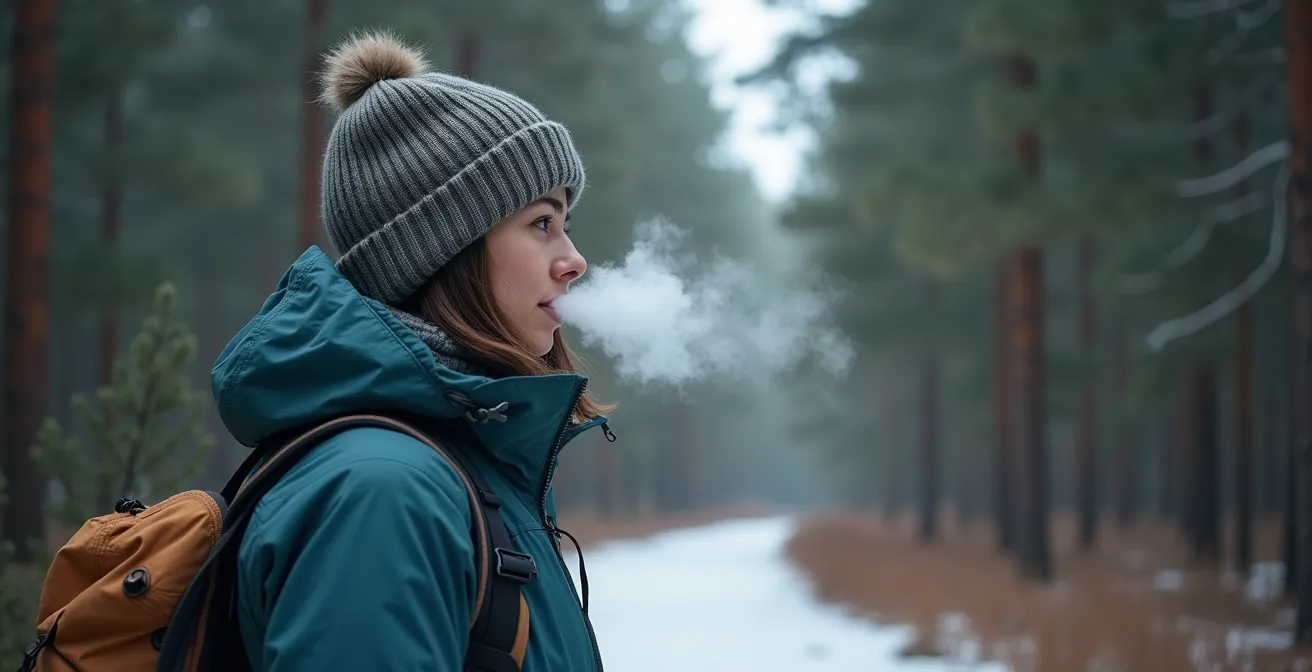
This transition from active movement to static observation is the most critical moment. Adding your insulation layer, a warm hat, and insulated gloves traps your existing body heat, creating a comfortable microclimate for your practice. Never remain static in damp base layers; this is where the risk of hypothermia peaks. According to a study on thermoregulation during exercise, managing moisture is paramount for safety in cold environments. Mastering this active layering protocol is the key to comfortable and safe winter Shinrin-yoku.
Why Does 3 Days in an Old-Growth Forest Lower Blood Pressure More Than a Beach Vacation?
While a beach vacation is relaxing, multi-day immersion in a forest—especially an old-growth forest—triggers deeper and more lasting physiological changes, including a significant reduction in blood pressure. This profound effect is rooted in a combination of reduced sensory distraction and the powerful psychological experience of awe.
In winter, this effect can be even more potent. The simplified, minimalist landscape of a snow-covered forest reduces sensory overload. There are fewer colours, sounds, and movements competing for your attention. This allows the nervous system to shift more easily from a “fight or flight” state to a “rest and digest” state, which is directly linked to lower blood pressure and heart rate. The forest isn’t just quiet; it’s neurologically calming.
The second, and perhaps more powerful, mechanism is the “awe response.” Standing in the presence of something vast and ancient—like the towering trees of an old-growth forest—triggers a sense of awe. This emotion has been shown to reduce levels of pro-inflammatory cytokines, proteins that are linked to cardiovascular disease and other health issues. It’s a humbling experience that literally calms inflammation in the body. The grandeur of a snow-covered ancient forest amplifies this effect.
For those in Canada, accessible old-growth stands like Cathedral Grove in British Columbia or the forests of Temagami in Ontario provide this profound awe experience. In Ireland, where true old-growth is rare, ancient heritage woodlands or even individual 500-year-old Oak or Yew trees can carry a similar cultural and biological significance. Connecting with these “witness trees” delivers a comparable awe response through their deep historical and ecological resonance. It is this unique combination of sensory calm and psychological awe that makes a forest immersion a uniquely powerful form of therapy.
Key Takeaways
- Master Thermal Regulation: Start your walk feeling cool and actively vent to prevent sweat, then add a heavy insulating layer during static moments. Dryness is more important than initial warmth.
- Prioritize Coniferous Forests: Seek out pine, spruce, or fir trees in winter, as they continue to release immune-boosting phytoncides when deciduous trees are dormant.
- Embrace the Sensory Shift: Utilize the quiet of a snow-dampened landscape to sharpen your visual focus on textures, patterns, and the unique quality of winter light.
- Time Your Walk Strategically: Use the midday window (11 a.m. – 2 p.m.) for a biological boost against SAD, and the ‘golden hours’ of morning and afternoon for psychological restoration.
How to Start Cold Water Dipping in the Atlantic Without Risking Cardiac Arrest?
Extending the principles of winter nature therapy to its ultimate expression, cold water dipping in the Atlantic requires strict safety protocols and profound respect for the power of the cold. The goal is a controlled, mindful immersion, not an endurance test. Starting safely is paramount to avoid the risk of cold water shock and cardiac arrest.
The most important rule is to never start in the deep of winter. Your body needs to acclimatize. Begin in the autumn when the water temperatures are gradually dropping, allowing your system to adapt over weeks and months. When you do enter the water, you must consciously control the ‘Cold Shock Response’—that initial gasp and hyperventilation. The key is to focus on a slow, controlled exhale as you enter the water. This calms the nervous system and gives you control over your breathing. Initial dips should be extremely short, from 30 to 60 seconds is more than sufficient to gain the benefits of hormetic stress.
As local communities will attest, you should never, ever dip alone. Joining an existing group provides a critical safety net and a powerful sense of community support.
For Ireland, tap into the massive cultural phenomenon of sea swimming at iconic spots like the Forty Foot in Dublin or Blackrock Diving Tower in Galway, where joining an existing group is the safest and most rewarding way to start.
– Local Irish Sea Swimming Communities
Finally, the pre- and post-dip rituals are as important as the immersion itself. Use a short forest bathing walk beforehand to get into a mindful, grounded state. Have warm, dry, loose-fitting clothes and a hot drink ready for the moment you get out. The walk back through the woods can then serve as a period of mindful re-warming and integration, completing a powerful cycle of nature-based therapy.
Action Plan: Safe Cold Water Dipping Protocol
- Begin acclimatization in autumn – never start in deep winter without gradual adaptation.
- Control the Cold Shock Response with focused, slow exhales during initial immersion.
- Limit initial dips to 30-60 seconds maximum – a brief immersion is sufficient for benefits and safer.
- Never dip alone – join existing groups for safety and community support.
- Have warm, dry clothes and a hot drink ready immediately post-dip.
- Use forest bathing beforehand to achieve a mindful, grounded state for cold preparation.
- Walk back through the woods as a mindful re-warming and integration period.
Your journey into winter Shinrin-yoku begins not with a leap into a frozen lake, but with a single, mindful step out your front door. Use these principles as your guide to practice safely, build resilience, and discover the profound and quiet beauty of the forest in its winter slumber. The rewards are waiting.