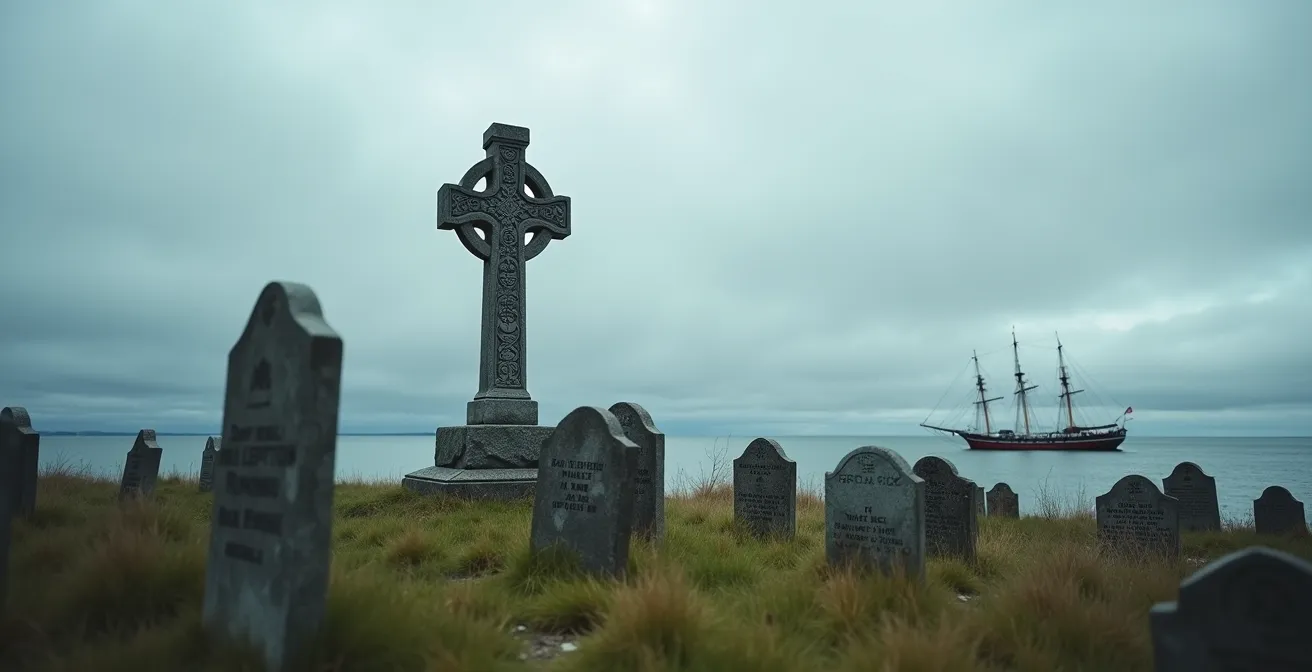
The story of Irish Famine “emigration” is not one of choice, but of forced displacement driven by a systemic collapse that continued long after the ships left Ireland.
- The catastrophic death rates at sea were a direct result of a predictable “chain of infection” beginning with malnutrition and eviction in Ireland.
- Tracing an ancestor requires a specific archival strategy, as Famine-era records differ significantly from those of earlier, more organized migrations.
Recommendation: To truly connect with your ancestor’s story, shift your focus from simply finding a name to reconstructing the full context of their journey—from their lost home in Ireland to their arrival in an overwhelmed Canada.
For many Canadians of Irish descent, the story of their family’s arrival is a ghostly echo, a tale of hardship and survival centered on the harrowing transatlantic voyage during the Great Famine. You may have heard the term “coffin ship” and know the destination: Grosse Île, the quarantine station in the St. Lawrence River that became a symbol of both tragedy and resilience. But to truly grasp what your ancestors endured, we must look beyond the general narrative of suffering. Standard genealogical research often focuses on finding names and dates, but the 1847 journey was not a standard migration; it was an exodus born from a societal cataclysm.
The key to retracing this path is not simply to look for a passenger list. It is to understand the journey as a consequence of a complete systemic collapse. This perspective changes everything. It reframes the voyage not as a single, tragic event, but as the final, fatal stage of a process that began with eviction from a cold cottage and ended in the fever sheds of Quebec or Montreal. Photography was not yet common, so our understanding is built from sketches, newspaper accounts, and the stark data found in archives—records that tell a story of desperation, not ambition.
This guide will equip you with the historical context and practical strategies needed to follow in their footsteps. We will deconstruct the “why” behind the tragedy, providing an archival roadmap to find their names, and exploring the physical landscapes in Ireland and Canada that still bear witness to their passage. This is more than a genealogical exercise; it’s a journey of remembrance and a way to honour the profound reality of their forced displacement.
To provide a visual and emotional complement to the historical details in this guide, the following song powerfully evokes the atmosphere and sorrow of the coffin ship experience.
To navigate this complex history, this article is structured to guide you from the core reasons for the tragedy to the practical steps for your own research and potential pilgrimage. The following sections will provide the context and tools to piece together your ancestor’s journey.
Summary: A Historical and Genealogical Guide to the Irish Famine Migration to Canada
- Why Did 30% of Passengers Not Survive the Voyage to Canada in 1847?
- How to Find Your Ancestor’s Name on Transatlantic Passenger Lists Online?
- Grosse Île vs. Partridge Island: Which Quarantine Site Offers the Best Historical Insight?
- The Myth of “Voluntary Migration” That Distorts 19th Century History
- Planning Your Ancestral Return: A 10-Day Itinerary from Cobh to Liverpool
- Push vs. Pull Factors: What Really Drove Pre-Famine Emigration?
- How to Request Archives from the National Library of Ireland from Canada?
- How Did the Great Famine Specifically Shape the Demographics of Montreal’s Griffintown?
Why Did 30% of Passengers Not Survive the Voyage to Canada in 1847?
The staggering mortality rate on the coffin ships in 1847 was not a simple matter of bad luck or a long voyage. It was the direct result of a predictable and horrifying “chain of infection” that began long before the passengers boarded. The systemic collapse of Irish rural society created the perfect conditions for an epidemic. According to a historical analysis of government statistics by RTE, a devastating 17% of all passengers from Ireland died either at sea, in quarantine, or in the hastily erected emigrant hospitals upon arrival in Canada.
This chain of infection had several deadly links:
- Pre-existing Malnutrition: Years of famine had already weakened the immune systems of the rural poor, making them highly susceptible to any illness.
- Overcrowding: To maximize profits, landlords and ship owners packed hundreds of people into cargo holds never designed for human transport. Some ships carried over 700 passengers in horrifically cramped and unsanitary conditions.
- “Ship Fever”: Typhus, a disease spread by lice, thrived in these confined spaces. Once one person was infected, the disease swept through the decks with terrifying speed.
- Inadequate Provisions: The journey could last from 15 to 40 days, yet there were often no doctors, minimal medical supplies, and insufficient food and fresh water.
The story of The Agnes provides a chilling case study. It arrived from Ireland on May 27, 1847, with 427 people aboard. Forced to quarantine on the ship itself due to the overwhelmed facilities at Grosse Île, the disease ran rampant. By the end of their 15-day quarantine, only 150 people were still alive. This wasn’t an anomaly; it was the grim, calculated outcome of placing desperate, sick people in deadly environments.
How to Find Your Ancestor’s Name on Transatlantic Passenger Lists Online?
Finding an ancestor from the Famine era requires a different archival strategy than for other periods. While some records are lost, many have been digitized, offering a powerful starting point for your research. The single most important resource for tracing an ancestor who landed in Quebec is the Grosse Île quarantine station database, which is now part of a larger collection at Library and Archives Canada.
This database is a remarkable tool. You can search through 33,026 immigration records from 1832-1937, a collection that includes thousands of names inscribed on the memorial. Finding a name here is a profound moment, a direct link to the arrival point. Your search should begin with any known information: a family name, an approximate year of arrival, or a ship’s name if it has been passed down through family lore. Be prepared for variations in spelling, as names were often recorded phonetically by English-speaking clerks.

Beyond this primary database, expand your search to other key resources. Websites like Ancestry and FamilySearch have extensive collections of Canadian and Irish records, including census data, church records, and other passenger lists. For Famine-era ancestors, church records are often more valuable than civil records, as many arrived before comprehensive civil registration was established. Cross-referencing a name found on a Grosse Île list with a baptismal or marriage record in a Quebec or Ontario parish can provide the definitive connection you are looking for.
Grosse Île vs. Partridge Island: Which Quarantine Site Offers the Best Historical Insight?
For descendants tracing their family’s journey, visiting a quarantine site can be a powerful pilgrimage. While Grosse Île is the most famous, it wasn’t the only one. Partridge Island, in the harbour of Saint John, New Brunswick, also served as a major quarantine station for Irish immigrants. Choosing which site offers the best historical insight depends on your ancestor’s port of arrival and what you hope to experience.
As Parks Canada states, “Grosse Île serves as a memorial to the tragic events endured by Irish immigrants, especially during the 1847 typhus epidemic when nearly 100,000 people, the majority escaping the Great Famine, set sail for Canada.” This status as a National Historic Site means it is exceptionally well-preserved and interpreted for visitors. The infrastructure, including hospitals and the Irish cemetery where over 5,000 are buried, provides a tangible, heart-wrenching connection to the past. In contrast, Partridge Island is less developed, though it also features a Celtic Cross memorial.
The following table, drawing from information provided by Parks Canada and other archival sources, compares the two key sites:
| Aspect | Grosse Île (Quebec) | Partridge Island (New Brunswick) |
|---|---|---|
| Records Available | 33,026 detailed immigration records, burial indexes, medical logs | Limited records via Provincial Archives |
| Modern Access | National Historic Site with guided tours May-October | More challenging access, less developed |
| Memorial Features | Celtic Cross, preserved hospitals, Irish cemetery | Celtic Cross memorial, less preserved infrastructure |
| Peak Year Deaths | 5,424 burials in 1847 alone | Fewer documented casualties |
| Settlement Impact | Led to Quebec/Ontario communities | Shaped Maritime Irish communities |
For most descendants whose ancestors arrived through the Port of Quebec, Grosse Île offers a far more comprehensive and moving experience. The wealth of available records, combined with the preserved landscape and expert-led tours, allows for a much deeper understanding of the events of 1847. It is not just a memorial but an outdoor museum and an archive, making it the premier destination for historical insight into the Famine migration to Canada.
The Myth of “Voluntary Migration” That Distorts 19th Century History
The term “emigration” itself can be misleading when discussing the Great Famine. It implies a degree of choice, a weighing of options, and a planned departure. For hundreds of thousands of Irish in 1847, there was no choice. Their journey was not voluntary migration; it was forced displacement. This distinction is crucial to understanding the trauma and injustice at the heart of the coffin ship story. The exodus was a direct consequence of eviction, a brutal policy used by landlords to clear their estates of destitute tenants.
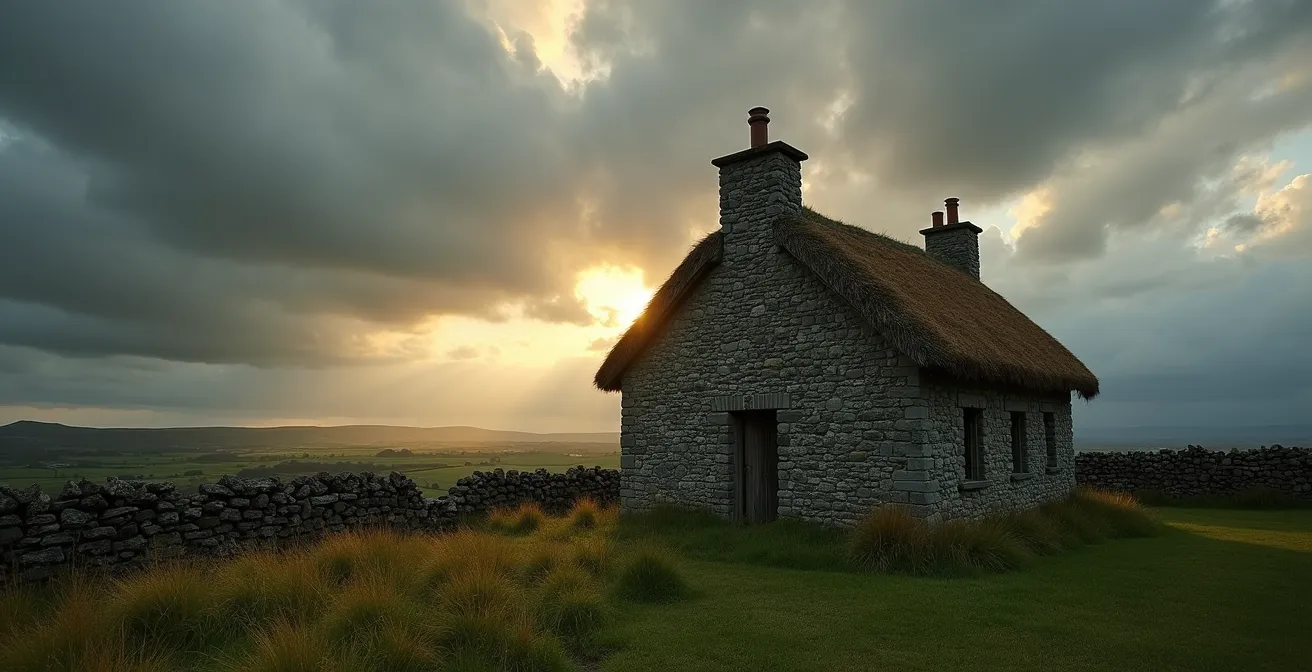
During the Famine, an estimated half-million Irish were evicted from their homes. Some landlords, eager to rid themselves of responsibility for the starving, implemented “assisted emigration” schemes. As historical records show, these were often cruel hoaxes. Landlords would make phony promises of money, food, and clothing to entice tenants to leave. They were then packed, often half-naked and starving, onto the cheapest possible vessels—the sailing ships that would earn the name “coffin ships.” They were not choosing a new life in Canada; they were being expelled from their homeland to face near-certain death.
The sheer scale of this expulsion is staggering. It is estimated that between 1845 and 1855, over 2 million Irish left their homeland, a catastrophic demographic event from which the island has never fully recovered. They were fleeing a landscape of starvation, disease, and mass graves. To call this a choice is to fundamentally distort the historical reality and dishonour the memory of those who were given an ultimatum: leave or starve.
Planning Your Ancestral Return: A 10-Day Itinerary from Cobh to Liverpool
A journey to trace your ancestors’ path can be a profoundly emotional and rewarding experience. While the focus is often on the Canadian arrival point, a full pilgrimage should ideally begin where their journey did: in Ireland. A 10-day itinerary allows you to connect with both the “push” factors in Ireland and the departure ports that funneled the desperate towards North America. This itinerary suggests a route from the south of Ireland up to the key port of Liverpool.
Days 1-3: County Cork & Cobh. Start in the county your ancestors may have left. Visit the Cobh Heritage Centre, located in the original Victorian railway station. Cobh (then Queenstown) was one of the single most important ports of emigration. Standing on the quayside where they would have last seen Ireland is a powerful moment.
Days 4-6: Dublin & National Archives. Travel to Dublin. Spend a day at the EPIC The Irish Emigration Museum. Dedicate another day to the National Library and National Archives of Ireland. Even if you don’t find a direct record, immersing yourself in the documents of the period provides invaluable context. This is also where you can connect with professional genealogists if you hit a roadblock.
Days 7-10: Liverpool. From Dublin, take the ferry to Liverpool, mirroring a common route for Irish emigrants seeking passage. Liverpool was the primary departure port for coffin ships. Visit the Merseyside Maritime Museum, which has extensive exhibits on emigration, and walk the docks at the Royal Albert Dock. Standing there, you are in the very place your ancestor may have waited, filled with fear and a sliver of hope, before boarding the ship that would take them to Grosse Île.
Push vs. Pull Factors: What Really Drove Pre-Famine Emigration?
To understand the unique horror of the Famine migration, it’s essential to contrast it with the Irish emigration that came before. Prior to the 1840s, leaving Ireland for Canada was often driven by “pull” factors—the promise of a better life. Canada was actively recruiting settlers, and the journey, while still difficult, was part of an organized and often supported process. It was emigration by choice, not by desperation.
A prime example is the work of the Canada Company and government-sponsored schemes like Peter Robinson’s settlements in the 1820s. Unlike the evicted Famine poor, these earlier settlers were often given tangible support. Peter Robinson’s settlers, for instance, were provided with land, a cow, basic farming implements, and even three bushels of seed potato. This successful scheme created a powerful “pull,” demonstrating that a prosperous life was possible. Word sent back home by these successful pioneers encouraged “chain migration,” where families and neighbours would follow the path to established communities.
The numbers show this was a well-trodden path long before the blight. Around 1830, for example, official data shows that of the roughly 30,000 immigrants arriving annually in Quebec, two-thirds were Irish. This was a steady, organized flow of people seeking economic opportunity. They were pulled by the promise of land and a future, a stark contrast to the Famine generation who were pushed out by starvation and the threat of immediate death. The pre-Famine emigrant packed their tools; the Famine refugee had nothing left to pack.
How to Request Archives from the National Library of Ireland from Canada?
For a Canadian researcher, accessing records held in Ireland can seem daunting, but modern technology and established institutions have made it more achievable than ever. Your archival strategy should be a mix of online searches and, if necessary, targeted professional assistance. The National Library of Ireland (NLI) and the National Archives of Ireland (NAI) are your primary targets, and much can be accomplished from across the Atlantic.
Start with what’s available online. The NLI has digitized its entire collection of Catholic parish registers, which are crucial for finding baptisms, marriages, and burials before civil registration began in 1864. These are freely accessible. You should also search their digital collections for land records, such as the Encumbered Estates Court records, which can reveal details about the sale of estates from which your ancestors may have been evicted. If you hit a wall, consider engaging a professional. The Association of Professional Genealogists in Ireland (APGI) maintains a list of accredited researchers who can perform targeted searches on your behalf.
Your Action Plan for Accessing Irish Archives from Canada
- Search NLI’s digital collections: Focus on the freely available Catholic parish registers and Encumbered Estates Court records for clues about location and eviction.
- Access microfilms locally: Check with major Canadian institutions like St. Michael’s College in Toronto or Memorial University in Newfoundland, as they hold extensive Irish microfilm collections.
- Engage a professional: If your search stalls, contact a member of the Association of Professional Genealogists in Ireland (APGI) for on-the-ground research.
- Budget for services: Be prepared for professional research fees, which typically range from €50-€100 per hour for an experienced genealogist.
- Explore Canadian-Irish archives: Don’t overlook resources in Canada. Institutions like Library and Archives Canada hold key immigration records that can provide the missing link back to an Irish townland.
Finally, remember that many crucial Irish record sets have been microfilmed and are available within Canada. The table below highlights some key collections accessible without leaving the country.
| Canadian Institution | Irish Collections Available | Access Method |
|---|---|---|
| Library and Archives Canada | Grosse Île records, passenger lists 1865-1935 | Online database |
| St. Michael’s College, Toronto | Irish parish microfilms | In-person research |
| Memorial University, NL | Maritime Irish immigration records | Archives appointment |
| FamilySearch Centers | Griffith’s Valuation, Tithe Books | Free online/in-person |
Key Takeaways
- The 1847 “coffin ship” tragedy was not an accident but the result of a predictable “chain of infection” created by malnutrition, eviction, and overcrowding.
- Retracing a Famine ancestor requires a specific archival strategy focused on official quarantine records (Grosse Île), church registers, and land records, as opposed to standard passenger lists.
- The term “emigration” is a misnomer for the Famine era; “forced displacement” more accurately describes the experience of those evicted and sent to Canada on landlord-sponsored ships.
How Did the Great Famine Specifically Shape the Demographics of Montreal’s Griffintown?
The impact of the Famine migration was not confined to the quarantine station at Grosse Île. For the thousands who survived the initial quarantine, the journey continued to cities like Montreal, where the systemic collapse simply followed them. The sudden influx of sick and destitute Irish permanently transformed the city’s demographics, particularly in the waterfront neighbourhood of Griffintown.
As the Canada Ireland Foundation notes, “The sudden arrival of Irish Famine emigrants across British North America in 1847 overwhelmed civic officials and priests and nuns who tried to care for them.” Montreal was unprepared. To handle the crisis, twenty-two temporary “fever sheds” were erected at Pointe-Saint-Charles, at the entrance to the Lachine Canal. These sheds, meant to be a place of healing, became another site of mass death. The conditions mirrored those on the ships, and typhus continued its deadly work. According to records kept by the heroic Grey Nuns who tended to the sick, a staggering 6,000 emigrants died in Montreal’s fever sheds alone. Their bodies are buried in a mass grave nearby, marked today by the Black Rock.

Those who survived this second ordeal formed the bedrock of Griffintown. The neighbourhood, situated along the Lachine Canal, became the city’s first and most famous Irish enclave. The survivors provided the labour that built the canal, the Victoria Bridge, and the surrounding factories. They established St. Ann’s Church as the heart of their community and created a vibrant, tight-knit, but impoverished neighbourhood that would define Irish Montreal for a century. The Famine, therefore, did not just bring people to Montreal; it created a specific community forged in tragedy, resilience, and hard labour, leaving a permanent demographic and cultural imprint on the city.
Frequently Asked Questions About the Coffin Ship Journey
How do I access Grosse Île today?
The island is a National Historic Site accessible by a private boat service from Berthier-sur-Mer (a 45-minute drive from Quebec City). It is open to the public from May to October, and visiting is the most direct way to connect with the history of the quarantine station.
What emotional milestones should I include in my pilgrimage?
A powerful pilgrimage connects the archival with the physical. Key milestones include finding your ancestor’s name on the Grosse Île memorial wall, walking the grounds where the hospital and fever sheds stood, visiting Montreal’s Black Rock memorial, and, if possible, standing in the Irish field or townland they were forced to leave behind.
Which Irish genealogy centers can help locate my ancestral townland?
If you are planning a trip to Ireland, county-based heritage and genealogy centers are invaluable. Centers in counties with high rates of emigration, such as Clare, Mayo, Galway, and Cork, offer specialized research services. They can often help pinpoint an exact ancestral townland and sometimes even the ruins of a former cottage, providing the ultimate connection to your family’s origins.