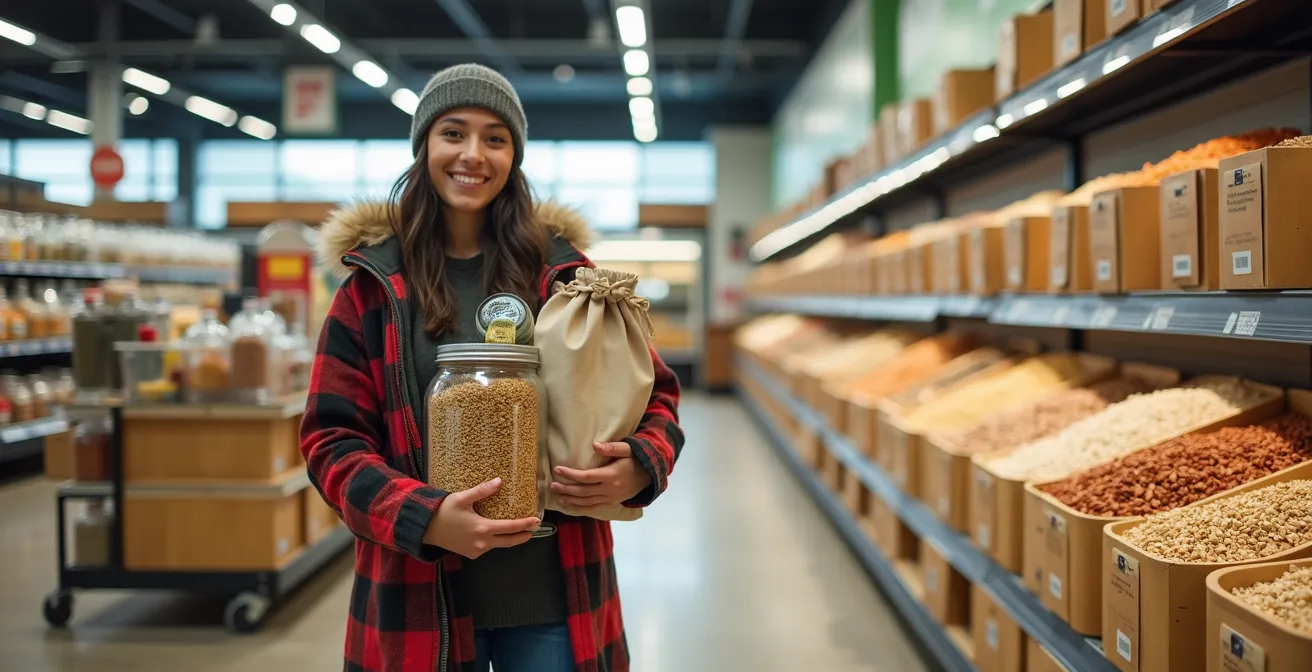
The key to meaningful waste reduction in a standard Canadian supermarket isn’t achieving plastic-free perfection, but making system-aware choices based on how products are made and what *actually* gets recycled in your municipality.
- Focus on avoiding “wish-cycling” complex materials like Tetra Paks, which often end up in landfills despite your blue bin.
- Prioritize reducing food waste through smart storage and composting, which can have a massive impact on your household’s footprint.
Recommendation: Start by analyzing the life cycle of a single daily item, like your coffee, to build the critical thinking skills needed for impactful, low-waste shopping anywhere.
Walking into a conventional Canadian supermarket like Loblaws, Sobeys, or Metro can feel defeating for anyone trying to reduce their waste. Aisles overflow with plastic-wrapped produce, pre-packaged meals, and disposable containers. The common advice—”bring your own bags,” “buy in bulk”—often feels inadequate or impossible when you don’t have a dedicated zero-waste store nearby. You end up feeling stuck, choosing between the lesser of two plastic-wrapped evils.
This frustration stems from a focus on an unattainable ideal. We’re told to avoid all packaging, but the system isn’t built for that. But what if the true path to progress isn’t about achieving plastic-free purity, but about becoming a more discerning, system-aware consumer? The real key is to understand the hidden life cycle of the products on the shelf and the realities of Canada’s municipal recycling infrastructure. It’s about moving beyond wishful thinking and making informed “lesser evil” choices that have a genuine impact.
This guide will equip you with that pragmatic mindset. We won’t just list what to buy. We will dissect the tricky decisions you face in every aisle, from choosing the right food wrap to understanding why some packaging is destined for the landfill no matter what. We will explore how to manage food waste effectively, rethink gift-giving, and ultimately, arm you with a mental tool to assess the true impact of your daily habits, turning your grocery run from a source of guilt into an act of pragmatic activism.
This article will guide you through the key dilemmas and solutions for reducing waste in a regular grocery store. The following table of contents outlines the specific, practical topics we’ll cover to help you navigate your next shopping trip with confidence.
Summary: A Pragmatic Guide to Low-Waste Groceries in Canada
- Beeswax Wraps vs. Silicone: Which Actually Keeps Cheese Fresh Longer?
- Vermicomposting: How to Keep Worms Under Your Sink Without Smells?
- Bulk Barn vs. Refill Stations: Which Is Cheaper for Laundry Detergent?
- Tetra Paks: Why Are They So Hard to Recycle in Many Municipalities?
- Experience Gifts: How to Give Meaningful Presents Without Physical Clutter?
- Freezing Stew: How long Can You Keep It Before the Texture Degrades?
- Zero-Waste Weddings: How to Celebrate Without Generating 400 lbs of Trash?
- How to Conduct a ‘Life Cycle Assessment’ of Your Daily Habits?
Beeswax Wraps vs. Silicone: Which Actually Keeps Cheese Fresh Longer?
The choice between reusable food wraps is a classic zero-waste dilemma. Beeswax wraps appeal for their natural, compostable nature, while silicone bags promise durability and an airtight seal. However, the “best” option isn’t universal; it depends entirely on the food you’re storing and your commitment to using the product. The goal is to match the material’s properties to the food’s needs to prevent spoilage, which is a far greater source of waste.
For items like hard cheeses or a loaf of bread, the breathability of beeswax wraps is a major advantage, preventing the condensation that can lead to sogginess or premature mould. However, this same quality makes them less ideal for high-moisture foods. In fact, a University of Montana study on cheese preservation found that cheese wrapped in beeswax developed mould faster than samples in plastic, suggesting it’s not the best choice for softer, high-moisture cheeses. On the other hand, silicone bags offer an airtight seal, perfect for marinades, cut fruit, or preventing freezer burn, but their lack of breathability can be detrimental to other foods.
Furthermore, the environmental benefit of a reusable product is only realized after a certain number of uses. A silicone bag, for example, must be used for around 18 months to offset its production emissions when replacing three plastic bags per week. This highlights a core principle of system-aware consumption: a reusable item you don’t use frequently is not inherently better than a disposable one.
The following table breaks down the key differences to help you make an informed choice based on your actual kitchen habits.
| Feature | Beeswax Wraps | Silicone Bags |
|---|---|---|
| Breathability | Excellent – prevents condensation | None – airtight seal |
| Lifespan | 6-12 months | 5+ years |
| Best for | Hard cheeses, bread | Wet foods, marinades |
| Temperature limit | Melts at 85°F | Up to 450°F |
| End of life | Compostable | Recyclable (limited facilities) |
Ultimately, the most sustainable choice is the one that best preserves your food, preventing it from being wasted. For a household that eats a lot of artisanal bread and hard cheese, a set of beeswax wraps is a fantastic investment. For a family that freezes batch-cooked meals and packs cut fruit for lunches, durable silicone bags will provide more value and prevent more waste over their long lifespan.
Vermicomposting: How to Keep Worms Under Your Sink Without Smells?
Reducing packaging is only half the battle; tackling food waste is equally critical. Composting is a powerful tool, but for those in apartments or without backyard space, vermicomposting—or composting with worms—is a surprisingly clean, odour-free, and compact solution that can be kept right under your kitchen sink. The key to a successful, smell-free worm bin is maintaining the right balance of moisture, air, and food, and understanding the specific needs of your wriggly tenants.
A properly managed bin does not smell like rotting garbage. Instead, it has a pleasant, earthy scent, much like a forest floor after it rains. Odours only arise when there’s an imbalance, typically from overfeeding (adding more food than the worms can process) or too much moisture, which creates anaerobic conditions. To avoid this, you should feed your worms a balanced diet of “greens” (fruit and vegetable scraps, coffee grounds) and “browns” (shredded newspaper, cardboard), burying the food scraps under the bedding to prevent fruit flies and smells.

As the image suggests, a modern vermicomposting setup is discreet and integrates seamlessly into a kitchen. The resulting product, worm castings, is a nutrient-rich “black gold” for houseplants or container gardens. For Canadians, managing a worm bin through the winter requires a few specific considerations to keep the ecosystem thriving even when it’s freezing outside. The following plan outlines how to manage a bin successfully within a Canadian context.
Your Action Plan: Canadian Winter Worm Bin Management
- Sourcing: Source Red Wigglers from Canadian suppliers like The Worm Factory (Ontario) or local BC worm farms to avoid the stress and regulations of cross-border shipping.
- Temperature Control: Maintain the bin temperature between 15-25°C. During cold Canadian winters, this means keeping the bin indoors and potentially using insulation like a blanket if it’s in a cooler basement.
- Harvesting & Storage: Store finished castings in sealed containers during the frozen months. This precious resource will be ready and waiting for your garden or houseplants in the spring.
- Feeding Canadian Scraps: Feed your worms local household scraps. They love Tim Hortons coffee grounds, peels from seasonal fruits like apples and pumpkins, and even waste from maple syrup production if you have access.
- Moisture Monitoring: Be extra vigilant about moisture levels, especially in dry Prairie winters. The air in our homes can be very dry, so you may need to mist the bedding more frequently to prevent the bin from desiccating.
Starting a worm bin is a tangible way to divert a significant amount of waste from landfills, reducing methane emissions and creating a valuable resource for your plants. It’s a closed-loop system in your own home, turning the problem of food scraps into a productive solution.
Bulk Barn vs. Refill Stations: Which Is Cheaper for Laundry Detergent?
The concept of refilling containers is central to the zero-waste movement, but its accessibility varies wildly across Canada. While independent refill stations are becoming more common in urban centres, for many Canadians, the most accessible option is a chain like Bulk Barn. This raises the question of which is better, not just for the planet, but for your wallet. The answer often depends on what products you’re buying and how you value convenience.
Independent refill stores often specialize in liquids like soaps, shampoos, and laundry detergents, which Bulk Barn typically doesn’t carry. For these items, refill stations are the clear winner. However, for pantry staples—flour, spices, nuts, pasta—Bulk Barn offers a widespread and practical solution. The key is to leverage their long-standing reusable container program.
Case Study: Bulk Barn’s Reusable Container Program
Bulk Barn, with locations across Canada, has made bulk shopping accessible in suburban and rural areas where independent refill stations are rare. Their program allows customers to bring their own clean, reusable containers. Before filling, cashiers weigh the empty container (a process called “taring”) and label it with its weight. At checkout, this weight is subtracted, ensuring you only pay for the product inside. This simple, effective system has normalized the practice of refilling and significantly reduced the need for single-use plastic bags for millions of Canadians.
This practice of avoiding packaging at the source is critically important due to the stark reality of our recycling systems. While we diligently put items in the blue bin, the unfortunate truth is that only 9% of plastic waste in Canada is actually recycled. The vast majority ends up in landfills, incinerators, or the environment. This makes every package we can refuse at the point of sale a significant win.
So, which is cheaper? It’s a mixed bag. For dry goods, Bulk Barn’s prices are often competitive, especially when you buy only the amount you need, reducing food and financial waste. For liquids like laundry detergent, a dedicated refill station is your go-to, and while the initial price per litre might seem higher, concentrated formulas often mean you use less, making it cost-effective in the long run. The most pragmatic approach is a hybrid one: use Bulk Barn for pantry staples and support a local refill station for your household liquids.
Tetra Paks: Why Are They So Hard to Recycle in Many Municipalities?
Tetra Paks and similar cartons, used for plant-based milks, soups, and broths, seem like a sustainable choice over plastic jugs. They’re lightweight and made primarily from paper, a renewable resource. However, their convenience masks a complex recycling challenge that illustrates the core of “recycling realism”: just because something is *technically* recyclable doesn’t mean it *will be* recycled in your town.
The difficulty lies in their composite nature. A Tetra Pak isn’t just paper; it’s a layered fusion of paper, plastic (polyethylene), and aluminum. To be recycled, these layers must be separated, a process that requires specialized, expensive machinery called “hydrapulpers.” These machines use water to pulp the cartons, allowing the heavier plastic and aluminum to separate from the paper fibres. Many smaller municipalities across Canada simply cannot afford this infrastructure, meaning the cartons they collect have no market and are often sent to the landfill.

As this visual representation suggests, separating these tightly bonded layers is a significant industrial challenge. This disparity in processing capability is why recycling rules for cartons can differ dramatically from one Canadian city to another. A major metropolitan area like Toronto or Vancouver may have the volume and funding to support a hydrapulper, while a smaller town in Saskatchewan or Nova Scotia does not. This is a perfect example of a systemic issue that individual consumers can’t solve alone, but can navigate with better information.
Before choosing a carton at the supermarket, the most impactful action you can take is to check your local municipality’s waste management website. Look for a “waste wizard” or a detailed list of accepted materials. If they explicitly state they accept “aseptic containers” or “cartons,” you can buy them with more confidence. If they don’t, opting for a product in glass, a more easily recyclable plastic (like #1 or #2), or making your own oat milk at home might be the more genuinely sustainable choice.
Experience Gifts: How to Give Meaningful Presents Without Physical Clutter?
The zero-waste philosophy extends beyond the kitchen and into all areas of consumption, including gift-giving. Shifting from physical objects to “experience gifts” is a powerful way to reduce waste, avoid unwanted clutter, and create lasting memories. An experience gift is any present that is an activity or event rather than a tangible item. This approach aligns perfectly with a minimalist, low-impact lifestyle and is often more meaningful for the recipient.
The beauty of experience gifts is their infinite variety and adaptability to any budget or interest. It could be as simple as a “coupon” for a home-cooked meal, a guided hike on a local trail, or a promise to babysit. For a larger budget, it could be tickets to a concert, a subscription to a streaming service, or a workshop to learn a new skill like pottery or cooking. These gifts show you’ve thought about what the person truly enjoys, rather than just buying an object for the sake of it.
In Canada, the changing seasons offer a wonderful palette for creative experience gifts. By tailoring the gift to the time of year, you can tap into unique local activities and support Canadian businesses and organizations. Here are some ideas to get you started, organized by season:
- Winter: A pass for a local conservation area for snowshoeing, a workshop at a sugar shack to learn about maple syrup production, or guided ice fishing lessons on a frozen lake.
- Spring: A tour of a maple syrup farm during tapping season, a membership for a local hiking guide association, or a wildflower photography workshop in a provincial park.
- Summer: Tickets to a Canadian music festival (like Osheaga or the Calgary Stampede), a guided kayak tour on one of the Great Lakes or a local waterway, or a cooking class at a farmers’ market.
- Fall: An apple orchard harvesting experience, a pre-booked camping reservation at a provincial park to see the fall colours, or a guided mushroom foraging course.
- Year-round: A streaming subscription to a Canadian service like Crave, a digital subscription to a Canadian publication (e.g., The Walrus, Maclean’s), or a pass to a national museum.
By choosing to give experiences, you are not only preventing an unwanted item from potentially ending up in a landfill, but you are also giving something far more valuable: your time, your thoughtfulness, and the opportunity for a shared memory. It’s a shift in mindset from “what can I buy them?” to “what can we do together?”.
Freezing Stew: How long Can You Keep It Before the Texture Degrades?
One of the most effective ways to combat household waste is to prevent food from spoiling in the first place, and the freezer is your best ally. Batch cooking and freezing meals like stew, chili, or soup is a cornerstone of a low-waste kitchen. It saves time, money, and prevents the tragedy of throwing out forgotten leftovers. However, there’s a limit to how long food can stay frozen before its quality, particularly its texture, begins to suffer.
For most cooked stews and soups, the sweet spot for freezer storage is 2 to 3 months. Within this timeframe, the dish will retain most of its original flavour and texture. Beyond this, it’s still perfectly safe to eat, but you’ll start to notice changes. The biggest enemy in the freezer is ice crystal formation. Large ice crystals can rupture the cell walls of vegetables like potatoes and carrots, making them mushy and watery upon reheating. Meats can also become tougher over extended periods.
To maximize the life of your frozen stew, follow these key principles:
- Cool it down completely: Never put a hot stew directly into the freezer. Let it cool to room temperature first, then chill it in the fridge. This prevents the freezer’s temperature from rising and promotes faster, more even freezing, which results in smaller ice crystals.
- Use airtight containers: Exposure to air causes freezer burn, which dehydrates the food and imparts off-flavours. Use well-sealed containers or reusable silicone bags, leaving a small amount of headspace (about an inch) for the liquid to expand.
- Label everything: Always label your container with the name of the dish and the date it was frozen. This prevents “mystery meals” and ensures you’re following the “first in, first out” rule.
This approach is a direct response to a significant national issue, as food waste is a big problem in Canada, with households being a major contributor. Every portion of stew you save from the compost bin is a small but meaningful victory.
When it’s time to reheat, the best method is to thaw the stew slowly in the refrigerator overnight. This gentle thawing helps maintain the texture better than a microwave. If some vegetables have become a bit soft, you can revive the stew by adding a handful of fresh herbs or a squeeze of lemon juice at the end to brighten the flavours.
Zero-Waste Weddings: How to Celebrate Without Generating 400 lbs of Trash?
The average wedding can be a massive source of waste, from single-use decorations to food surplus. However, applying the principles of low-waste living to a large-scale event is entirely possible, and a growing number of Canadian couples and vendors are pioneering creative, beautiful, and sustainable celebrations. The key is to apply the same “system-aware” thinking you use in the grocery store to every decision, from the venue to the party favours.
A zero-waste wedding doesn’t mean sacrificing style or hospitality. It means making conscious choices to prioritize reusability, local sourcing, and waste diversion. This can involve renting everything from linens and dishes to decorations, choosing a venue with a robust composting and recycling program, and sending digital invitations to avoid paper waste. The goal is to reduce waste at the source so there’s less to manage at the end of the night.
Case Study: The Canadian Zero-Waste Vendor Approach
Pioneering zero-waste stores across Canada, such as Nada in Vancouver, Unboxed Market in Toronto, and The Tare Shop in Halifax, offer a model that wedding vendors can adopt. These businesses champion community-focused sustainability. For a wedding, this translates to florists partnering with local farms for seasonal, pesticide-free flowers; caterers working with food rescue organizations like Second Harvest to donate leftovers; and rental companies offering returnable container programs for everything from serving dishes to guest favours.
One of the most impactful areas to focus on is the menu. Planning a “100-mile menu” not only supports local farmers and reduces transportation emissions but also ensures the food is fresh and seasonal. Here are some actionable steps for planning a low-waste, Canadian-centric wedding menu and celebration:
- Source Locally: Commit to sourcing all major ingredients from farms and producers within a 100-mile or 160-kilometre radius of your venue.
- Partner for Leftovers: Before the event, establish a partnership with a Canadian food rescue organization like Second Harvest to arrange for the pickup and donation of any unserved food.
- Replantable Decor: Use native Canadian potted plants and flowers as centrepieces. At the end of the night, these can be given to guests to replant in their own gardens.
- Give Meaningful Favours: Offer local and consumable favours that won’t be thrown away, such as small jars of maple syrup from a local sugar bush, local honey, or packets of native wildflower seeds.
- Choose Smart Venues: Select a venue in a city like Toronto, Calgary, or Halifax that has established low-waste practices and strong municipal composting programs.
Ultimately, a zero-waste wedding is about intentionality. By communicating your values to your vendors and guests, you can create a celebration that is not only a reflection of your love for each other but also your respect for the environment. It proves that sustainability and celebration can, and should, go hand in hand.
Key Takeaways
- The most impactful zero-waste strategy in a conventional store is not perfection, but making informed “lesser evil” choices based on product life cycles.
- Understand your local Canadian recycling system’s limitations to avoid “wish-cycling” complex materials like Tetra Paks, which often end up in landfills.
- Reducing food waste through practical methods like vermicomposting and proper freezing is just as crucial as reducing your packaging consumption.
How to Conduct a ‘Life Cycle Assessment’ of Your Daily Habits?
After exploring specific dilemmas from cheese wraps to weddings, the final step is to internalize the underlying mental model: the Life Cycle Assessment (LCA). This sounds technical, but in practice, it’s a simple way of thinking about the entire journey of a product, from creation to disposal. Applying a mini-LCA to your daily choices is the single most powerful tool for becoming a truly system-aware consumer. It moves you from simply asking “Is this recyclable?” to asking “What is the true cost of this item?”
A life cycle assessment looks at every stage: the extraction of raw materials, the energy used in manufacturing, the emissions from transportation, the resources consumed during its use, and finally, its end-of-life fate—whether it’s reused, recycled, composted, or sent to a landfill. You don’t need a spreadsheet or scientific data; a simplified, qualitative assessment is enough to reveal surprising truths, as the following Canadian example shows.
Case Study: The Morning Double-Double Life Cycle Analysis
Let’s compare a daily Tim Hortons coffee to a home-brewed cup using fair-trade beans from a Canadian roaster like Kicking Horse Coffee. The Tim’s coffee involves a disposable cup (often with a plastic liner making it non-recyclable), a plastic lid, a sleeve, and the industrial process of a massive chain. The home-brewed coffee, made in a French press or drip machine and consumed in a ceramic mug, eliminates all single-use packaging. The life cycle analysis is clear: while both involve growing and roasting beans, the home-brew option drastically reduces the impact at the consumption and disposal stages, which are the parts you directly control.
This way of thinking can be applied to anything. Is it better to buy a cucumber wrapped in plastic or an unwrapped one that was air-freighted from another continent? The LCA helps you weigh the packaging waste against the transportation emissions. This critical thinking is the antidote to greenwashing and empowers you to make genuinely better choices within the systems available to you. The potential for impact is huge; some dedicated zero-waste practitioners have achieved an 80% reduction in their household garbage by applying this mindset consistently.
Start small. Pick one single, routine purchase—your morning yogurt, your afternoon snack bar, your bottle of soap. Spend five minutes thinking about its journey. Where did the ingredients come from? How was it packaged? What will happen to that package when you’re done? This simple exercise will begin to rewire your brain, transforming you from a passive consumer into an active, conscious participant in the food system.
Frequently Asked Questions About Zero-Waste Shopping
Why can Vancouver recycle Tetra Paks but smaller towns cannot?
Large Municipal Recycling Facilities in cities like Vancouver can afford ‘hydrapulper’ technology to separate the multiple layers of Tetra Paks, while smaller Saskatchewan or Nova Scotia towns lack this expensive equipment.
How will Extended Producer Responsibility (EPR) programs change Tetra Pak recycling?
EPR programs rolling out across BC, Ontario, and Quebec shift the financial burden from municipalities to producers, potentially funding better recycling infrastructure for complex packaging.
Which Canadian cities currently accept Tetra Paks in their recycling programs?
Most major census metropolitan areas including Toronto, Vancouver, Montreal, Calgary, and Ottawa accept Tetra Paks, but collection rules vary – always check your local municipality’s guidelines.