In summary:
- The high-impact nature of Irish dance requires a training approach focused on shock absorption and resilience, not just traditional cardio.
- Developing true stamina involves mastering neuromuscular dissociation (a rigid torso over fast feet) and building proprioceptive strength on uneven terrain.
- A non-negotiable, structured 20-minute recovery protocol is essential for managing inflammation and preventing overuse injuries.
- Your long-term career depends on shifting from a “practice more” mindset to a “train smarter” athletic system.
For any aspiring Irish dancer with dreams of the Riverdance stage, the goal is clear: explosive stamina. The power to execute intricate, rapid-fire footwork for minutes on end, all while maintaining a perfectly still upper body. The common advice you’ve heard a thousand times—run more, practice longer, push through the pain—often leads to a frustrating cycle of shin splints, knee pain, and burnout. It treats the symptoms, not the cause, and it’s the fastest route to a short career.
This approach fails to recognize a fundamental truth: elite Irish dancers are not just artists, they are high-performance athletes. The immense forces generated by hard-shoe dancing require a sophisticated training system, one that goes far beyond simple cardiovascular endurance. The constant, repetitive impact places unique stresses on the lower body that differ significantly from almost any other athletic activity, including other dance forms.
But what if the key to unlocking world-class stamina wasn’t about enduring more punishment, but about building a more resilient, efficient machine? This guide reframes the challenge. Instead of just focusing on the engine (your heart and lungs), we will re-engineer the chassis and suspension (your muscles, joints, and nervous system). We will move beyond the platitudes and into the science of systemic conditioning, proprioceptive resilience, and non-negotiable recovery protocols specifically tailored for the demands of Irish dance. This is your blueprint for building a body that can not only perform at its peak but thrive for a long and healthy career on stage.
This comprehensive guide will explore the specific biomechanics of Irish dance, compare career pathways, and provide actionable training and recovery strategies. You’ll find concrete drills, localized advice for dancers in Ireland and Canada, and a clear plan to build elite stamina without sacrificing your joints.
Summary: Training for Riverdance-Level Stamina
- Why Does Irish Step Dance Cause More Shin Splints Than Ballet?
- How to Maintain a Rigid Upper Body While Moving Your Feet at 140 BPM?
- Competition School vs. Performance Troupe: Which Path Leads to a Professional Career?
- The Perfectionism Trap: How It Leads to Early Retirement for 25% of Dancers
- Post-Show Recovery: The 20-Minute Routine to Reduce Inflammation
- Why Is Irish Set Dancing More Effective Than Jogging for Cardiovascular Health?
- Pavement vs. Trail: Why Is Uneven Ground Better for Your Ankles?
- How to Start “Rucking” (Weighted Walking) to Build Resilience in Bad Weather?
Why Does Irish Step Dance Cause More Shin Splints Than Ballet?
The answer lies in one word: impact. While both ballet and Irish dance are physically demanding, the fundamental biomechanics of how a dancer interacts with the floor are worlds apart. Ballet training emphasizes absorbing force through a deep, controlled plié, distributing the load across the ankle, knee, and hip. In stark contrast, Irish dance, with its rigid torso and relatively straight-legged landing style, channels significantly more impact force directly into the lower leg. This repetitive shock is the primary culprit behind the high rates of overuse injuries.
The data is clear and sobering. Research into dance injuries reveals that almost 80% of Irish dance injuries are attributable to overuse, not acute trauma. Of these, a staggering 95% involve the hip or lower extremity, with the most common sites being the foot, ankle, and knee. This isn’t an accident; it’s a direct consequence of the art form’s unique physical demands. The hard shoes, the amplified sound, and the very aesthetic of the dance all encourage a powerful, percussive connection with the floor, which, without proper impact load management, inevitably leads to conditions like shin splints and stress fractures.
To understand this difference, it’s helpful to visualize the landing mechanics. The image below contrasts the shock absorption patterns of each discipline.
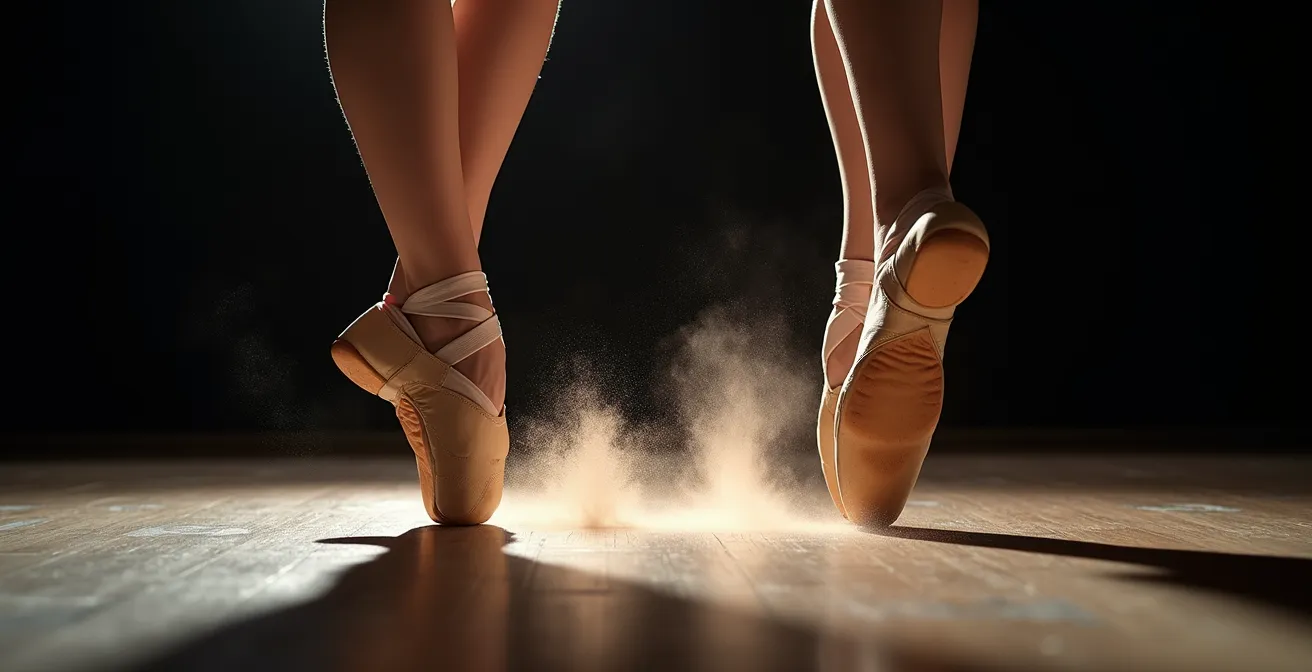
As you can see, the ballet dancer’s plié acts as a natural spring, dissipating energy. The Irish dancer’s posture, essential for the style, offers a more direct and less forgiving path for shockwaves to travel up the kinetic chain. Training for stamina, therefore, isn’t just about being able to dance longer; it’s about training your muscles to become better shock absorbers to protect the bones and joints from this relentless impact. This is the foundational principle for a long and healthy career.
How to Maintain a Rigid Upper Body While Moving Your Feet at 140 BPM?
This is the defining paradox of Irish dance: absolute stillness above the waist, and explosive, lightning-fast movement below. Achieving this requires more than just a “strong core”; it demands a highly developed skill called neuromuscular dissociation. This is the ability of your brain to send completely independent signals to different parts of your body simultaneously. You are consciously commanding your upper body to remain a solid, unmoving frame while your lower body executes complex rhythms at incredible speeds.
This is not a natural state. The body’s instinct is to use counter-movements for balance—swinging the arms to stabilize the legs, for example. To overcome this, you must train your nervous system just as much as your muscles. It’s about creating a “firewall” at your hips, allowing energy and movement to flourish below without disturbing the posture above. This efficiency is key to stamina; any extraneous upper body movement is wasted energy that you simply can’t afford in a long-form performance.
The following drills are designed specifically to train this mind-body separation. They force your brain to isolate muscle groups and build the deep postural strength needed to maintain that signature rigid form under pressure. Incorporate them into your training regularly to turn this conscious effort into an unconscious, automatic skill.
- Practice trebles while balancing a book on your head – start with 30 seconds and progress to 2 minutes.
- Hold a full glass of water at shoulder height while performing basic footwork patterns to train stability.
- Perform Tabata-style intervals: 20 seconds of high-intensity footwork with a rigid torso, followed by 10 seconds of rest, and repeat 8 times.
- Use diaphragmatic breathing: Inhale for 4 counts through the nose while maintaining rigid posture, then exhale for 6 counts.
- Practice “statue drills”: freeze your upper body completely while only moving your feet in rhythmic patterns.
Competition School vs. Performance Troupe: Which Path Leads to a Professional Career?
For aspiring professional Irish dancers, a critical question often arises: what is the best path to the professional stage? The two most common routes—rising through the ranks of a competitive school or joining a performance-focused troupe—build different skills and have different requirements. The competitive circuit is vast and demanding; the World Championships now attract approximately 5,000 competitors from over 30 countries, creating an intense environment focused on solo technical perfection.
Conversely, performance troupes, while still requiring high technical ability, prioritize stage presence, adaptability, and the stamina to perform in an ensemble for 90-minute shows. Neither path is inherently “better,” but they cultivate different strengths. A competitive dancer may have unparalleled technical precision in a two-minute solo, while a troupe performer excels at blending, storytelling, and maintaining energy over a full evening’s performance. Many professional shows like Riverdance recruit from both pools, looking for dancers who possess the technical foundation of a champion and the stagecraft of a seasoned performer.
A third path is also emerging through university programs, such as the one at the University of Limerick in Ireland, which offers degrees combining performance with choreography, pedagogy, and dance theory, preparing dancers for a broader range of careers within the industry. The table below outlines the key differences between these primary pathways.
| Path | Requirements | Timeline | Skills Emphasized |
|---|---|---|---|
| Competition School to Riverdance | Championship level, preferably World recall/placement | 10-15 years training | Technical precision, solo performance |
| Performance Troupe Circuit | Strong stage presence, ensemble skills | 5-8 years training | Showmanship, adaptability, stamina for 90-minute shows |
| University Programs (e.g., University of Limerick) | Academic qualifications plus dance experience | 3-4 year degree | Choreography, pedagogy, performance theory |
Ultimately, the “best” path is the one that aligns with your personal goals and temperament. However, all professional avenues demand a foundation of exceptional stamina and a body conditioned to withstand the rigors of performance, night after night. Understanding these different demands early on can help you tailor your training for the career you truly want.
The Perfectionism Trap: How It Leads to Early Retirement for 25% of Dancers
Irish dance is an art form judged on precision, and this culture can breed a dangerous level of perfectionism. The desire to achieve flawless technique, perfect turnout, and an unshakeable upper body is a powerful motivator. However, when this drive becomes obsessive, it transforms into a significant risk factor for both mental burnout and physical injury. Dancers caught in the perfectionism trap often over-train, ignore the early warning signs of pain, and tie their self-worth exclusively to their performance. This creates a high-stress environment where the body is in a constant state of “fight or flight,” which can impede recovery and heighten the risk of injury.
This isn’t just anecdotal; research identifies that psychological factors are significantly correlated with injury rates in elite-level dancers. The pressure to be perfect can lead a dancer to push through the pain of emerging shin splints, for instance, turning a manageable issue into a chronic condition or even a stress fracture. The statistic that up to 25% of dancers retire early due to injury is often viewed as a purely physical problem, but the underlying psychological pressures are a massive contributing factor. A sustainable career requires mental resilience as much as physical power.
The first step to avoiding this trap is self-awareness. It’s crucial to honestly assess your training habits, your mindset, and your recovery protocols. The following checklist is designed to help you audit your current approach and identify areas where you may be putting your long-term health at risk for short-term gains.
Action Plan: Audit Your Stamina & Injury-Prevention Habits
- Impact Logging: Track your high-impact sessions (jumps, trebles) versus low-impact or recovery sessions for one week. Are you giving your body enough time to repair?
- Recovery Inventory: List your current post-training recovery methods. Do they consistently include the key elements of active recovery, foam rolling, and targeted icing?
- Cross-Training Check: What does your non-dance training consist of? Does it build systemic resilience through activities like proprioceptive work (trail running) and postural strength (weighted walking)?
- Symmetry & Control Audit: Film yourself during a difficult passage. Is your upper body truly rigid and quiet, or are you compensating with small, energy-wasting movements? Are your landings controlled?
- Support System Review: Honestly assess your relationship with perfectionism. Do you have a support system, and are you aware of the professional mental health resources available to you?
If you identify with the pressures of perfectionism, seeking support is a sign of strength, not weakness. Both Ireland and Canada have excellent resources dedicated to the mental health of high-performance athletes. Taking advantage of them is a crucial part of a professional training regimen.
- Ireland: The Sport Ireland Institute provides sports psychology services for elite athletes. For local practitioners, contact the Irish Sport Psychology Association in Dublin.
- Canada: The Game Plan program offers comprehensive mental health support for high-performance athletes across the country.
- Toronto: Consult the Canadian Sport Psychology Association directory for certified local specialists.
- Vancouver: Pacific Sport provides integrated support teams that include mental performance coaches.
- Online: The Target Training Dance Institute offers mental training modules developed specifically for the challenges faced by Irish dancers.
Post-Show Recovery: The 20-Minute Routine to Reduce Inflammation
For an elite dancer, the show isn’t over when the curtain falls. What you do in the 20 to 30 minutes immediately following a performance or intense training session has a profound impact on your stamina for the next day. This window is your prime opportunity to combat the inflammation caused by high-impact movement and kickstart the body’s repair processes. Skipping this step is like asking a race car driver to compete in the next race without changing the tires or refueling. It’s a recipe for breakdown.
An effective recovery protocol is not passive rest. It’s an active, systematic process designed to flush out metabolic waste products (like lactic acid), reduce muscle soreness, and calm the nervous system. A structured routine ensures you address the most stressed parts of your body—primarily the calves, shins, and hips—and gives your system the signal to shift from a state of high stress to one of repair and adaptation. This is not a luxury; it is a non-negotiable part of your training. The following 20-minute protocol is a simple but powerful framework you can use after every single session.
The foam rolling portion is particularly crucial for releasing the tight fascia in the lower legs, a primary contributor to shin splints and other overuse injuries.
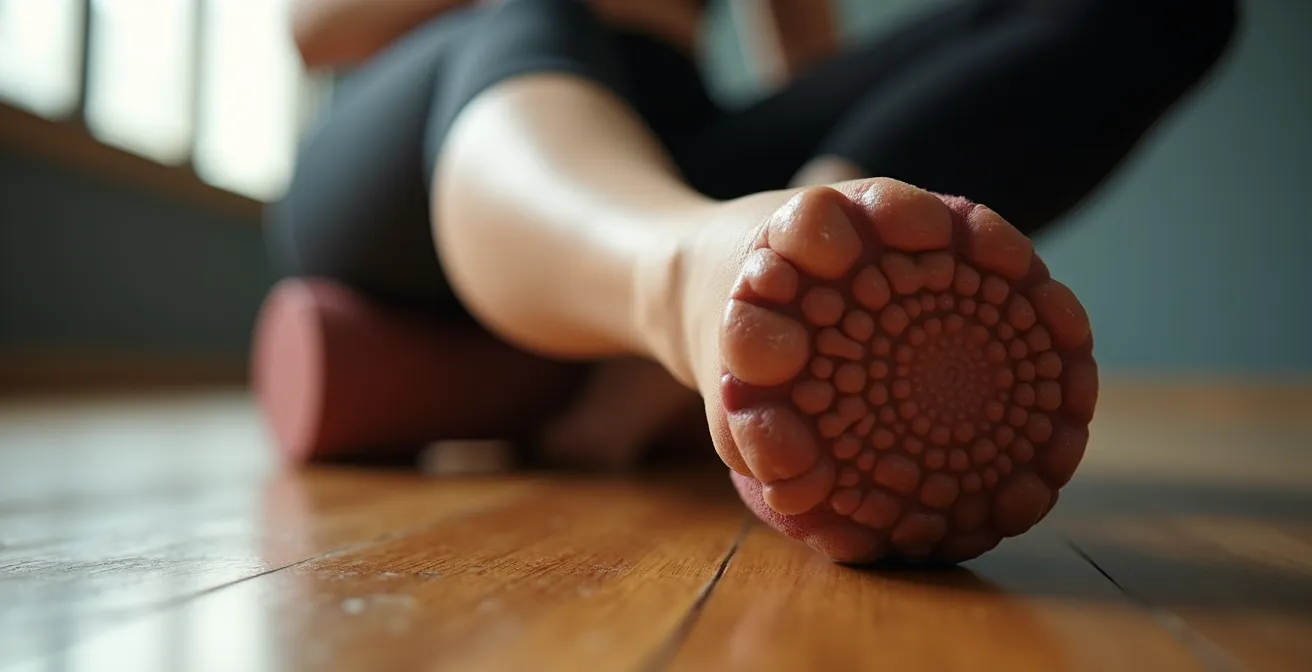
By making this routine an automatic habit, you are actively investing in your future performances. You’ll wake up with less stiffness, have more energy for the next day’s training, and dramatically reduce your cumulative risk of the overuse injuries that sideline so many talented dancers.
Pro-Tip: The Anti-Inflammatory Recovery Smoothie
To further boost your recovery, consuming the right nutrients within 30 minutes of finishing is key. Irish nutritionist Laurann O’Reilly recommends a simple but potent anti-inflammatory smoothie. The recipe is simple: combine 1 cup of frozen banana, 1½ cups of frozen mango, 2 teaspoons of turmeric, and a piece of ginger, then blend until smooth. For dancers in Ireland, these ingredients can be sourced at stores like Holland & Barrett, while in Canada, retailers like Community Natural Foods or Healthy Planet are excellent options. This combination helps to systemically reduce inflammation from the inside out.
Why Is Irish Set Dancing More Effective Than Jogging for Cardiovascular Health?
The standard prescription for building stamina has always been steady-state cardio, like jogging. While jogging certainly has benefits, it fails to prepare a dancer’s body for the specific demands of Irish dance. A performance is not a marathon; it’s a series of explosive, all-out sprints. This is why training methods that replicate this pattern, like Irish set dancing itself, are far more effective for building performance-specific cardiovascular health.
The key lies in the concept of High-Intensity Interval Training (HIIT). Irish dance choreography is naturally structured as a HIIT workout. Studies show that Irish dance routines typically involve 40-60 seconds of high intensity, all-out effort, followed by brief periods of lower intensity or rest. This pattern trains your heart to recover quickly and teaches your body to efficiently clear lactic acid, the substance that causes that familiar muscle burn during intense exertion. Jogging, on the other hand, trains your body for low-intensity, long-duration effort—a completely different energy system. You can be a great marathon runner and still be out of breath 30 seconds into a treble reel because your body hasn’t been conditioned for that type of explosive output.
This athletic reality is at the heart of modern training philosophy. As noted by 6-time World Champion and elite trainer Lauren Early:
Irish dancers are fast paced athletes that need to focus on the development of our speed, power, height, posture, flexibility, and lactic acid tolerance, similar to competition conditions and expectations.
– Lauren Early, 6-time World Champion Irish Dance Trainer
Her statement underscores a critical point: to get better at Irish dancing, you must train the precise physical qualities Irish dancing demands. While supplemental cardio has its place, your primary conditioning should mirror the intensity and duration of your performance. This means prioritizing interval-based work that pushes you into that anaerobic zone and improves your lactic acid tolerance. This is how you build the capacity to perform with power from the first beat to the last.
Pavement vs. Trail: Why Is Uneven Ground Better for Your Ankles?
For dancers, the ankle is a high-value asset, but it’s also highly vulnerable. We spend years training on perfectly flat, predictable surfaces like studio floors and stages. While this is necessary for technique, it inadvertently “dumbs down” our ankles. The small stabilizing muscles around the joint don’t get challenged, and our body’s sense of spatial awareness, known as proprioception, becomes lazy. This leaves us incredibly susceptible to sprains and instability when faced with any unexpected force or slightly uneven surface.
This is where training on uneven ground, like a forest trail, becomes a game-changer. Running or even just walking on a varied surface forces the ankles to make thousands of micro-adjustments with every step. This process is a powerful form of proprioceptive resilience training. It awakens and strengthens the intricate network of muscles and ligaments that support the joint, turning your ankle from a fragile hinge into a robust, responsive structure. It’s like upgrading your car’s suspension to handle an off-road rally instead of just a perfect racetrack.
The Science of Proprioception and Injury Prevention
The connection between muscle balance and injury is well-documented. As one analysis points out, weak or imbalanced muscles, especially in the calf or foot, place significantly more strain on the shin bone. Dancers with flat feet or poor foot mechanics are at a higher risk for shin splints because their arches may not provide sufficient support during intense, high-impact activity. Proprioception training on uneven ground directly addresses this by strengthening those supportive foot and ankle muscles, creating a much more stable base for every jump and landing.
For dancers in Ireland and Canada, there are fantastic opportunities to swap out monotonous pavement runs for more effective trail work. The goal isn’t speed; it’s engagement. Move at a comfortable pace and focus on how your feet and ankles are adapting to the terrain. A short, 15-minute session on a trail is far more beneficial for joint resilience than a 45-minute run on a flat sidewalk.
- Ireland (Dublin): Instead of running the flat Sandymount Strand pavement, try the varied and challenging terrain of the Howth Cliff Path.
- Ireland (Wicklow): The Wicklow Way offers miles of excellent uneven surfaces perfect for ankle strengthening.
- Canada (Toronto): Replace the paved Waterfront Trail with the dirt paths and rolling hills of the Don Valley.
- Canada (Vancouver): Use the extensive network of trails in Pacific Spirit Regional Park instead of the flat, predictable seawall.
Key Takeaways
- True dance stamina is built on shock absorption and neuromuscular control, not just traditional cardio.
- A structured, consistent recovery protocol is a non-negotiable component of elite training and injury prevention.
- Systemic resilience is forged through varied cross-training that challenges your body with uneven terrain and postural loads.
How to Start “Rucking” (Weighted Walking) to Build Resilience in Bad Weather?
There will be days when the weather is miserable, the studio is closed, or you simply need a break from high-impact training. This is where “rucking,” or walking with a weighted backpack, becomes an invaluable tool for the serious dancer. It is the ultimate form of low-impact, systemic conditioning. Rucking builds a rock-solid foundation of strength, endurance, and mental toughness that translates directly back to the dance floor.
The benefits are threefold. First, it builds incredible postural strength. Carrying a load forces your core, back, and hips to engage constantly to maintain an upright, stable posture—the exact same stability required for Irish dance. Second, it’s a potent cardiovascular workout without the destructive impact of running. You can elevate your heart rate into a productive training zone for an extended period, building deep aerobic fitness while giving your shins and knees a much-needed rest. Finally, it builds mental fortitude. Training outdoors in less-than-perfect conditions, with a weight on your back, cultivates a resilience and grit that is indispensable for a professional performer.
Getting started is simple. You don’t need fancy equipment. A sturdy backpack and some weight (books, water bottles, or sandbags) are all it takes. The key is to start smart and progress gradually.

To begin, load a backpack with approximately 10% of your body weight. Focus on maintaining perfect posture: shoulders back, chest up, core engaged. Walk for 20-30 minutes on a familiar route, ideally one with some gentle hills. As you get stronger, you can gradually increase the weight or the duration, but never sacrifice form for more load. Rucking isn’t about lifting heavy; it’s about moving well under load for a sustained period. It is the perfect cross-training activity to build a truly robust and injury-proof athletic base.
Your professional career depends on this crucial shift in mindset from amateur artist to professional athlete. Start implementing these principles of systemic conditioning, intelligent recovery, and mental resilience today to build not just a powerful performance, but a long, healthy, and successful career on the world’s stages.