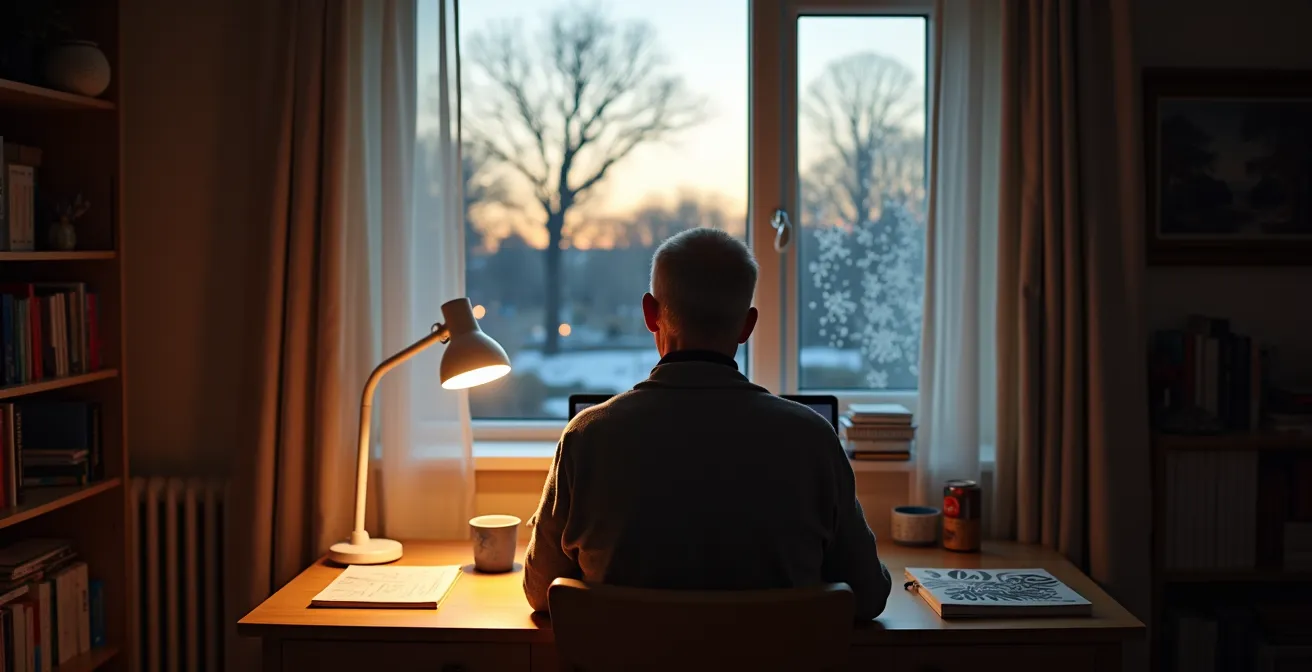
Beating afternoon fatigue isn’t about using your light lamp more; it’s about using it smarter in the morning and, crucially, managing your light exposure at night.
- Your morning light session is a non-negotiable “circadian anchor” that sets your body’s 24-hour clock.
- What you do in the evening—dimming lights and avoiding screens—is just as important for preserving daytime energy.
Recommendation: Adopt a 24-hour ‘light diet’. Start with a powerful dose of morning light and end with intentional digital and environmental darkness.
The feeling is all too familiar for office workers from Dublin to Edmonton. The clock strikes 3 PM, and a wave of fatigue washes over you, making focus an uphill battle. You reach for another coffee, but the jolt is temporary. Many turn to light therapy lamps, hoping a blast of artificial sun will solve the problem. The standard advice is simple: sit in front of a 10,000 lux lamp for 30 minutes in the morning. While this is a crucial first step, it’s only half the story.
Viewing a light therapy lamp as an isolated “fix” is like trying to fix a leaky boat with a single patch while ignoring other holes. True, sustainable energy isn’t about one powerful action; it’s about a consistent, 24-hour strategy. The real key to conquering the afternoon slump lies not just in the bright light you get in the morning, but in the darkness you cultivate at night. This is the core principle of chronobiology: your body’s energy levels are governed by the stark contrast between your daily light and dark cycles.
But what if the conventional wisdom about blue light is too simplistic? What if the temperature of your bedroom has a more profound impact than you realize? This guide moves beyond the basics. We will explore how to orchestrate a complete “light diet” that synchronizes your internal clock. It’s a system where your morning light therapy is the anchor, but your evening habits, eating schedule, and even the color temperature of your light bulbs are the critical supporting elements that secure your energy and sleep quality.
This article provides a comprehensive framework, grounded in chronobiology, to transform your light therapy lamp from a simple tool into the cornerstone of a high-energy lifestyle. Below, we’ll detail the specific strategies—from timing your meals to choosing the right light bulbs—that will help you master your circadian rhythm and leave the 3 PM slump behind for good.
Summary: Master Your Circadian Rhythm to Eliminate Afternoon Fatigue
- Morning vs. Evening: When Should You Block Blue Light for Better Sleep?
- Time-Restricted Eating: Why Should You Stop Eating 3 Hours Before Bed?
- 65°F vs. 70°F: What Is the Ideal Temperature for Deep REM Sleep?
- Melatonin: Why Is Less Often More When It Comes to Dosage?
- Sunrise Alarms: Do They Really Work Better Than Noise Alarms?
- Optimizing Your Home Lighting for Short Winter Days: Lessons from Galway
- Kelvin Scale: Why Should You Never Use 5000K Bulbs in the Living Room?
- How to Calculate Your ‘Health Span’ vs. ‘Life Span’ and Why It Matters?
Morning vs. Evening: When Should You Block Blue Light for Better Sleep?
The conversation around blue light is often oversimplified to “it’s bad at night.” The reality is more nuanced. Blue light itself isn’t the enemy; it’s a powerful signal. In the morning, it’s exactly what your brain needs to shut down melatonin production and signal the start of the day. Evening exposure, however, is what sabotages your internal clock. While blue-blocking glasses have gained popularity, their effect can be minimal. A recent 2024 meta-analysis found that blue-blocking glasses showed only a non-significant reduction in the time it took to fall asleep. This suggests a more robust strategy is needed.
The most effective approach isn’t to simply filter blue light, but to eliminate the source. This means actively managing your light environment in the 2-3 hours before bed. This is especially challenging during long summer evenings in places like Dublin or Edmonton, where the sun can set after 10 PM. True light hygiene involves dimming all overhead lights, switching devices to their warmest “night mode,” and choosing ambient light over direct, harsh lighting. Think of it as creating a “digital sunset” inside your home, regardless of what the sun is doing outside. This practice sends a much stronger “it’s time to wind down” signal to your brain than glasses alone ever could.
Practical steps for evening light discipline are straightforward:
- Start dimming all lights 2-3 hours before your target bedtime.
- Use warm-toned bulbs (2700K or less) in lamps for evening reading or relaxation.
- If you’re socializing on a pub patio or in a brightly lit space, try to sit with your back to the brightest lights.
- Activate night mode on all your digital devices to coincide with sunset, adjusting it seasonally.
The goal is to create a stark contrast: a bright, blue-light-rich environment in the morning and a dim, warm-light environment in the evening.
Time-Restricted Eating: Why Should You Stop Eating 3 Hours Before Bed?
Your body’s master circadian clock resides in your brain’s suprachiasmatic nucleus, but it’s not the only clock. Secondary “peripheral clocks” exist in your organs, including your liver and digestive system. These clocks are highly sensitive to when you eat. Eating a large meal late at night forces your digestive system to work overtime when it should be winding down, creating a conflict with your brain’s sleep signals. This process can raise your core body temperature, directly interfering with the natural temperature drop required to initiate and maintain deep sleep.
Establishing a consistent eating window, a practice known as Time-Restricted Eating (TRE), is a powerful way to synchronize these internal clocks. By stopping all food intake (except water) at least three hours before your intended bedtime, you give your body ample time to digest. This allows your core temperature to fall on schedule, reinforcing your brain’s signal to sleep. This isn’t about what you eat, but *when* you eat. Creating this nightly fasting period is a potent, non-light-based signal that tells your entire system it’s time to shift from “active/digest” mode to “rest/repair” mode.
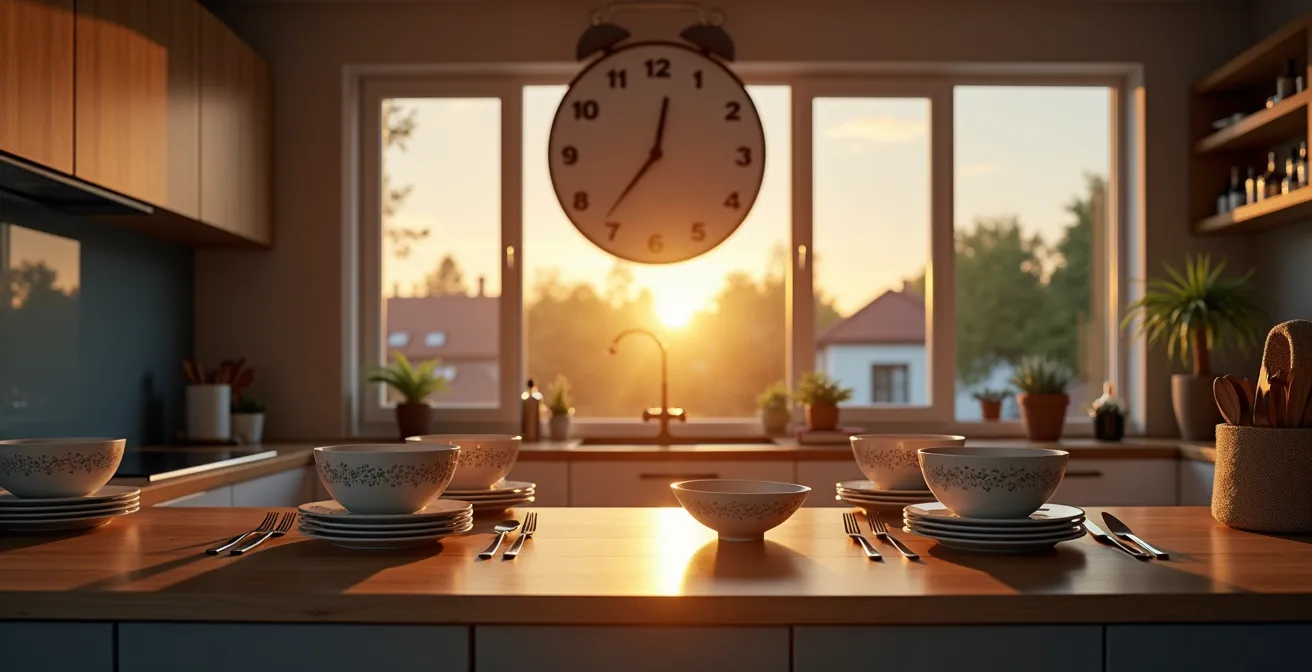
As the illustration suggests, think of it as “closing the kitchen” for the night. This simple rule helps align your metabolic and sleep rhythms, leading to more restorative sleep and, consequently, more stable energy the following day. For an office worker, this could mean finishing dinner by 7 PM to prepare for a 10 PM bedtime, preventing digestive processes from disrupting the critical early stages of sleep and helping you wake up feeling genuinely refreshed.
65°F vs. 70°F: What Is the Ideal Temperature for Deep REM Sleep?
A cool room is one of the most powerful and often overlooked regulators of sleep quality. To initiate sleep, your body’s core temperature needs to drop by about 2 to 3 degrees Fahrenheit (about 1.5°C). Sleeping in a room that is too warm can inhibit this natural drop, leading to more frequent awakenings and less time spent in deep, restorative REM sleep. The ideal temperature range for most adults is surprisingly cool: between 60-67°F (15.5-19.5°C). This range helps facilitate the necessary drop in core body temperature, signaling to your brain that it’s time for sleep.
However, achieving this ideal temperature can present a practical and economic challenge, particularly in colder climates. As Statistics Canada reports that nearly 14% of Canadian households face difficulties affording their energy needs, simply cranking down the thermostat isn’t always feasible. Likewise, poorly insulated homes in damp Irish winters can make a cool room feel uncomfortably cold. The key is to find a balance that is both biologically optimal and economically sustainable. Using a programmable thermostat to lower the temperature only during sleep hours is an effective strategy.
This table provides a practical guide for setting your bedroom temperature, with tips tailored to Irish and Canadian climates.
| Climate Type | Recommended Bedroom Temperature | Cost-Saving Tips |
|---|---|---|
| Irish Damp Winters | 16-18°C (60-65°F) | Use thermal curtains, draft excluders |
| Canadian Dry Winters | 18-19°C (65-67°F) | Program smart thermostat, zone heating |
| Summer (Both) | 18-20°C (65-68°F) | Use fans instead of AC when possible |
Melatonin: Why Is Less Often More When It Comes to Dosage?
Melatonin is widely misunderstood as a sleep-initiating “knockout pill,” similar to a sedative. In reality, it’s a “darkness signal” hormone. Its gradual rise in the evening tells your brain that night is approaching, helping to orchestrate the timing of sleep. Critically, this signal works best when it stands in stark contrast to the bright light signals of the day. As chronobiologist Dr. Patel notes, “The brain needs to register a difference between morning and night light in order to initiate the production of melatonin and encourage sleep.”
This is why morning light therapy is so foundational; it creates a strong “day” signal that makes the subsequent “night” signal from melatonin more effective. When it comes to supplementation, many people take doses (3mg, 5mg, or even 10mg) that are far higher than what the body produces naturally. Such high doses can overwhelm the system, leading to grogginess the next day and desensitizing your brain’s receptors over time. For circadian rhythm regulation, a much smaller, physiological dose of 300-500 micrograms (0.3-0.5mg) is often more effective and sustainable. The goal is to gently nudge your clock, not hit it with a sledgehammer. The most powerful approach is to optimize your body’s own melatonin production through a strict light-dark cycle, using low-dose supplements only as a temporary tool to shift your clock, not as a nightly crutch.
Action Plan: Your Protocol for Natural Melatonin Optimization
- Weeks 1-2: Establish a consistent morning light therapy routine. Use a 10,000 lux lamp for 30 minutes within the first 30 minutes of waking to create a strong circadian anchor.
- Weeks 3-4: Begin aggressively managing evening light. Start dimming all home lighting by 8 PM and enable night mode on all devices.
- Weeks 5-6: If currently using melatonin supplements, reduce your dose by 25% while maintaining your strict morning and evening light routines. Monitor sleep quality.
- Weeks 7-8: If sleep remains stable or improves, continue reducing your supplement dose by another 25%. The goal is to rely on your light-dark cycle as the primary signal.
- Ongoing: Maintain morning light therapy as your primary tool. Use low-dose melatonin supplements only strategically, such as for managing jet lag or occasional disruptions.
Sunrise Alarms: Do They Really Work Better Than Noise Alarms?
A traditional sound-based alarm clock jolts you out of sleep with a sudden burst of noise, triggering a cortisol-fueled stress response. It’s an effective but neurologically violent way to wake up. A sunrise alarm, in contrast, works *with* your biology. It simulates a natural dawn by gradually increasing the light in your room over 30-60 minutes, moving from a warm red to a bright, day-like white. This gentle, progressive light signal tells your brain to slowly suppress melatonin and begin the wake-up process before you’re even consciously aware of it. By the time the (often optional) sound alarm goes off, your body is already prepared to wake up.
This method avoids the “sleep inertia”—that groggy, disoriented feeling—that often follows a sudden awakening. You wake up feeling more alert and ready for the day. This gentle start is the perfect precursor to your main light therapy session. While a sunrise alarm typically peaks at a gentle 200-300 lux, your dedicated therapy lamp provides the powerful dose needed to fully anchor your circadian rhythm. As Dr. Michael Mak from Toronto’s CAMH states that the clinical standard for SAD is 10,000 lux, a level far greater than an alarm but necessary to mimic the biological effect of a bright morning sun. Think of the sunrise alarm as the gentle nudge and the therapy lamp as the definitive command.
The combination is a powerful one-two punch: the alarm ensures a smooth transition from sleep to wakefulness, and the therapy lamp locks in your circadian rhythm for the day ahead. This synergy is particularly beneficial during the dark winter months in Canada and Ireland, where a natural sunrise may not occur until well after you need to be awake and functional. This technology, championed by long-standing Canadian manufacturers like Northern Light Technologies, helps bridge the gap between your schedule and the natural world.
Optimizing Your Home Lighting for Short Winter Days: Lessons from Galway
During the short, often overcast winter days common in places like Galway or Vancouver, the lack of natural light is a significant challenge. The intensity of sunlight is measured in lux; a bright sunny day can exceed 100,000 lux. However, as Dr. Mak explains, on a gloomy day, that level can plummet. He states that sunlight can drop to just 1,000 to 2,000 lux on overcast days, an amount insufficient to provide a strong “day” signal to your brain. This is where a strategic approach to home lighting becomes essential. It’s not just about using your therapy lamp; it’s about creating layers of light throughout the day, a concept we can call “light stacking.”
Light stacking involves using different types and intensities of light at specific times to support your circadian rhythm. The cornerstone is your 10,000-lux therapy lamp in the morning, which acts as your artificial sun. Throughout the day, you supplement this with other light sources to maintain alertness. This could mean positioning your desk by a window to capture any available natural light and using cooler-toned bulbs (e.g., 4000K) in your home office. A crucial, often-missed opportunity is the “light snack”—a quick, 15-minute booster session with your therapy lamp around 2-3 PM to directly combat the afternoon slump without interfering with your nighttime sleep.
This strategy transforms your home into a dynamic light environment that changes with your biological needs:
- Morning (7-9 AM): The main event. A 30-60 minute session with your 10,000-lux lamp to anchor your rhythm.
- Mid-day (12-1 PM): Maximize natural light by working near a window. Supplement with neutral white overhead light (4000K).
- Afternoon (2-3 PM): The “light snack.” A brief 15-minute session with your therapy lamp to boost alertness.
- Evening (5 PM onwards): The transition. Shift to warm, low-intensity lighting (2700K) throughout your living spaces to signal to your brain that the day is ending.
This layered approach provides consistent circadian cues, even when the sky outside is persistently grey.
Kelvin Scale: Why Should You Never Use 5000K Bulbs in the Living Room?
Not all light is created equal. The color of light, measured on the Kelvin (K) scale, has a profound impact on your biology. Light sources with a high Kelvin temperature (4000K-6500K) appear as cool, blue-toned white light, mimicking the midday sun. This type of light is excellent for promoting alertness and focus, making it ideal for a home office or kitchen during the day. Conversely, light with a low Kelvin temperature (2000K-3000K) emits a warm, amber, or reddish glow, similar to a sunset or candlelight. This warm light has a minimal effect on melatonin suppression, making it perfect for evening relaxation.
Using a 5000K “daylight” bulb in your living room or bedroom in the evening is a form of circadian sabotage. It sends a powerful “it’s still daytime” signal to your brain, actively suppressing the melatonin production you need to feel sleepy. This is a common mistake people make when trying to brighten their homes during dark winters. They install high-Kelvin bulbs everywhere, creating an environment that is perpetually “on” and preventing their bodies from ever receiving the signal to wind down. Leading light therapy suppliers in Ireland, like BrighterDay.ie, emphasize that affecting the brain chemicals linked to mood and sleep requires the *right light at the right time*.
A home optimized for circadian health should have its lighting zoned by room and time of day, as this guide demonstrates.
| Room | Morning (6-10 AM) | Day (10 AM-5 PM) | Evening (5-9 PM) | Night (After 9 PM) |
|---|---|---|---|---|
| Kitchen | 4000-5000K | 4000K | 3000K | 2700K |
| Home Office | 4000-5000K | 4000K | 3000K | Avoid if possible |
| Living Room | 3000K | 3000K | 2700K | 2200K or less |
| Bedroom | 3000K | Natural light only | 2700K | Amber/Red only |
Key Takeaways
- Morning Light is a Non-Negotiable Anchor: A 30-minute, 10,000-lux light therapy session within an hour of waking is the single most important action to set your daily rhythm and combat fatigue.
- Evening Darkness is a Discipline: The benefits of morning light are undone by bright, blue-toned light at night. Actively dimming lights and avoiding screens for 2-3 hours before bed is critical.
- Your Environment Sends Signals: A cool bedroom (16-19°C) and finishing your last meal 3 hours before bed are powerful, non-light cues that reinforce your body’s “time for sleep” message.
How to Calculate Your ‘Health Span’ vs. ‘Life Span’ and Why It Matters?
In modern health discussions, the focus is shifting from “life span” (how many years you live) to “health span” (how many of those years are spent in good health, full of vitality). Mastering your circadian rhythm is a foundational pillar of extending your health span. Chronic circadian disruption—caused by inconsistent sleep schedules and poor light hygiene—is linked to a host of metabolic and cognitive issues that degrade quality of life long before they shorten it. The daily battle with the 3 PM slump is more than an inconvenience; it’s a symptom of a misaligned system and a direct hit to your health span.
Every strategy discussed in this guide—from the timing of your morning light to the Kelvin temperature of your evening bulbs—is an investment in your daily energy and, by extension, your long-term health. The goal isn’t just to feel better tomorrow afternoon, but to build a robust biological rhythm that supports cognitive function, metabolic health, and emotional well-being for decades. The impact can be surprisingly direct; evidence from Good Housekeeping Institute shows that just 20 minutes of light exposure can have a measurable impact on mood, demonstrating how sensitive our systems are to these cues.
Calculating your health span isn’t a simple formula; it’s an assessment of your daily quality of life. Do you have the energy to engage fully in your work, hobbies, and relationships? Or is your day a cycle of fatigue and stimulants? By taking control of your light exposure, you are actively choosing to enhance your daily performance and protect your future health. It’s one of the most powerful, proactive steps you can take to ensure your years are not just long, but also vibrant and full of energy.
Start by auditing your own 24-hour light diet today. By implementing these chronobiological principles, you can reclaim your afternoons and make a lasting investment in your long-term health span.