
Learning Irish in Canada is less about mastering a foreign language and more about an act of cultural archaeology to reconnect with your heritage.
- Success depends on building a personal “linguistic mosaic” of digital tools, local community events, and daily family rituals.
- Debunking the “dead language” myth is the first step; the language is vibrant within diaspora communities and offers cognitive benefits beyond communication.
Recommendation: Start not by memorizing grammar, but by finding one tangible connection: locate a “Pop-Up Gaeltacht” near you or trace one ancestral name back to its original Gaelic spelling.
For many of the 4.4 million Canadians of Irish descent, seeing a name like O’Malley or Fitzgerald on a mailbox feels like a distant echo from a forgotten world. There’s a sense of connection, but the language that shaped that identity—Irish Gaelic, or Gaeilge—often remains silent. The desire to bridge that silence is strong, a profound pull to reconnect with a heritage that feels both intrinsically part of you and just out of reach. The journey to learn Irish in a country as vast as Canada, far from the native-speaking Gaeltacht regions of Ireland, can feel daunting.
Standard advice often points to generic solutions: download a language app, watch Irish films, or try to find a conversation partner. While these have their place, they fail to address the core motivation of the heritage learner. For the Canadian diaspora, this isn’t an academic exercise. It’s a personal quest, a way of piecing together a fragmented identity. The true challenge isn’t just learning vocabulary; it’s finding a way to make the language live and breathe within a Canadian context.
But what if the key wasn’t to replicate an immersive experience that doesn’t exist here, but to embrace a different approach altogether? This guide is built on the idea that learning Irish in Canada is an act of cultural archaeology. It’s about meticulously assembling your own learning environment, creating a unique linguistic mosaic from a combination of powerful online resources, vibrant local initiatives, and meaningful daily rituals. It transforms the process from a classroom lesson into a deeply personal and rewarding journey of discovery.
This article will guide you through that process. We will deconstruct the unique challenges of Irish grammar, show you where to find the growing community of speakers in your own province, and debunk the myths that hold learners back. Finally, we’ll provide concrete, actionable steps to weave the language into your family life, your genealogical research, and even your professional development, building a bridge back to your roots, one word at a time.
Summary: A Canadian’s Guide to Reconnecting with the Irish Language
- Why Is Irish Grammar More Complex Than French for Anglophones?
- Where to Find “Pop-Up Gaeltacht” Events in Ontario This Year?
- The Myth of the “Dead Language” That Stops 50% of Heritage Learners
- How to Incorporate 5 Gaelic Phrases into Your Daily Family Routine?
- The First 100 Words: In What Order Should You Learn Irish Vocabulary?
- STEAM vs. STEM: Why Adding ‘Arts’ Improves Engineering Creativity?
- The Spelling Error That Hides 60% of Irish Ancestors in Canadian Census Data
- How to Build a Ivy-League Education Curriculum Using Only Free Open Courseware?
Why Is Irish Grammar More Complex Than French for Anglophones?
For many Canadians, French serves as the primary benchmark for learning a second language. Its familiar Subject-Verb-Object (SVO) sentence structure and shared Latin roots with English provide a recognizable foundation. However, diving into Irish Gaelic presents a different kind of challenge, as it belongs to the Celtic language family, which evolved on a completely separate path. This isn’t a flaw in the language or the learner; it’s simply a matter of navigating a different grammatical universe.
The complexity for an English speaker often stems from concepts that have no direct parallel in the languages they’re used to. Understanding these differences isn’t just an academic hurdle; it’s the key to unlocking the language’s unique logic and beauty. Rather than being a barrier, mastering these concepts becomes a fascinating part of the journey into a different way of thinking.
Here are the core grammatical features that distinguish Irish from both English and French:
- Master VSO word order: Unlike English’s SVO pattern, Irish places the verb first. The sentence “I am” is Tá mé, which literally translates to “Am I.” This fundamental shift requires rewiring your brain’s sentence-building process.
- Learn the case system: Irish uses four grammatical cases (nominative, genitive, dative, vocative) that change the form of nouns depending on their function in a sentence. This is a level of complexity beyond French’s gendered articles.
- Understand initial mutations: The first letter of an Irish word can change depending on the word that comes before it. This grammatical feature, known as lenition or eclipsis, is a core part of the language’s flow and has no equivalent in English or French.
- Practice synthetic verb forms: Irish often combines the pronoun and the verb into a single word, especially in certain tenses and forms, whereas French and English keep them separate.
- Study the two-verb ‘to be’ system: Irish makes a crucial distinction between states/conditions and identity/classification, using two different verbs: Tá (for how something is) and Is (for what something is).
Approaching these features not as obstacles but as the unique architecture of the language is the first step. Each rule is a piece of a logical system that, once understood, offers a rewarding sense of accomplishment and a deeper connection to the Celtic mindset.
Where to Find “Pop-Up Gaeltacht” Events in Ontario This Year?
One of the biggest challenges for Irish learners in Canada is the lack of a “Gaeltacht”—a region where Irish is the predominant language of daily life. Without this immersive environment, practice can feel isolating. The “Pop-Up Gaeltacht” movement offers a brilliant, modern solution. These are informal social gatherings, typically held in pubs or community spaces, where speakers of all levels can come together to use their Irish in a relaxed setting. It’s a Gaeilge-only zone for a few hours, creating a temporary, living language community.
This is not just a niche phenomenon. The concept, born in Dublin, has spread globally as a powerful tool for diaspora vitality. The originators have estimated that there have been over 150 held world-wide, from Toronto to Tokyo. For Canadian learners, these events are invaluable, providing a rare opportunity to move the language from the textbook to conversation and build connections with fellow enthusiasts.

As you can see, the atmosphere is about connection and encouragement, not perfection. Finding these events, especially in a large province like Ontario, requires a strategic approach. They are often organized by passionate volunteers and promoted through specific community channels rather than broad advertising.
Here is a strategic guide to locating these vibrant gatherings across Ontario:
- Monitor University of Toronto Celtic Studies program announcements for academic-affiliated events.
- Follow Conradh na Gaeilge Toronto (Torontó le Gaeilge) on social media platforms for pub-based gatherings.
- Check Ottawa Irish Society channels for family-oriented events in the capital region.
- Search Eventbrite and Meetup using terms ‘Irish language’, ‘Gaeilge’, and ‘Gaeltacht’ filtered by Ontario location.
- Join Facebook groups like ‘Irish in Toronto’ and ‘Ottawa Irish Community’ for direct announcements and community discussion.
These events are the living, breathing heart of the Irish language community in Canada. They are the perfect embodiment of the linguistic mosaic, combining social connection with practical language use to keep the heritage alive and well, thousands of kilometres from Ireland.
The Myth of the “Dead Language” That Stops 50% of Heritage Learners
One of the most persistent and damaging misconceptions that discourages heritage learners is the idea that Irish is a “dead language.” This narrative suggests that learning it is a purely academic exercise with no practical application, a linguistic relic preserved only in old books. This myth is not only factually incorrect, but it also fundamentally misunderstands the role and vitality of a heritage language, especially within a global diaspora.
The numbers alone tell a different story. Far from being extinct, there are around 2 million people who speak Irish to some degree, and it holds official status in both the Republic of Ireland and Northern Ireland, as well as the European Union. But its true vitality isn’t just measured by census data in Ireland; it’s found in the passion and dedication of learners across the world, particularly in countries with large Irish diaspora populations like Canada.
The motivation for these learners is not purely utilitarian. It’s about identity, connection, and the reclamation of a cultural inheritance. As one Canadian learner powerfully stated, the interest is deeply personal:
I was born and raised in an English speaking country (Canada) and I really don’t like English. Generally speaking, people in Ireland don’t realise the interest internationally in learning their native language.
– Canadian Learner, LearnIrishGaelic.com
This perspective reveals a crucial truth: the health of a language is also measured by the desire of people to speak it. For the Canadian diaspora, learning Irish is an act of diaspora vitality. It’s a statement that culture and identity are not geographically contained. By speaking even a few words, learners actively participate in the language’s living, global story, proving it is anything but dead.
Therefore, when you choose to learn Irish, you are not engaging with a relic of the past. You are joining a dynamic, worldwide community and becoming an active custodian of a rich cultural legacy, ensuring its voice continues to be heard for generations to come.
How to Incorporate 5 Gaelic Phrases into Your Daily Family Routine?
For heritage learners, especially those with families, the goal isn’t just to study Irish—it’s to live it. The most effective way to prevent the language from remaining an abstract concept is to weave it into the fabric of daily life. This practice of creating small “heritage rituals” transforms your home into a micro-Gaeltacht and builds a natural, emotional connection to the language for all family members, young and old.
The key is to start small and be consistent. Attaching specific Irish phrases to recurring daily events helps cement them in memory without the pressure of formal study. It could be a simple greeting at the breakfast table or a farewell at bedtime. This approach makes the language a part of your family’s unique culture and shared experience, grounding it in the familiar context of your Canadian home.

As this scene illustrates, language comes alive when it’s connected to real-world actions and observations. Pointing out the snow and saying it in Irish makes the vocabulary tangible and memorable. Below are five essential phrases, specifically chosen to resonate with Canadian family life, that you can begin to incorporate today.
- Morning greeting: ‘Maidin mhaith’ (Good morning) – Start each day with Irish at the breakfast table.
- Winter weather: ‘Tá sé ag cur sneachta’ (It’s snowing) – A phrase perfectly suited for the long Canadian winters.
- Outdoor activities: ‘Téigh ag siúl cois locha’ (Let’s go for a walk by the lake) – Ideal for life in Canadian cottage country or a trip to a local park.
- Bedtime routine: ‘Oíche mhaith, codladh sámh’ (Good night, sleep well) – End each day with a warm, comforting phrase in Irish.
- Family appreciation: ‘Is breá liom mo theaghlach’ (I love my family) – Use the language to build and reinforce powerful emotional connections.
By creating these small moments of linguistic immersion, you are doing more than teaching words; you are passing on a legacy. You are demonstrating that Irish is not just the language of your ancestors, but a living, breathing part of your family’s present and future.
The First 100 Words: In What Order Should You Learn Irish Vocabulary?
When embarking on the journey of learning any new language, the sheer volume of vocabulary can feel overwhelming. The temptation is to learn words related to your interests, but a more strategic approach is far more effective, especially with a grammatically complex language like Irish. The goal isn’t just to accumulate words, but to acquire the foundational toolkit that allows you to understand and construct basic sentences as quickly as possible.
Linguists and experienced educators agree that focusing on the 100 most frequent words is the most efficient starting point. These core words act as the scaffolding upon which you can build a more extensive vocabulary later. As the experts at Gaeltacht an Oileáin Úir (North American Gaeltacht) advise, this method prioritizes understanding structure over memorization:
If you’re just starting to learn Irish, it’s a good idea to focus on the first 100 most common words. Our lessons will mostly use these words, so you can see grammar in action without also having to learn vocabulary to understand what is happening.
– Gaeltacht an Oileáin Úir, North American Gaeltacht Language Resources
For a Canadian heritage learner, this strategy can be further refined. The optimal order for learning vocabulary should reflect your primary motivation: reconnecting with identity. Therefore, your first 100 words should be a blend of high-frequency vocabulary and terms that are deeply relevant to your personal journey of cultural archaeology.
The following table outlines priority categories for a Canadian learner, ensuring that your first steps into the language are both practical for communication and meaningful for heritage connection.
| Category | Essential Words | Canadian Context |
|---|---|---|
| Family Terms | máthair (mother), athair (father), seanmháthair (grandmother) | Connect with genealogy research |
| Place Names | Éire (Ireland), Ceanada (Canada), baile (home/town) | Discuss dual heritage |
| Identity Words | oidhreacht (heritage), teanga (language), muintir (people) | Express cultural connection |
| Canadian Environment | crann meapail (maple tree), béabhar (beaver), loch (lake) | Describe local surroundings |
| Pop-Up Phrases | Cá as duit? (Where are you from?), pionta Guinness, le do thoil | First Gaeltacht experience |
By prioritizing vocabulary in this way, you create a powerful learning loop. You acquire the tools needed to understand basic grammar while simultaneously learning the words that matter most to your identity, making every new phrase a step closer to home.
STEAM vs. STEM: Why Adding ‘Arts’ Improves Engineering Creativity?
At first glance, the push to turn STEM (Science, Technology, Engineering, Math) into STEAM by adding ‘Arts’ might seem disconnected from learning Irish. However, for many professionals in technical fields, the ‘A’ represents more than just aesthetics; it signifies the kind of abstract, systems-level thinking that is crucial for innovation. This is where learning a language with a complex, rule-based grammar like Irish becomes a powerful cognitive tool—a cognitive bridge to better problem-solving.
The process of mastering Irish grammar forces the brain to engage with non-linear logic, pattern recognition, and systematic rule application in a way that directly mirrors the challenges of software architecture and complex engineering design. Concepts like initial mutations or the VSO word order are not arbitrary; they are part of a deeply logical, albeit unfamiliar, system. Learning to navigate this system is a rigorous mental workout that builds transferable skills.
Case Study: Irish Language Learning as a Cognitive Enhancement Tool
Canadian engineers and tech workers who are learning Irish have reported a fascinating crossover effect. They find that the discipline required to master the language’s systematic grammar—with its logical mutation rules and verb-first syntax—enhances their ability to think systematically about abstract problems in their professional lives. The act of internalizing Irish grammar provides a unique cognitive challenge that strengthens their capacity for pattern recognition and abstract reasoning, skills that are paramount in fields like software development and system design.
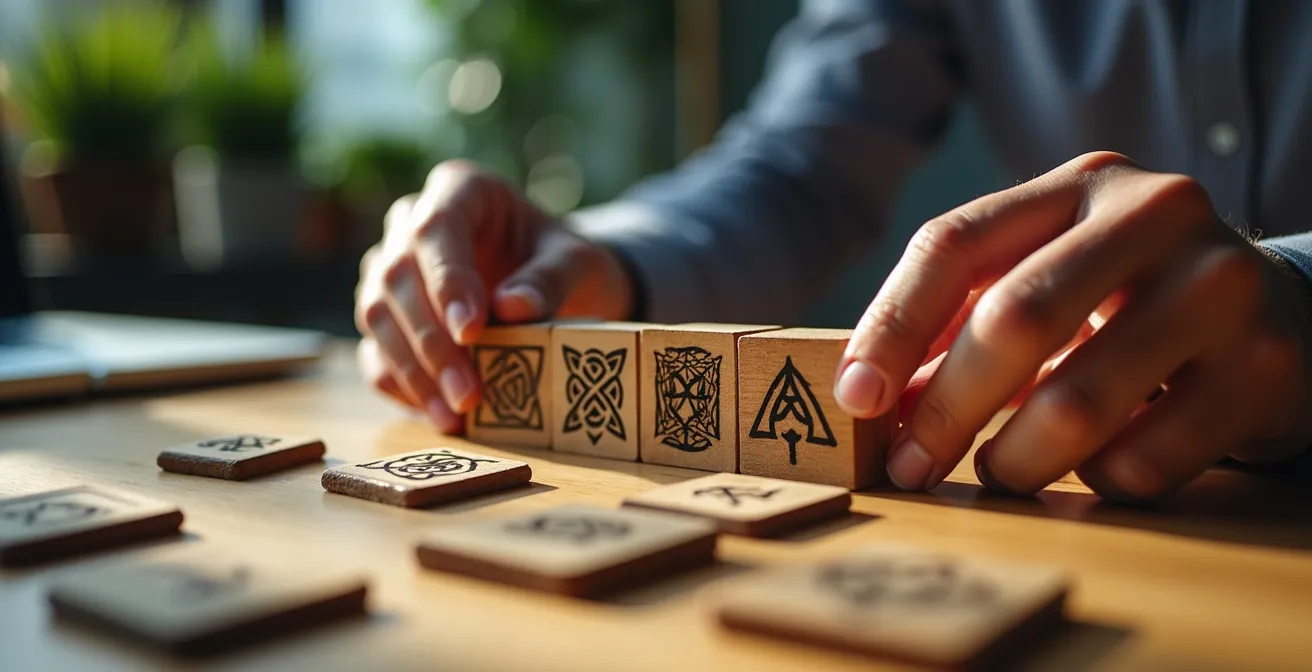
This visual metaphor of Celtic knotwork patterns alongside coding flowcharts captures the essence of this connection. Both are intricate systems built from simple, repeatable rules that create something complex and beautiful. For a STEM professional, learning Irish is not a distraction from their career; it’s a unique form of cross-training for the mind, a way of practicing creative problem-solving in a completely different domain.
Therefore, for the analytically-minded Canadian learner, embracing the complexities of Irish is more than an act of cultural reconnection. It’s a strategic investment in your own cognitive flexibility, proving that the ‘Art’ of language can indeed sharpen the ‘Engineering’ mind.
The Spelling Error That Hides 60% of Irish Ancestors in Canadian Census Data
For many Canadians of Irish descent, the journey into their heritage begins with genealogy. However, this path of cultural archaeology is often blocked by a simple but pervasive obstacle: the anglicization of Irish surnames. When Irish immigrants arrived in Canada in the 18th and 19th centuries, census enumerators, unfamiliar with Gaelic spelling and pronunciation, often recorded names phonetically or according to English conventions. A name like Ó Cathasaigh could become Casey, O’Casey, or even Kasey, effectively hiding generations of a family from modern database searches.
This isn’t a minor issue. It’s a significant barrier that can obscure the roots of a vast number of people. In a country where just over 4.4 million Canadians reported having Irish origins in a recent census, countless individuals may be unable to trace their lineage back to Ireland due to these historical spelling inconsistencies. Learning the basics of Irish names and their common English equivalents is therefore not just a linguistic exercise; it’s a critical skill for any aspiring family historian.
Uncovering these hidden ancestors requires a detective’s mindset and a specific set of research strategies. You must learn to think beyond the name as you know it and search for its potential variations. This process of linguistic forensics can unlock decades, or even centuries, of your family’s story.
Your Action Plan: Finding Hidden Irish Ancestors in Canadian Records
- Search multiple spelling variations: Actively search for your surname and its potential Irish original. For example, try Casey, O’Casey, Ó Cathasaigh, and phonetic variants like Kasey or Casie.
- Use wildcard searches: In databases like Ancestry.ca, use wildcard characters (* or ?) to replace letters you are unsure of. This can help you find unexpected variations recorded by enumerators.
- Check anglicization patterns: Familiarize yourself with common transformations, such as Mac an tSaoir becoming MacIntyre, Ó Maoldomhnaigh becoming Moloney, or Ó hÓgáin becoming Hogan.
- Review census enumerator notes: As Library and Archives Canada notes, spelling was not standardized. Look for handwritten notes or inconsistencies in original documents that might offer clues.
- Cross-reference with parish records: Church records in both Canada and Ireland often preserved the original Irish spellings more faithfully than civil documents, providing a vital cross-reference.
By understanding the linguistic journey of your own surname, you are not only enriching your family tree but also gaining a profound, personal connection to the history of the Irish language in Canada.
Key Takeaways
- Learning Irish in Canada is an act of “cultural archaeology,” best approached by building a “linguistic mosaic” of digital, community, and family resources.
- The language is not “dead” but vibrant, with a global community and specific hubs in Canada like “Pop-Up Gaeltachts” that are crucial for practice.
- Mastering Irish grammar, while challenging, offers cognitive benefits that can enhance logical and abstract thinking skills relevant to technical professions.
How to Build a Ivy-League Education Curriculum Using Only Free Open Courseware?
For the truly dedicated Canadian learner, the ultimate expression of the linguistic mosaic is to become your own program director. In an era of abundant free and open-source educational content, it is entirely possible to construct a comprehensive, university-level Irish Studies curriculum for yourself without paying tuition fees. This self-directed approach allows you to tailor your learning to your specific interests, whether they lie in literature, history, or advanced linguistics.
The key is to strategically combine different types of free resources: structured online courses for grammar, authentic media for immersion, and academic databases for deep research. This creates a well-rounded educational experience that rivals what you might find at a top-tier university. It requires discipline and initiative, but the rewards are immense, offering a depth of knowledge that goes far beyond basic language acquisition.
Example: A Free, University-Level Irish Studies Program
A Canadian learner can create a complete curriculum by leveraging a variety of free platforms. For example, the online community at Let’s Learn Irish provides free monthly workshops, scholarships, and access to conversation sessions. By combining these with Dublin City University’s free “Irish 101” online course, immersing in media via the free TG4 Player app, and accessing academic papers through university libraries or open-access journals, a learner can build a robust educational path equivalent to a formal degree program.
To provide a clearer picture of what this looks like in practice, the following table outlines a potential three-year, self-directed curriculum structure. It’s a blueprint you can adapt to your own pace and passions.
This structured plan demonstrates how to progress from fundamentals to advanced application, as detailed in this comparative analysis of learning structures.
| Year | Focus Area | Primary Resources | Canadian Component |
|---|---|---|---|
| Year 1 | Grammar Foundations | Duolingo, Ranganna.com basics | U of T Celtic Studies public lectures |
| Year 2 | Media Immersion | TG4 Player, Raidió na Gaeltachta | Canadian Gaeltacht meetups |
| Year 3 | Academic Research | JSTOR Irish studies papers | Local Irish-Canadian history project |
| Capstone | Applied Project | Independent research tools | Translate local Irish gravestones/place names |
Embark on your journey of cultural archaeology today. By exploring one of the free resources mentioned and taking the first step to build your own learning plan, you can transform a simple interest into a profound and lifelong connection with your Irish heritage.