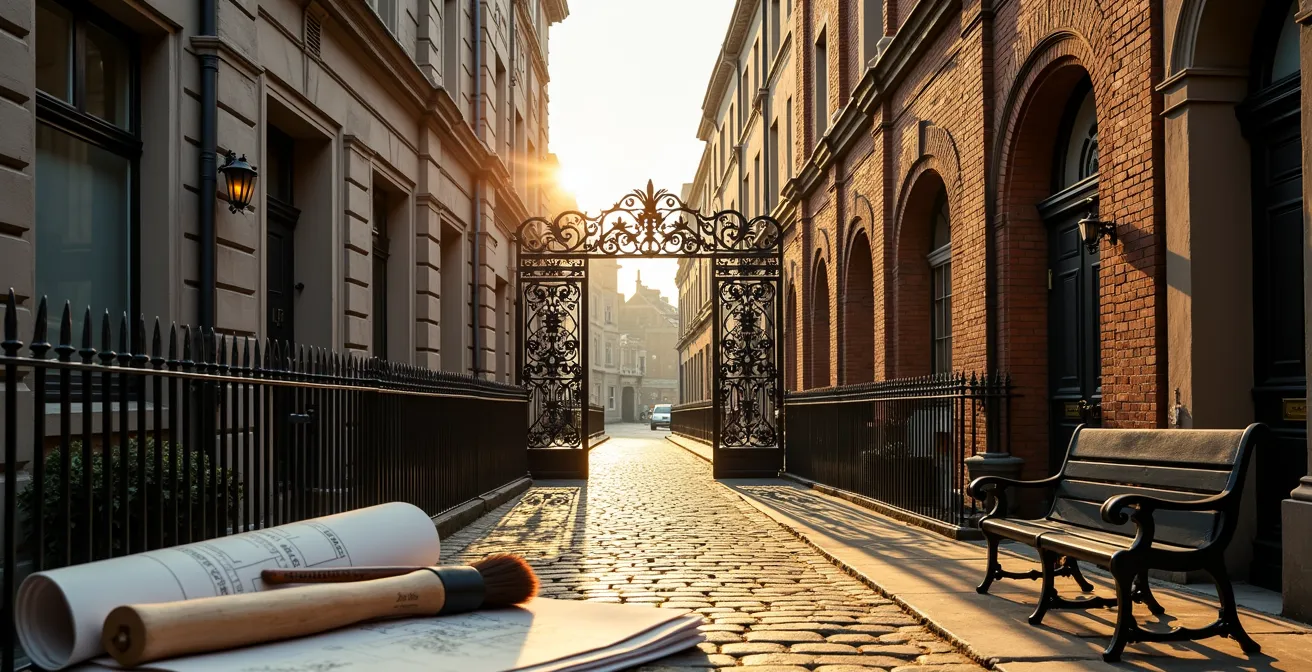
The preservation of Quebec City and Dublin reveals a fundamental philosophical divide: Quebec’s top-down, legislated approach to heritage versus Dublin’s more organic, contested management of its historic urban fabric.
- Quebec City’s model, driven by UNESCO status, prioritizes a curated, visually consistent visitor experience, which risks “Disneyfication” and residential displacement.
- Dublin’s approach, while appearing less cohesive, reflects a continuous negotiation between preservation, development, and the daily life of its residents within a vast number of protected structures.
Recommendation: Heritage professionals should analyze this contrast to understand that the most effective preservation strategy is not universal, but is deeply tied to a city’s economic pressures, legal frameworks, and cultural definition of “authenticity.”
For the discerning traveller or heritage professional, walking through the historic districts of Quebec City and Dublin offers a study in contrasts. Both cities are steeped in a complex colonial history, their stone facades and cobblestone streets whispering tales of empires, migrations, and transformations. The immediate impression is one of successful preservation—beautiful old buildings are cherished and central to their identity. Yet, this surface-level observation masks a profound divergence in preservation philosophy. Most discussions simply note that one feels more ‘French’ and the other more ‘Irish’, missing the crucial systems at play.
The common approach to heritage management often focuses on architectural fidelity and tourism appeal. However, the real story lies in the subtle but significant differences in governance, economic pressures, and the very definition of authenticity. Is heritage a pristine cultural asset to be protected and presented, or is it a dynamic, lived-in fabric that must evolve with its inhabitants? This question is the invisible fault line running between these two UNESCO-recognized cities.
This comparative analysis moves beyond the postcard views to dissect the practical consequences of these two models. We will explore how Quebec’s “legislated authenticity” and Dublin’s “lived-in heritage” manifest in everything from the choice of paint on 18th-century walls to the type of tourism that is cultivated. By understanding the forces that shape these districts, we can better appreciate the delicate balance between preserving the past and serving the present.
This article provides a comparative framework for understanding the distinct heritage preservation tactics in Quebec City and Dublin. Explore the sections below to delve into the specific challenges and strategies that define each city’s unique approach to its colonial past.
Summary: A Comparative Analysis of Heritage Preservation
- Why Do Residents of Historic Districts Hate “Disneyfication” of Their Neighborhoods?
- Plaques and Statues: How to Contextualize Colonial Monuments Without Erasing History?
- Limewash vs. Modern Paint: Which Is Best for Preserving 18th Century Stone?
- The Grant Application Error That Leaves Historic Homes in Disrepair
- Ghost Tours vs. History Walks: Which Attracts More Sustainable Tourism Revenue?
- The Demolition Mistake of the 1960s That Changed Montreal’s Landscape Forever
- The “Fever Shed” Remnants That Tourists Walk Past Unknowingly in Toronto
- Historic Montreal vs. Dublin: Which City Offers the Best Georgian Architecture Walk?
Why Do Residents of Historic Districts Hate “Disneyfication” of Their Neighborhoods?
The term “Disneyfication” is often levied against historic districts that feel more like theme parks than living communities. It describes a process of sanitizing a place, stripping it of its authentic, sometimes gritty, character in favour of a polished, tourist-friendly veneer. For residents, this isn’t just an aesthetic complaint; it represents a fundamental shift in the neighbourhood’s purpose, from a place to live into a product to be consumed. This tension is particularly palpable in Old Quebec, where the 1985 UNESCO World Heritage designation has been both a blessing for preservation funding and a catalyst for intense tourism pressure.
The economic impact is undeniable. As tourism grows, so does the demand for short-term rentals, souvenir shops, and chain restaurants that cater to visitors. This drives up property values, making the area unaffordable for long-term residents. Research from Laval University highlights this pressure, showing that the heritage policy in Old Quebec led to a 26.9% increase in the prices of listed buildings. This economic-cultural tension erodes the social fabric, as local bakeries and grocers are replaced by businesses that serve a transient population. The result is a beautifully preserved but hollowed-out district, where the sense of community is lost.
This phenomenon is defined by sociologists as a specific form of commodification, as one analysis explains:
The process of stripping a real place or thing of its original character and representing it in a sanitized format where references to anything negative or inconvenient are removed.
– Sociology definition, Wikipedia – Disneyfication
In Dublin, while areas like Temple Bar face similar accusations, the “lived-in heritage” model is more prevalent. The sheer scale of the city’s Georgian core and its integration into the modern administrative and residential life of the capital provides a buffer. The preservation philosophy is less about creating a pristine historical diorama and more about managing adaptation within a working city. This often leads to a messier, more visibly layered urban environment, but one that arguably retains a stronger sense of local identity and function beyond tourism.
Plaques and Statues: How to Contextualize Colonial Monuments Without Erasing History?
Colonial monuments, plaques, and statues are flashpoints in heritage debates worldwide. They are often artifacts of a past political agenda, celebrating figures and events that are now viewed through a more critical lens. The challenge for heritage managers in cities like Dublin and Quebec is not simply whether to remove these contentious markers, but how to reframe them. The goal is to transform them from static symbols of veneration into active sites of education and dialogue, a process that requires a sophisticated interpretive framework.
Erasing history is a crude solution that satisfies few and prevents future generations from grappling with the complexities of their past. A more diplomatic and effective approach involves contextualization. This can take many forms: adding new plaques that offer counter-narratives, especially from Indigenous or marginalized perspectives; creating digital overlays accessible via QR codes that provide detailed historical context; or designing guided tours that explicitly address the controversies surrounding a monument. In Dublin, this conversation is shaped by its post-colonial identity, with a tendency to either quietly ignore or critically re-evaluate remnants of British rule. The sheer number of protected sites—nearly 44,000 protected structures and 550 architectural conservation areas across Ireland—necessitates a pragmatic rather than monolithic approach.
This complex task requires collaboration between historians, community leaders, and heritage professionals to create a richer, more honest historical landscape.

As the image suggests, the future of historical interpretation is collaborative. It involves bringing diverse voices to the table to examine the artifacts of the past and decide, together, what stories they should tell. Quebec, with its own intricate history involving French, British, and First Nations narratives, is actively navigating this space. The process is slow and often contentious, but it is essential for moving beyond a one-dimensional, celebratory view of colonial history towards a more inclusive and accurate public memory. This careful, layered approach avoids the pitfalls of both erasure and uncritical preservation.
Limewash vs. Modern Paint: Which Is Best for Preserving 18th Century Stone?
The choice of coating for a historic stone or brick building is far from a simple aesthetic decision. It is a critical technical choice that can either ensure the long-term health of the structure or condemn it to a slow decay. The primary conflict is between traditional, breathable materials like limewash and modern, film-forming acrylic or latex paints. For the 18th-century stone common in both Dublin and Quebec City, this choice directly reflects a city’s underlying preservation philosophy.
The key difference is breathability. Historic masonry needs to breathe; it naturally absorbs and releases moisture with environmental changes. Limewash, a mineral-based coating, has a high vapour permeability. It allows moisture trapped within the stone to evaporate, which is crucial in climates with freeze-thaw cycles like Eastern Canada. When water freezes, it expands. If trapped behind a non-breathable paint film, this expansion causes the paint to peel and, more destructively, can lead to spalling, where the face of the stone itself breaks off. Modern paints create a sealed plastic-like layer, trapping moisture and accelerating this damage.
While modern paints offer a wider colour palette and are often perceived as lower-maintenance, their long-term cost to a historic building’s integrity can be catastrophic. The following table illustrates the fundamental performance differences.
| Property | Limewash | Modern Paint |
|---|---|---|
| Breathability | Allows moisture vapor through | Traps moisture |
| Freeze-thaw resistance | Enhanced through weathering | Risk of peeling/chipping |
| Lifespan (Mediterranean) | 20-30 years | 5-10 years |
| Anti-fungal properties | Natural resistance | Requires additives |
Quebec’s model of legislated authenticity often includes strict codes that mandate the use of traditional materials like limewash, preserving the building’s physical integrity and historical appearance. In Dublin, the approach can be more varied, dependent on the specific listing of a building and the oversight within its Architectural Conservation Area. However, conservation professionals in both cities overwhelmingly advocate for breathable coatings as a fundamental principle of sound heritage management.
The Grant Application Error That Leaves Historic Homes in Disrepair
For owners of historic properties, securing funding for restoration and maintenance is a critical but often labyrinthine process. Both the Irish government and Quebec’s Ministry of Culture offer grants to support heritage preservation, but a simple error in the application can mean the difference between a successful project and continued deterioration. The most common and damaging mistake is a failure to fully understand and align with the specific preservation philosophy embedded in the grant’s criteria.
In Quebec, heritage is governed by a highly structured legislative framework. Properties are protected under the Cultural Heritage Act, and a successful grant application must demonstrate meticulous adherence to the standards set by the Quebec Cultural Heritage Register. Applicants often fail by submitting incomplete photographic documentation or by proposing modern materials that conflict with the principle of “legislated authenticity.” The expectation is for a museum-quality restoration that uses specialized craftsmanship and historically accurate materials.
In Dublin, the system is guided by the Planning and Development Act 2000 and the specific guidelines for Architectural Conservation Areas (ACAs). While also rigorous, the focus is often on appropriate adaptation and integration into the “lived-in heritage” of the city. A common error here is misinterpreting the flexibility of the guidelines, or failing to consult with a conservation officer early in the process. The application must show how the project respects the character of the structure while allowing for its continued use. Simply aiming for a pristine historical look may not be enough if the functional aspects are ignored.
Action Plan: Avoiding Common Heritage Grant Application Pitfalls
- Documentation: Provide exhaustive photographic and written documentation of the building’s current state, highlighting areas of decay and the specific features to be preserved. This forms the baseline for your proposal.
- Code Compliance: Explicitly reference the relevant codes and guidelines in your application. Whether it’s Quebec’s municipal aesthetic codes or Dublin’s ACA guidelines, show the reviewers you have done your homework.
- Consultation: Engage with heritage or conservation officers *before* submitting your application. Their feedback is invaluable for aligning your project with their expectations and avoiding fatal flaws.
- Material Justification: Clearly justify your choice of materials, prioritizing traditional, breathable options like limewash and slate. If a modern material is necessary, provide a strong technical argument for its use.
- Budgetary Precision: Develop a detailed budget that allocates sufficient funds for specialized craftsmanship. Underestimating the cost of skilled labour is a major red flag for grant reviewers.
Ultimately, a successful grant application is a well-argued case for responsible stewardship. It must prove that the applicant is not just a homeowner, but a custodian of a shared cultural asset, fully aligned with the governing preservation doctrine.
Ghost Tours vs. History Walks: Which Attracts More Sustainable Tourism Revenue?
As historic districts grapple with the economic pressures of tourism, the type of experiences they offer becomes a strategic choice. The contrast between ghost tours and history walks provides a clear lens through which to examine a city’s approach to monetizing its past. This choice impacts not only the brand of the destination but also the sustainability of its tourism revenue and its alignment with core preservation goals.
Ghost tours are a booming business in many historic cities, including Quebec and Dublin. They are highly entertaining, require little historical accuracy, and appeal to a broad demographic seeking a thrilling night out. They capitalize on the atmosphere of old streets and dark alleyways, weaving tales of paranormal activity. While they generate revenue, this form of tourism is often criticized by heritage professionals for being extractive. It “uses” the historic setting as a theatrical backdrop without contributing to a deeper understanding or appreciation of its actual history or the need for its preservation. The revenue is often concentrated in the hands of a few tour operators and may not circle back to conservation efforts.
History walks, by contrast, are rooted in an educational mission. Led by knowledgeable guides, they aim to interpret the architecture, social history, and cultural significance of the district. This model attracts a different kind of tourist: one who is generally more engaged, stays longer, and spends more broadly in the local economy (e.g., in museums, bookshops, and local restaurants). This aligns more closely with the goals of sustainable tourism, where the visitor experience actively supports the cultural and economic health of the destination.

The most successful heritage destinations find a balance. They may not ban ghost tours, but they actively promote and invest in high-quality historical interpretation. In Old Quebec, major financial contributions from government partners support the restoration of heritage buildings, and the city leverages its authentic history as its primary tourism product. The choice is not necessarily to eliminate entertainment, but to ensure that the dominant narrative presented to visitors is one of genuine historical substance, which in turn fosters a public appreciation that translates into support for conservation.
The Demolition Mistake of the 1960s That Changed Montreal’s Landscape Forever
While this analysis focuses on Quebec City and Dublin, the nearby case of Montreal serves as a powerful cautionary tale in Canadian heritage preservation. The post-war decades, particularly the 1960s, were a period of aggressive urban renewal across North America. “Progress” was often synonymous with demolition, and Montreal lost a significant portion of its historic building stock, including much of its Victorian-era architecture, to make way for skyscrapers and expressways. This era of demolition represents a colossal failure of preservation foresight, one that permanently altered the city’s character and galvanized the modern heritage conservation movement in Canada.
The mistake was rooted in a worldview that saw old buildings as obsolete obstacles to modernity rather than irreplaceable cultural assets. This perspective has since been corrected, but the losses are permanent. The lesson learned was that demolition is irreversible, and that public and legislative will are the only true bulwarks against the pressures of development. This realization paved the way for stronger protective legislation, such as Quebec’s Cultural Heritage Act, which now makes such wholesale destruction far more difficult.
However, the threat of loss by neglect or disaster remains. A recent and tragic example is the 2024 fire that destroyed the iconic 1951 modernist Montreal residence of artist Charles Daudelin. Even with protective measures in place, heritage remains fragile. The inverse of these losses are the “great saves,” often driven by citizen action, which demonstrate the power of community engagement in preservation. As The Canadian Encyclopedia notes, proactive citizens were instrumental in saving key landmarks, a trend that underscores the importance of a vigilant public:
Concerned citizens in the 1950s saved Craigdarroch Castle in Victoria from demolition.
– The Canadian Encyclopedia, Heritage Conservation article
This highlights a key difference in preservation culture. While Quebec has a strong top-down legislative framework, the history of Canadian conservation is also rich with examples of bottom-up, citizen-led movements. This contrasts with the Irish model, where state-level protection through the Planning Act is the dominant force. The Montreal experience teaches that legislation alone is not enough; an engaged citizenry that values its built heritage is the ultimate defense against its loss.
The “Fever Shed” Remnants That Tourists Walk Past Unknowingly in Toronto
The history of Irish immigration is deeply woven into the fabric of Canadian cities, but often in ways that are invisible to the casual observer. In Toronto, near the modern waterfront, lie the faint archaeological remnants of “fever sheds.” These were hastily constructed wooden shelters built in the 1840s to quarantine tens of thousands of desperate Irish migrants fleeing the Great Famine (An Gorta Mór). Suffering from typhus and other diseases, thousands died in these sheds and were buried in mass graves nearby. Today, tourists walk past these sites, unknowingly treading on a landscape of immense historical trauma and significance.
This phenomenon of “hidden heritage” is a critical challenge for preservationists. How do we honour and interpret histories that have no grand monument, histories of suffering that are written into the very soil of a city? This is where the story connects back to Quebec. The primary quarantine station for these migrants was Grosse Île, an island in the St. Lawrence River near Quebec City. It is now a national historic site, a place of memory thanks in large part to the work of historians like Marianna O’Gallagher, who dedicated her life to documenting Quebec City’s Irish community and commemorating those who perished there.
The preservation of this difficult heritage is an ongoing mission. It requires more than just protecting buildings; it involves archaeological work, archival research, and the creation of interpretive centers and memorials. Significantly, a two-year project funded by the SRQEA is currently focused on preserving and promoting Irish heritage across Quebec. This initiative recognizes that the Irish contribution to Canada is a foundational story that needs to be made more visible in the cultural landscape.
For heritage professionals, the “fever sheds” of Toronto and the memorial at Grosse Île serve as a powerful reminder that preservation must also encompass the intangible: the stories, the memories, and the unmarked graves. It is our duty to make this hidden heritage visible, to ensure that these pivotal chapters of our shared history are not forgotten. It forces a reckoning with the parts of colonial history that are not about grand architecture, but about human survival and loss.
Key Takeaways
- Philosophical Divide: Quebec City’s preservation is a top-down, legislated model focused on presenting a curated historical product, while Dublin’s is a more bottom-up, contested process of adapting a “lived-in” historic core.
- Economic & Social Tension: The success of preservation, particularly under a UNESCO designation, creates intense economic pressure that can lead to “Disneyfication” and displace the very residential communities that give a district its soul.
- Beyond the Facade: True preservation extends beyond architecture to the interpretation of complex histories. The choice of paint, the contextualization of monuments, and the type of tourism promoted are all tactical decisions reflecting a city’s core heritage strategy.
Historic Montreal vs. Dublin: Which City Offers the Best Georgian Architecture Walk?
When it comes to experiencing a cohesive and immersive Georgian streetscape, Dublin holds a distinct advantage over Montreal. While both cities possess beautiful examples of Georgian architecture, their respective histories of development and preservation have resulted in vastly different urban landscapes. A walk through Dublin’s “Georgian Mile” is a journey through a largely intact architectural ecosystem, whereas in Montreal, it is a tour of surviving, often isolated, masterpieces.
Dublin’s Georgian core—the area around Merrion Square, Fitzwilliam Square, and St. Stephen’s Green—is one of the most extensive and best-preserved in the world. The city’s relatively slow economic development in the 19th century and more recent, robust protective legislation (the Planning Act 2000) helped save its architectural heritage from the widespread demolitions that plagued many North American cities. The result is a remarkable uniformity of style: elegant brick townhouses with distinctive fanlights, symmetrical facades, and a grand, harmonious urban plan. The “lived-in heritage” approach means these buildings are not just museum pieces; they house government offices, museums, and private residences, creating a vibrant, functional historic district.
Montreal’s Georgian heritage, though of high quality, is far more fragmented. The city experienced more aggressive 19th and 20th-century development, and its preservation efforts started later and were less comprehensive. Consequently, its Georgian buildings are often found scattered, standing as proud but lonely survivors amidst later Victorian or modern structures. The preservation approach has been more focused on individual buildings rather than entire districts. This comparative table highlights the systemic differences in their approaches.
| Aspect | Montreal | Dublin |
|---|---|---|
| Legislative Framework | Quebec Cultural Heritage Act | Planning Act 2000 |
| Conservation Approach | Isolated Georgian buildings | Cohesive Georgian core |
| Adaptation Policy | Limited flexibility | Granada Convention principles |
| Protected Buildings | Scattered preservation | 44,000 protected structures |
For the heritage tourist or professional seeking to understand the principles of Georgian urban planning and design in their intended context, Dublin offers a more complete and instructive experience. Montreal, in turn, offers powerful individual lessons in architectural beauty and the urgent need for preservation in the face of overwhelming development pressure. Each city tells a different, valuable story about the fate of Georgian architecture in the colonial world.
To apply these comparative insights, the next step for any heritage professional or enthusiast is to observe these principles in other historic cities. Analyze how they manage the tension between preservation and tourism, and identify whether their approach leans more towards Quebec’s curated model or Dublin’s lived-in fabric.