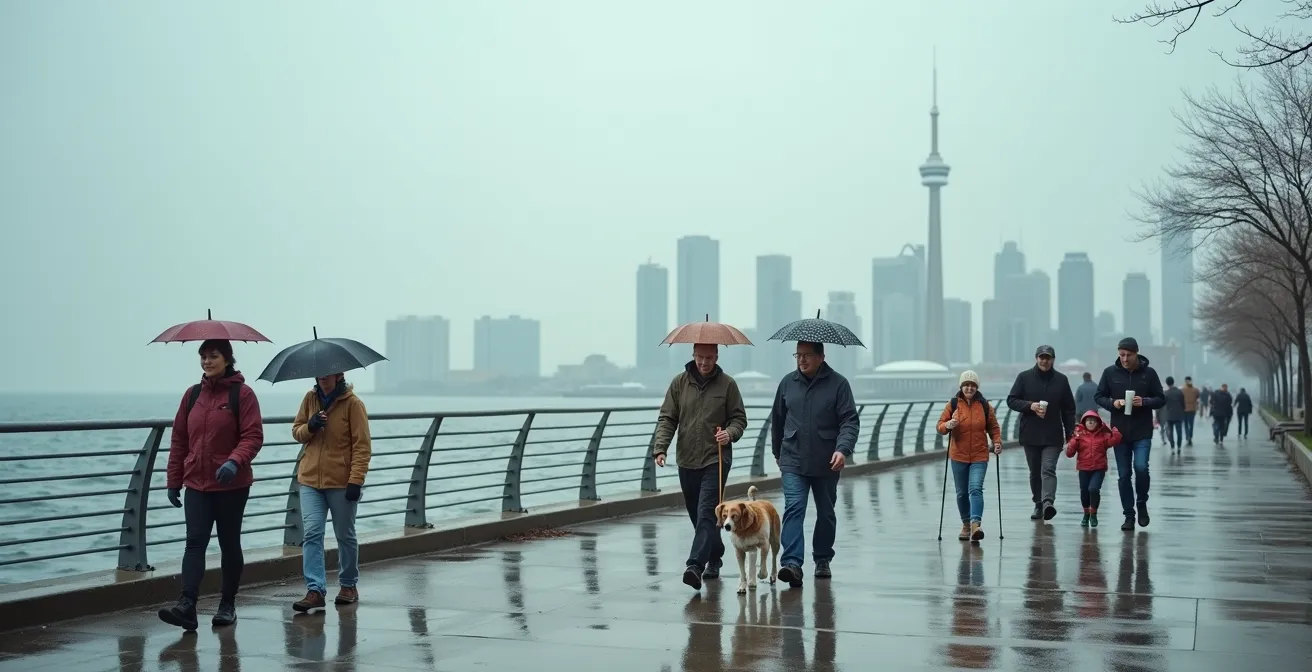
True resilience in a demanding city like Toronto isn’t about forced optimism; it’s about embracing a practical, ‘Productive Pessimism’.
- This approach, rooted in Atlantic cultures, means preparing for the worst (threatcasting) instead of emotionally spiraling (catastrophizing).
- It prioritizes building deep, local community (‘urban parishes’) over individual achievement as the core support system.
Recommendation: Start by reframing ‘bad’ weather and daily challenges not as obstacles, but as opportunities to build fortitude.
For the young professional in Toronto or Vancouver, the pressure is relentless. The hustle culture demands constant growth, unwavering optimism, and a curated online presence that masks the reality of burnout. We’re told to practice mindfulness, light a few candles to channel “hygge,” and just think positive thoughts. Yet, anxiety and a sense of disconnection are more prevalent than ever. The feeling that these prescribed solutions are flimsy answers to deep-seated problems is a shared, if often unspoken, truth.
The standard North American script of relentless optimism can feel alienating when facing a precarious economy or another bleak November day. But what if the key to genuine mental resilience wasn’t about ignoring potential negatives, but about engaging with them strategically? What if the wisdom for thriving in a challenging modern city lies not in sunny California but in the damp, resilient cultures of the North Atlantic, from Dublin to Newfoundland?
This is the essence of the North Atlantic mindset. It’s a form of practical stoicism that values preparedness over positivity, community over individualism, and endurance over explosive growth. It’s a worldview forged by volatile weather and economic uncertainty, which makes it uniquely suited for the realities of modern Canadian urban life. This is not a call to despair, but a call to prepare—to build a robust, weatherproof sense of self.
This guide explores how to adapt this grounded philosophy to your life. We will deconstruct the psychological foundations of the Atlantic outlook, offer practical strategies for everything from your daily commute to your home life, and provide a roadmap for building the kind of resilience that lasts.
Summary: A Guide to Mental Resilience for Toronto’s Burnt-Out Professionals
- Why Does the “Atlantic Outlook” Reduce Anxiety for 70% of Coastal Residents?
- How to Waterproof Your Daily Commute Like a Dubliner Living in Vancouver?
- Atlantic Stoicism vs. American Optimism: Which Mindset Fits the Canadian Economy?
- The Isolation Mistake Newcomers Make When Moving to Rural Nova Scotia
- Optimizing Your Home Lighting for Short Winter Days: Lessons from Galway
- Friluftsliv: How to Enjoy the Outdoors When It’s Raining Sideways in November?
- The “Catastrophizing” Error: How to Stop Imagining the Worst-Case Scenario?
- How to Create a “Koselig” Atmosphere in a Drafty Canadian Rental Apartment?
Why Does the “Atlantic Outlook” Reduce Anxiety for 70% of Coastal Residents?
The modern Canadian experience is increasingly marked by a quiet crisis of well-being. The promise of urban life, with its endless opportunities, often comes with a steep psychological cost. Post-pandemic, this trend has accelerated dramatically. According to a groundbreaking report from the Canadian Mental Health Association, a staggering 26% of Canadians reported their mental health as fair or poor in 2021, a sharp rise from pre-pandemic levels. This is the backdrop against which many young professionals are trying to build a life, armed with advice that often feels mismatched to the scale of the challenge.
The “Atlantic Outlook” offers a compelling alternative precisely because it doesn’t begin with a demand for happiness. Its power lies in what psychologists might call ‘defensive pessimism’ or ‘productive pessimism’. This isn’t about morbidly expecting the worst; it’s the practice of considering potential negative outcomes in order to prepare for them, thereby neutralizing the anxiety of the unknown. For a culture shaped by the unpredictability of the sea, assuming a storm might come isn’t negative—it’s just good sense. It leads to building stronger boats and tighter communities.
This mindset fundamentally reframes success. Instead of a relentless upward trajectory, success is defined as stability, endurance, and the strength of one’s social fabric. In a coastal village in Ireland or Nova Scotia, a person’s worth is tied to their reliability and contribution to the community, not just their financial accumulation. This shifts the source of self-esteem from volatile external metrics (like job titles or income) to more stable, internal, and communal ones. It inoculates against the anxiety that comes from a culture of constant comparison and achievement, offering a more grounded sense of purpose.
How to Waterproof Your Daily Commute Like a Dubliner Living in Vancouver?
There’s nothing quite like a cold, rainy commute in Vancouver or Toronto to test one’s resolve. For many, it’s a daily friction point—a miserable bookend to the workday. The default reaction is often one of resistance and frustration. The Atlantic mindset, however, approaches this challenge not as an obstacle to be endured, but as a condition to be mastered. The philosophy is simple: you cannot control the weather, but you can control your preparation and your attitude. This is the art of weathering the storm, both literally and metaphorically.
The Norwegian concept of ‘friluftsliv’ (free-air life) offers a powerful framework. As a case study on its adoption in Canada during the pandemic winter highlighted, the core principle is that “there is no bad weather, only bad clothing.” This simple shift in perspective transforms the commute from a battle against the elements into a daily practice of resilience. It’s about investing in the right gear—genuinely waterproof jackets, good boots, warm gloves—not as a luxury, but as essential infrastructure for well-being. It’s an act of self-respect.

Beyond gear, the mindset extends to creating moments of comfort and civilization amidst the chaos. As the image above captures, it’s about the small rituals: a thermos of hot tea or coffee, a good paperback book, a compelling podcast. These aren’t distractions; they are deliberate acts of creating a personal sanctuary. A Dubliner waiting for the bus in the rain doesn’t just stand there miserably; they are often equipped with the tools to make that waiting time productive or pleasant. This proactive approach gives you a sense of agency, turning a moment of passive suffering into one of active, personal comfort.
Atlantic Stoicism vs. American Optimism: Which Mindset Fits the Canadian Economy?
The dominant cultural script in North America, heavily influenced by its southern neighbour, is one of relentless optimism. It’s the belief that with a positive mindset, continuous growth is not only possible but expected. Failure is a temporary blip on an otherwise upward chart. This worldview, however, can feel deeply misaligned with the economic realities many Canadians face—housing insecurity, precarious work, and cyclical downturns. The pressure to remain optimistic in the face of these structural challenges can lead to a sense of personal failure and anxiety.
In contrast, the Atlantic mindset is rooted in a pragmatic, stoic realism. This is particularly visible in Atlantic Canada, where a survey found that 25% of Atlantic Canadians expect more bad than good from the coming year, the highest level of pessimism in the country. This isn’t a sign of depression, but of a deeply ingrained cultural preparedness. It’s an understanding that life moves in cycles, with lean years being as much a part of the natural order as prosperous ones. Atlantic Stoicism doesn’t ask you to ignore problems; it asks you to anticipate them.
This fundamental difference in worldview has profound implications for financial and career planning. While American Optimism focuses on maximizing the best-case scenario, Atlantic Stoicism prioritizes surviving the worst-case. The following table illustrates the key distinctions:
| Aspect | Atlantic Stoicism | American Optimism |
|---|---|---|
| Response to Failure | Expected and planned for | Temporary setback to overcome |
| Success Definition | Stability & community reputation | Financial metrics & growth |
| Planning Approach | Prepare for worst case | Focus on best case |
| Community Role | Essential support network | Individual achievement focus |
For a young professional in Toronto, adopting elements of Atlantic Stoicism could mean prioritizing a six-month emergency fund over speculative investments, or choosing a stable career path over a high-risk, high-reward startup. As this comparative analysis of mindsets suggests, it is about building a life that is robust and shock-resistant, rather than one that is fragile and dependent on perpetual good fortune.
The Isolation Mistake Newcomers Make When Moving to Rural Nova Scotia
The title might seem specific to rural life, but the core mistake it highlights is universal: underestimating the need for intentional community building. A person moving to a small town in Nova Scotia and expecting community to just “happen” will quickly find themselves isolated. The exact same is true for someone moving into a new condo tower in downtown Toronto. These high-rises can become “vertical cul-de-sacs,” where you are surrounded by thousands of people yet know no one. The architecture of modern urban life often breeds anonymity.
The Atlantic mindset has a built-in solution for this: the concept of the parish. Traditionally a geographic church district in Ireland, it functions as a powerful social unit. Your ‘parish’ was your world—the people you relied on, celebrated with, and mourned with. In a secular, urban context, we can redefine this as the ‘Urban Parish’: a consciously created, hyperlocal network of support. This is your immediate neighbourhood, your condo floor, the dog park you frequent, the local coffee shop where the barista knows your order.
Research on Toronto’s social fabric confirms the urgency of this. A 2023 study on the city’s vanishing “Third Places”—spaces that are neither home nor work—found their decline is directly linked to deteriorating social connections and a loneliness epidemic. Young people, in particular, struggle to find these spaces due to high costs. The solution isn’t to wait for the city to provide them, but to actively create them. This involves a radical shift from a consumer mindset (what can this city offer me?) to a citizen mindset (what can I build here?).
Your Action Plan: Creating an Urban Parish in Toronto
- Define your ‘parish’ boundaries: Start small. Focus on your condo floor, your specific block, or a maximum of two to three streets.
- Identify existing third places: Locate the local coffee shops that welcome lingering, community centres, public libraries, and park benches.
- Join hyperlocal online groups: Actively participate in neighbourhood Facebook groups, building-specific WhatsApp chats, or local BIA networks.
- Become a regular: Choose one or two local spots and visit them consistently. Recognition is the first step toward relationship.
- Initiate micro-connections: Learn the names of your neighbours or their dogs. Make eye contact and nod to familiar faces. Chat with the shopkeeper. These small acts build social fabric.
Building an Urban Parish is an act of resistance against the isolating tendencies of modern city life. It’s the practical application of the Atlantic value of community, adapted for the concrete canyons of Toronto or Vancouver.
Optimizing Your Home Lighting for Short Winter Days: Lessons from Galway
As the days shorten and a persistent grey settles over the city, our homes are supposed to be our sanctuaries. Yet for many renters in older Canadian buildings, they can feel cold, dark, and drafty, exacerbating the effects of seasonal affective disorder. The connection between housing quality and mental well-being is not just anecdotal; CMHA’s State of Mental Health data reveals that a staggering 18.1% of Ontarians with poor mental health also face core housing need. While we may not be able to fix structural issues, we can adopt an Atlantic approach to creating warmth and light.
A lesson from cities like Galway, Ireland—famous for its horizontal rain and cozy pubs—is the art of layered lighting. A single, harsh overhead light creates a sterile, institutional feel. The key to a warm, inviting atmosphere is to use multiple light sources at different heights. Think table lamps, floor lamps, and even candles (used safely) to create pools of warm light. The goal is to mimic the inviting glow of a fireplace or a pub corner, drawing people in.
Crucially, the quality of the light matters. Look for bulbs with a warm colour temperature, around 2700K (Kelvin). This is the warm, yellowish glow of traditional incandescent bulbs, not the cold, blueish light of a fluorescent office tube. This warm light is psychologically comforting and signals to our brains that it’s time to relax and unwind.

This isn’t about expensive renovations. It’s about a strategic, resourceful approach. It’s about hunting for second-hand lamps at vintage shops, using smart plugs to have lights turn on before you get home (so you never walk into a dark, cold apartment), and using mirrors to reflect the light you do have. It’s applying a pragmatic mindset to your immediate environment to make it a fortress of comfort against the winter darkness, a space that feels like a genuine refuge.
Friluftsliv: How to Enjoy the Outdoors When It’s Raining Sideways in November?
November in Canada can be a soul-crushing month. The autumn colours are gone, the festive lights aren’t up yet, and a persistent, cold drizzle often sets in. The natural instinct is to hibernate, to seal ourselves indoors until the first “real” snowfall. The Norwegian philosophy of *friluftsliv*, however, presents a radical alternative: get outside anyway. It’s a concept built on a deep cultural belief that time spent in nature is essential for physical and mental health, regardless of the season or the weather.
This philosophy is perfectly encapsulated in a famous Norwegian proverb. As Visit Norway, the country’s official travel guide, emphasizes when explaining the national love for the outdoors, the saying goes:
There is no such thing as bad weather, only bad clothing.
– Norwegian proverb, Visit Norway
This isn’t just a quaint saying; it’s an operational principle. It means that the responsibility for your comfort and enjoyment rests on your preparation, not on the weather. For a Torontonian, this means that a walk along The Beaches boardwalk on a windy day or an exploration of Moore Park Ravine in the rain isn’t “bad.” They are simply different sensory experiences. The dampness intensifies the smell of the earth; the mist creates dramatic views at Bluffers Park. It’s about reframing the experience.
Making this a habit requires a toolkit of motivational strategies. Don’t set an ambitious goal of a two-hour hike. Instead:
- Apply the Five-Minute Rule: Commit to just five minutes outside. Often, once you’re out, momentum takes over, and you’ll stay out longer.
- Use Destination Bribes: Plan a walk that ends at a favourite independent café in Kensington Market or a cozy bakery in your neighbourhood.
- Pack a Ritual: Bring a thermos of a hot drink. The simple act of pausing mid-walk to pour a cup of tea creates a moment of deliberate coziness and warmth.
- Call it a “Soft Day”: Adopt the Irish term for a misty, drizzly day. It rebrands the weather from something negative to something atmospheric and gentle.
By embracing *friluftsliv*, you break the cycle of seasonal confinement and reclaim the entire year as your own. It builds a ruggedness of spirit that is deeply rewarding.
The “Catastrophizing” Error: How to Stop Imagining the Worst-Case Scenario?
Anxiety is often fueled by a cognitive error called “catastrophizing.” This is when your mind latches onto a worry—a potential job loss, a health scare, a relationship problem—and spirals into the absolute worst-case scenario. It’s an emotional vortex that paralyzes you with fear but offers no path to action. The North Atlantic mindset, particularly as seen in Irish resilience training, offers a powerful antidote: moving from emotional catastrophizing to logical ‘threatcasting’.
What’s the difference between catastrophizing and this ‘productive pessimism’? Catastrophizing is an uncontrolled emotional spiral (“I’ll lose my job, then my apartment, and I’ll be ruined!”). Threatcasting, on the other hand, is a calm, rational assessment of a potential threat followed by the creation of a simple contingency plan. It turns vague anxiety into a concrete to-do list. For a Toronto-specific worry like job loss, threatcasting means taking actionable steps now: update your resume, research EI benefits, and identify three contacts in your network you could reach out to. You acknowledge the threat, but you focus your energy on what you can control.
This approach is exemplified by the training philosophy of Ray Goggins, a former Irish Special Forces instructor. In his programs, he teaches that resilience is not about brute strength but about mindset. His method involves forcing participants to confront worst-case scenarios and then, crucially, to make a plan. This process of acknowledging the risk and then creating a plan stops the anxiety spiral and returns a sense of agency. It proves that you can handle more than you think.
Your Action Plan to Practice Threatcasting
- Identify a recent challenge: Think of a situation where you felt overwhelmed or wanted to give up. Write down the specific fear.
- Acknowledge the catastrophic thought: What was the “I’m not good enough” or “Everything is going to fall apart” thought that arose? Name it.
- Reframe with growth potential: Actively rephrase the thought. Change “I’m not good at this” to “I’m not good at this *yet*, but I can learn.”
- Create a simple contingency plan: For your specific fear, create an “If X happens, then I will do Y” statement. (e.g., “If my project gets negative feedback, then I will schedule a meeting to ask for specific improvements.”)
- Use humor to shrink the problem: Try making a dark joke about the potential disaster. This asserts control over your emotional reaction and can create connection if shared with a trusted friend.
This mental discipline is the engine of the Atlantic mindset. It doesn’t promise a life without problems. It promises that you have the tools to face them when they arrive.
Key takeaways
- Productive Pessimism: True resilience comes from preparing for challenges, not from forced optimism.
- The Urban Parish: Intentional, hyperlocal community is a non-negotiable defense against urban loneliness.
- Mindset Over Matter: Your attitude and preparation can transform negative environments, from a rainy commute to a drafty apartment.
How to Create a “Koselig” Atmosphere in a Drafty Canadian Rental Apartment?
We’ve explored the psychological and communal aspects of the North Atlantic mindset, but its final expression is in the home. “Koselig” (or “hygge”) is not something you can buy; it’s an atmosphere you create. It’s the feeling of safety, warmth, and togetherness. For a renter in a less-than-perfect Canadian apartment, achieving this can seem difficult, but it’s where the resourcefulness of the Atlantic mindset truly shines. It’s about working with what you have to create a sanctuary.
The first principle is to wage a gentle war against the cold. This means focusing on practical, low-cost solutions. Thick, second-hand curtains from a vintage shop on Queen West do more to block drafts than any decorative item. Layering multiple, inexpensive rugs on the floor provides insulation and dampens the sound of the TTC streetcar rumbling by. Using decorative draft stoppers at the base of doors is a Canadian winter essential. It’s about practical fortification, making your space physically warmer and quieter.
The second principle is to fill the space with signs of life and hospitality. This is less about aesthetics and more about function. A permanent ‘tea station’ on a corner of your counter, always ready with mugs and a selection of teas, sends a powerful signal: this is a space where people are welcome, where conversation can happen at a moment’s notice. The smell of something baking, or a stew simmering on the stove, creates a primal sense of warmth and abundance that no scented candle can replicate. Finally, sound plays a crucial role. Creating playlists of folk music—from Great Big Sea to The Dubliners—can fill a room with a sense of history, storytelling, and communal joy.
These small, deliberate acts accumulate. They transform a transient rental unit into a genuine home—a personal, cozy harbour against the storms of the outside world. It’s the ultimate expression of the North Atlantic mindset: creating enduring comfort and stability in an imperfect environment.
Begin today by choosing one small, practical action from this guide—whether it’s packing a thermos for your commute, buying a warmer lightbulb, or simply learning your neighbour’s name. The journey to a more resilient life starts not with a grand gesture, but with a single, deliberate step.