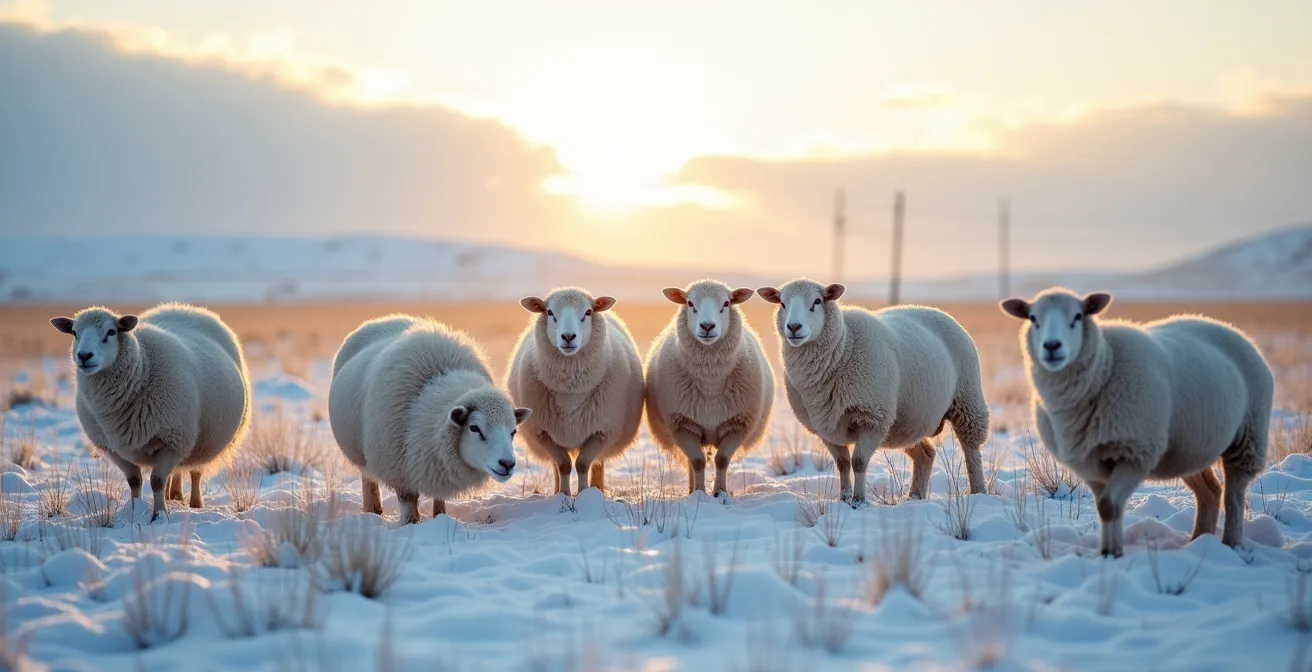
Despite the marketing of ‘performance synthetics,’ traditional wool is the superior fabric for Canada because its value extends beyond simple warmth to encompass ecological responsibility, economic sovereignty, and generational durability.
- Recycled synthetics still shed microplastics, polluting Canadian waterways like the Great Lakes with toxins.
- Wool’s high upfront cost is an investment in a local, ethical “fibreshed” economy, offering a lower cost-per-wear over its long lifespan.
Recommendation: Prioritize investing in high-quality, ‘Made in Canada’ wool garments as the foundational pieces of a durable and ethical wardrobe built for the realities of the Canadian climate.
For decades, outdoor enthusiasts and fashion lovers in Canada have been told a simple story: for performance, choose synthetics. Polyester, nylon, and acrylic fabrics—often marketed with high-tech names—promise to keep us dry, warm, and comfortable from the icy sidewalks of Toronto to the rugged trails of the Rockies. They are the cheap, accessible, and seemingly logical choice. Wool, conversely, has often been painted as a relic: expensive, difficult to care for, and heavy.
This narrative, however, is beginning to unravel. As we look closer, the promises of plastic-based fabrics reveal hidden costs—not just to our wallets in the long run, but to our environment. The conversation around what we wear is shifting from a simple question of immediate performance to a deeper consideration of a garment’s entire lifecycle. We’re rediscovering that the original performance fabric, shaped by millennia of evolution, already provides the perfect solution.
But what if the real superiority of wool wasn’t just about its ability to keep you warm when wet? What if choosing wool was an act of ‘material sovereignty’—a deliberate decision to support a local, resilient, and ethical system that connects us directly to the Canadian landscape? This is not just a comparison of fibres; it’s a comparison of two fundamentally different economic and ecological models.
This article explores why traditional wool is not just a better fabric, but a better choice for Canadians. We will dismantle the myth of ‘eco-friendly’ synthetics, reframe the true cost of our clothing, and explore the practicalities of caring for and repairing these heritage garments. Ultimately, you will have a clear framework for building a wardrobe that is not only high-performing but also deeply and authentically Canadian.
In this guide, we will navigate the key considerations that define a truly sustainable and high-performance wardrobe, moving from the microscopic impact of our laundry to the macroeconomic meaning of a label.
Summary: Why Wool is the Superior Performance Fabric for a Canadian Wardrobe
- The “Recycled Polyester” Myth: Why Is It Still a Microplastic Problem?
- The $300 Sweater: How to Justify High Upfront Costs for Ethical Fashion?
- Washing Wool: The Temperature Mistake That Shrinks Your Favorite Sweater
- Visible Mending: How to Turn a Moth Hole into a Design Feature?
- Made in Canada: Does It Mean the Fabric Was Woven Here Too?
- Hard Shoes vs. Soft Shoes: Which Should Beginners Buy First to Save Money?
- Gore-Tex vs. Traditional Wool: Which Layering System Wins for North Atlantic Hiking?
- How to Shop Zero-Waste in a Conventional Canadian Supermarket?
The “Recycled Polyester” Myth: Why Is It Still a Microplastic Problem?
The rise of “recycled polyester,” often made from PET bottles, has been marketed as a win for sustainability. It feels like a virtuous circle: we turn plastic waste into functional clothing. However, this narrative conveniently ignores a persistent and insidious problem: microplastic pollution. Whether virgin or recycled, polyester is a plastic, and every time it’s washed, it sheds microscopic fibres.
These microplastics are too small to be filtered out by wastewater treatment plants and flow directly into our rivers, lakes, and oceans. The scale of this issue is staggering. Recent research from ACS Sustainable Chemistry shows that households in Canada and the United States release a combined total of 878 tonnes of microfibres into the aquatic environment annually. This isn’t an abstract global issue; it’s a local ecological disaster happening in our own backyard.
A landmark review led by the University of Toronto provides a stark Canadian case study. After analyzing a decade of data, researchers found that nearly 90% of water samples from the Great Lakes contained microplastic concentrations exceeding levels considered safe for wildlife. The report, highlighted by Great Lakes Now, explains that fish and other organisms ingest these fibres, leading to malnutrition and the introduction of associated chemical pollutants into the food web. In essence, our synthetic fleece jackets and performance leggings are slowly contaminating one of the world’s largest freshwater ecosystems.
In contrast, wool is a natural, protein-based fibre. When it sheds, it biodegrades harmlessly back into the ecosystem, just as a fallen leaf would. Choosing wool over synthetics is one of the most direct actions a consumer can take to stop contributing to this invisible, yet pervasive, form of plastic pollution. It is a choice to protect the very Canadian landscapes we love to explore.
The $300 Sweater: How to Justify High Upfront Costs for Ethical Fashion?
The most significant barrier for many people rediscovering wool is the initial price tag. A well-made wool sweater can cost $300, while a synthetic equivalent might be $50. The key to overcoming this “sticker shock” is to shift our mindset from viewing clothing as a disposable expense to seeing it as a long-term investment. This is the principle of cost-per-wear.
A $50 fast-fashion sweater might pill, lose its shape, and be discarded after one or two seasons. Your cost-per-wear remains high. A $300 wool sweater, with proper care, can last for decades, even a lifetime. Worn 30 times in its first year alone, its cost-per-wear is already down to $10. Over a decade, it approaches mere cents. This longevity is the first layer of justification, but the price tells a much deeper story about value.
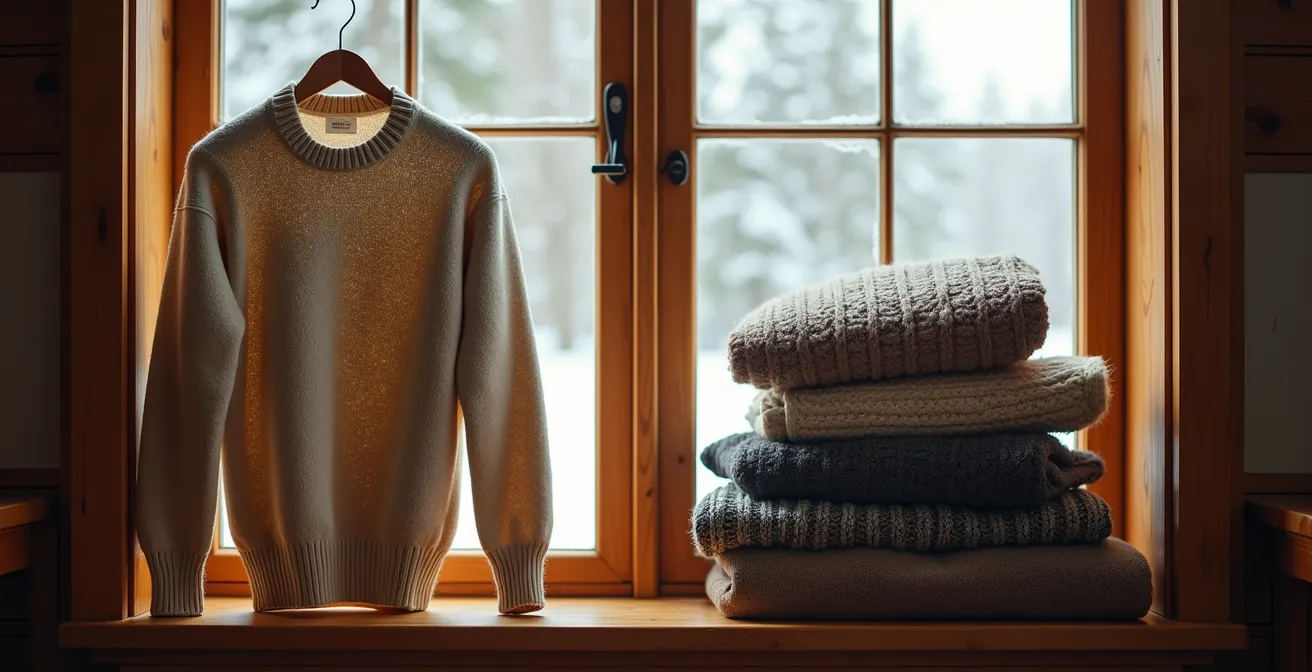
That higher price reflects a fundamentally different, and healthier, economic system. It pays for what can be called ‘material sovereignty’. As highlighted by initiatives like the Wave Fibre Mill in Ontario, this cost supports small Canadian farms and a revitalized local textile industry. It fosters a “fibreshed”—an integrated regional system where wool is grown, processed, and used locally. This model enhances biodiversity, strengthens rural economies, and provides consumers with a tangible connection to the source of their clothing.
When you buy a cheap synthetic sweater, your money primarily supports a globalized petrochemical industry and complex, often exploitative, supply chains. When you invest in a Canadian-made wool sweater, you are funding regenerative agriculture on a farm you could one day visit, skilled labour at a local mill, and the preservation of heritage craft. The $300 isn’t just for a sweater; it’s a vote for a more resilient, transparent, and ethical Canadian economy.
Washing Wool: The Temperature Mistake That Shrinks Your Favorite Sweater
One of the most persistent myths about wool is that it is fragile and difficult to care for. This fear often stems from a single, traumatic experience: shrinking a beloved sweater in the wash. The culprit, however, is almost never the water itself, but a combination of two factors: high heat and agitation. Wool fibres are covered in microscopic scales, like tiles on a roof. When exposed to heat and friction, these scales lock together, causing the fibres to felt and the garment to shrink permanently.
Understanding this simple mechanism is the key to effortless wool care. The rule is simple: cool water and minimal friction. Most modern washing machines have a ‘wool’ or ‘hand wash’ cycle that uses cold water and gentle tumbling. Paired with a pH-neutral, lanolin-renewing wool soap, this method is perfectly safe for most woolens. Even better, simply hand washing in a basin of cool water for a few minutes, gently squeezing out excess water (never wringing!), and laying flat to dry is all that’s required.
The true magic of wool, however, is how infrequently it needs washing. The natural lanolin and complex structure of the fibre are inherently antimicrobial and odour-resistant. Unlike synthetics that trap sweat and breed bacteria, wool wicks moisture vapour away from the skin and allows it to evaporate. Often, all a wool garment needs is to be aired out overnight. In fact, Unbound Merino’s care guide indicates that a merino garment can be worn for 3-4 days of continuous activity before washing is necessary. This drastically reduces water consumption, energy use, and labour over the garment’s lifetime, making it a surprisingly low-maintenance fabric.
By avoiding the simple mistake of hot water and high agitation, you unlock one of wool’s greatest benefits. It’s a fabric that asks for less of your time and resources, while providing superior performance and comfort, wear after wear.
Visible Mending: How to Turn a Moth Hole into a Design Feature?
In the world of fast fashion, a hole is a death sentence. A snag, a tear, or the tell-tale pinprick of a moth signals the end of a garment’s useful life. But within the philosophy of sustainable, long-lasting clothing, a hole is not an end—it’s an opportunity. Visible mending is the practice of repairing clothing in a way that is intentionally conspicuous, turning a flaw into a unique and beautiful design element.
This practice is especially suited to wool. The stable, textured nature of a knit fabric provides a perfect canvas for creative repair. Techniques like Swiss darning (re-weaving the knit pattern) or decorative sashiko-style stitching can transform a simple moth hole into a colourful patch of pattern. It’s a rejection of the idea that our belongings must remain in pristine, store-bought condition to be valuable. Instead, it celebrates the story of an object, with each mend marking a chapter in its life with you.
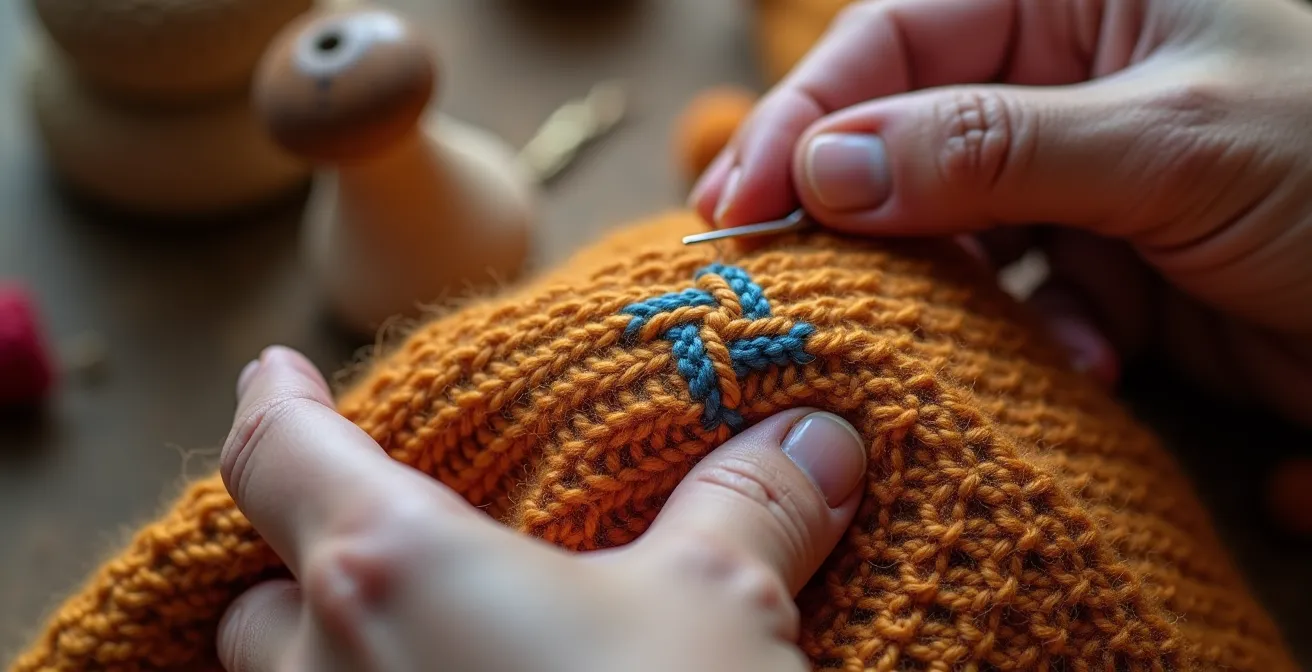
This approach transforms garment care from a chore into a creative act. It imbues a piece of clothing with personal history and makes it truly one-of-a-kind. A sweater mended with a contrasting colour of yarn becomes more “yours” than it was the day you bought it. In a Canadian context, this can even be an opportunity to connect with heritage textile arts, incorporating patterns and techniques inspired by traditional quilting or weaving from different regions.
Embracing visible mending is a powerful statement against disposability. It builds a deeper relationship with our clothing and equips us with the skills to ensure our favourite pieces last not just for years, but potentially for generations. It is the ultimate expression of the ‘buy it for life’ mentality.
Your Garment Repair Audit: 5 Steps to Plan Its Second Life
- Assess the Damage: Lay the garment flat in good light. Identify all areas of wear—not just holes, but also thinning spots at elbows, cuffs, and collars. Differentiate between moth holes, snags, and frictional wear.
- Gather Your Palette: Inventory your mending materials. This includes not just yarn and thread, but also fabric scraps for patching. Consider colour, texture, and fibre type. Do you want the repair to blend in or stand out?
- Choose Your Technique: Match the repair method to the damage and fabric. Is it a knit that requires darning? A woven fabric that needs a patch? Research simple techniques like the running stitch, darning, or appliqué.
- Map the Aesthetics: Plan the repair as a design element. Sketch out how a patch or stitch pattern will look. Consider balance, colour theory, and how the repair interacts with the garment’s original design. Does this one hole call for a single, bold statement, or a series of smaller, subtle repairs?
- Reinforce for the Future: Before closing the mend, check the surrounding area. Is the fabric thin? Add a lightweight, fusible interfacing on the inside or extend your stitching to reinforce the fabric around the original hole to prevent future tears.
Made in Canada: Does It Mean the Fabric Was Woven Here Too?
For the conscious consumer, the “Made in Canada” label feels like a trustworthy seal of quality and ethical production. It suggests local jobs, high standards, and a smaller carbon footprint. However, the reality of the global textile industry means this label can be more complex than it appears. The term often refers only to the final stage of production—the cutting and sewing of the garment.
The fabric itself could have been sourced from anywhere in the world. This is a critical distinction for anyone wanting to support a truly Canadian wool industry. A garment can be “Made in Canada” using wool from New Zealand that was processed and spun in China before being woven into fabric in Italy and finally shipped to Canada for assembly. While this still provides some local jobs, it does little to support Canadian farmers or mills.
As one stark reminder from Asparagus Magazine points out, the disconnect in the global system is so severe that it has created a tragic paradox for local producers.
In the era of fast fashion, shepherds are forced to destroy their fleece because it’s not worth the time and money to process
– Asparagus Magazine, Wool is the Soil-to-Soil Fashion Solution
To navigate this, consumers need to become label detectives. True material sovereignty comes from supporting brands that are transparent about their entire supply chain, from farm to finished product. The following table breaks down the common labels and what they truly signify, helping you make a more informed choice.
| Label Type | Wool Source | Processing Location | Final Assembly | Examples |
|---|---|---|---|---|
| Product of Canada | Canadian farms | Canadian mills | Canada | Wave Fibre Mill partners |
| Made in Canada with Canadian Materials | Canadian farms | Mixed (some imported processing) | Canada | Select Quebec brands |
| Made in Canada with Imported Materials | International (often New Zealand) | International | Canada only | Many mainstream brands |
| Assembled in Canada | International | International | Final stitching only in Canada | Fast fashion brands |
Seeking out brands that proudly declare themselves “Product of Canada” or work within a regional fibreshed is the most direct way to ensure your purchase contributes to rebuilding a resilient and fully domestic wool industry.
Hard Shoes vs. Soft Shoes: Which Should Beginners Buy First to Save Money?
The “right material for the job” philosophy extends beyond fabric to every part of an outdoor enthusiast’s kit, especially footwear. For beginners looking to invest wisely, the “hard shoe vs. soft shoe” debate can be confusing. Do you start with a stiff, heavy-duty hiking boot or a flexible, lightweight trail runner? The most cost-effective answer isn’t about choosing one over the other, but about matching your first purchase to the terrain you’ll encounter most often in your part of Canada.
A hard shoe, typically a mid or high-cut boot with a rigid sole, offers maximum support and protection. Its stiffness prevents foot fatigue on long days with a heavy pack and shields you from sharp rocks underfoot. This is the superior choice for the rugged, uneven terrain of the Canadian Shield, the Rocky Mountains, or multi-day treks on challenging coastal trails like those in the Fundy region.
A soft shoe, like a trail runner or light hiker, prioritizes flexibility, breathability, and ground-feel. It’s lighter, requires less break-in time, and is often more comfortable for faster-paced activities on well-maintained paths. However, it offers less ankle support and underfoot protection. This is a great option for groomed provincial park trails, prairie paths, or for those who prioritize speed and agility over maximum protection.
For a beginner aiming to save money, the smartest move is to buy for your 80% reality, not your 20% aspiration. If you live in Southern Ontario and mostly hike on weekends, a soft trail shoe will be more versatile and comfortable. If you’re planning a trip to Banff, investing in a hard boot first is essential for safety and comfort. Choosing the right first pair prevents a poor experience and the need to buy a second, more appropriate pair sooner. Here’s a quick guide to matching footwear to classic Canadian conditions:
- Icy Toronto/Montreal sidewalks: Insulated boots with aggressive tread and waterproofing.
- Muddy Fundy coastal trails: Mid-height waterproof boots with ankle support.
- Rocky Canadian Shield terrain: Stiff-soled hiking boots with toe protection.
- Prairie winter conditions: Insulated pac boots with removable liners.
- West Coast rainforest trails: Breathable waterproof boots with good grip.
Gore-Tex vs. Traditional Wool: Which Layering System Wins for North Atlantic Hiking?
On a crisp, clear day, the debate between different layering systems can seem academic. But in the demanding, perpetually damp conditions of a North Atlantic hike—think Newfoundland’s East Coast Trail or Cape Breton’s Skyline Trail—the theoretical differences become profoundly real. Here, the modern tech of a Gore-Tex shell and synthetic base layer goes head-to-head with a traditional wool system, and the ancient fibre often emerges as the clear winner.
Gore-Tex and similar waterproof-breathable membranes work by having pores large enough to let water vapour (sweat) out, but too small to let liquid water (rain) in. In theory, it’s brilliant. In practice, this system has a critical failure point. The “breathability” relies on a gradient of temperature and humidity between the inside and outside of the jacket. In the cool, high-humidity, and misty environment of the North Atlantic, this gradient is often minimal. As a result, your sweat vapour condenses on the inside of your shell. As one analysis from Maine Sport Outfitters puts it, “In the persistent damp chill… you inevitably get ‘wet from the inside’ with Gore-Tex.”
This is where a traditional wool system excels through its principle of therm-regulating biomimicry. A wool base layer absorbs a significant amount of moisture vapour into the core of its fibres, keeping your skin feeling dry. A thick, tightly woven wool outer layer, like a classic Mackinaw or fisherman’s sweater, is naturally water-resistant due to its dense structure and lanolin content. While it may eventually get damp in a downpour, wool’s unique magic is its ability to retain insulating properties even when wet. It generates a small amount of heat as it absorbs moisture, keeping you warm, not clammy.
In the biting wind and fog of a place like Gros Morne, the failure of a synthetic system leaves you cold, damp, and miserable. The wool system keeps you comfortable and safe, regulating your temperature through the same incredible properties that allow sheep to thrive in harsh weather. For the specific challenges of Canada’s damp coastal regions, heritage trumps hype.
Key Takeaways
- Synthetic fabrics, even recycled ones, are a primary source of microplastic pollution in Canadian waters.
- The high price of ethical wool reflects its true value: supporting local farms, a resilient economy, and offering superior long-term durability.
- Wool’s longevity and performance depend on simple care—avoiding heat and agitation—while visible mending can turn wear-and-tear into a unique design feature.
How to Shop Zero-Waste in a Conventional Canadian Supermarket?
The principles of conscious consumption—questioning supply chains, prioritizing natural materials, and rejecting disposability—that guide the building of an ethical wardrobe can be powerfully applied to another area of our lives: grocery shopping. While zero-waste specialty stores are ideal, they aren’t accessible to everyone. The real challenge, and opportunity, lies in reducing waste within a conventional Canadian supermarket like Loblaws, Sobeys, or Metro.
The strategy is to see the supermarket not as a pre-packaged monolith, but as a collection of different zones, some more friendly to zero-waste efforts than others. The key is to start at the perimeter of the store, where fresh, unpackaged foods are most abundant. The produce section is the easiest place to start: simply bring your own reusable mesh or cloth bags for loose fruits and vegetables. This single habit can eliminate a dozen single-use plastic bags per trip.
Next, approach the service counters. The butcher, deli, and seafood counters are often staffed by employees who can place your items directly into your own clean containers. A polite request is usually all it takes. Similarly, the bakery section often has loose bread and buns that can be placed in a cloth bag. While this requires more forethought—remembering to bring your containers—it makes a significant impact. Here are some actionable tips for major Canadian chains:
- At Loblaws: Bring mesh bags for bulk bins, request butcher counter items in your own containers, and choose loose produce from the organic section.
- At Sobeys: Use their reusable produce bags program, shop the bulk aisle early in the morning for the best selection, and ask the deli to slice directly into your containers.
- At Metro: Take advantage of their zero-waste pilot locations in Quebec, bring glass jars for bulk items, and request the fish counter to wrap in paper only.
- At all stores: Shop the perimeter first (less packaging), bring beeswax wraps for the cheese counter, and use cloth bags for bakery items.
Shopping this way transforms a routine chore into a mindful act. It forces us to slow down, interact with staff, and be more intentional about what we buy. It proves that even within a system designed for convenience and disposability, individual choices can carve out a more sustainable path.
By choosing natural fibres, investing in local craftsmanship, and adopting a mindset of care and repair, you are doing more than just building a better wardrobe. You are participating in a movement towards a more resilient, beautiful, and authentically Canadian material culture. To fully commit to this path, the next logical step is to begin assessing your own needs against the principles of local, ethical production.